How to Return Without a Receipt: What You Get
How to return without a receipt in 2026: expect store credit instead of cash, a photo ID check and, at Best Buy, no sales tax back. What 8 big stores pay.
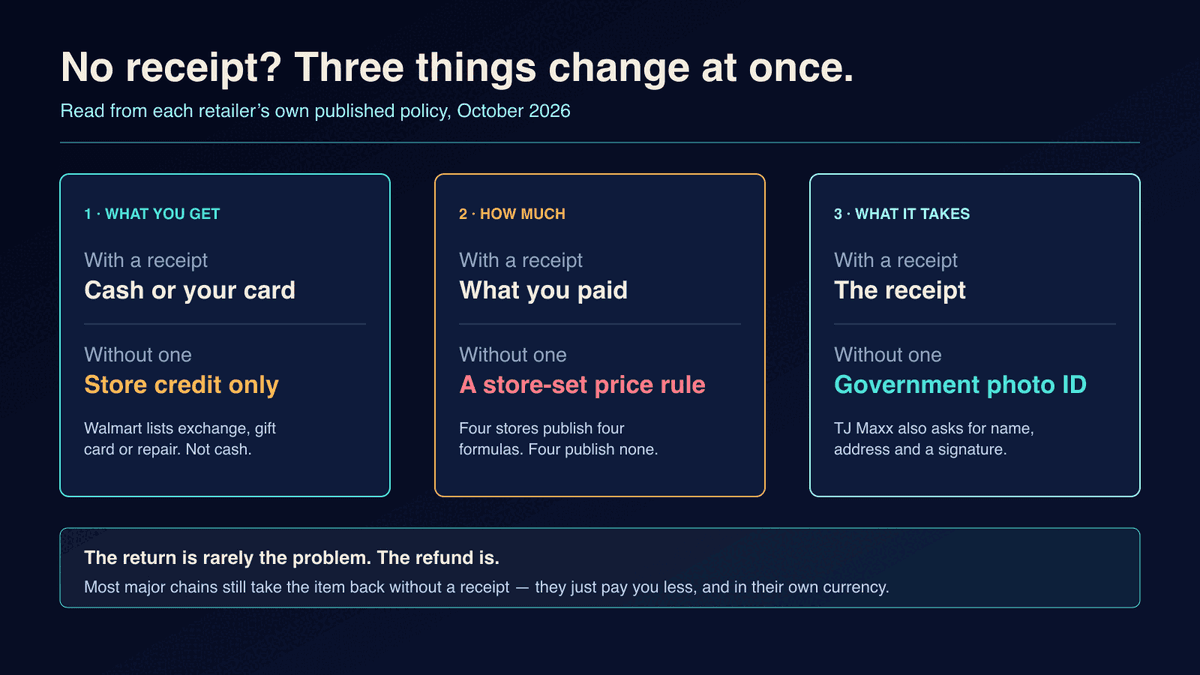
Losing the receipt rarely costs you the return. It costs you the refund. When you return without a receipt in 2026, three separate things change at once: you stop getting cash or your card credited, you start getting store credit locked to the retailer, and — the part almost nobody mentions — the amount on that credit is set by a pricing formula that is different at every store.
At one major chain the formula is the lowest advertised price, with no time limit published at all. At another it reaches back thirteen weeks. At a third you get today's price. One retailer keeps your sales tax in every state. And if you paid by tapping your phone, the lookup that would rescue you only works from that exact phone.
Every retailer figure below was read on 14 October 2026 from that retailer's own published policy page, and quoted directly. The 2026 holiday dates and the Target, Walmart, Kohl's, Home Depot, TJ Maxx and Costco pages were re-checked on 28 October 2026.
Returning without a receipt: the short answer
Without a receipt, most major U.S. retailers will still take the item back, but they pay you in store credit or a gift card rather than cash or a card refund, and most ask for a government-issued photo ID. Where a store publishes a valuation rule at all, it is usually a lowest-price rule rather than what you paid. Expect to lose money.
How to return something without a receipt: step by step
If you are heading to the store now, the order of operations matters more than the policy does. Getting the purchase found is worth more than anything else on this page, because a successful lookup pays what you paid instead of a lowest-price formula.
- Search your own records first. Check the retailer's app and account order history, your email for an order or shipping confirmation, and your card statement for the date and amount. Any one of these can turn a no-receipt return into an ordinary one.
- Read that store's rule before you go. The eight policies below differ sharply on what you get. Knowing whether you are facing a current-price refund or a thirteen-week lowest-price rule tells you whether the trip is worth making today or after the item comes off sale.
- Bring a government-issued photo ID. Target, Walmart, Home Depot and TJ Maxx require government-issued ID for a no-receipt return, Kohl's says a photo ID "may be required," and Nordstrom asks for "personal identification." Best Buy asks only for an email address, and Costco publishes no no-receipt clause. Without ID, most of these returns stop at the counter.
- If you tapped a phone to pay, bring that exact phone. Mobile-wallet lookups need the device-specific account number, which exists only on the handset used for the purchase.
- Ask for a receipt lookup before you accept a no-receipt return. Say which card you used, give your loyalty phone number or pull up the app barcode. Associates can search on an order number, a rewards account, a card number or an in-app return barcode depending on the chain.
- Ask which price they are using. If you are being paid out on a lowest-price rule, that is a published policy you can ask to see — and at Best Buy it also means the sales tax is not coming back.
- If you are denied, ask for the Transaction ID. A warned or denied return prints an ID you can use to request your file from the verification company, and you can ask a manager to review the decision. The file is free.
What happens if you lost the receipt
A receipt does three jobs at the return counter, and losing it breaks all three independently. Understanding them separately is what stops you from being surprised at the register.
It proves the price. This is the one that costs real money. With a receipt, the store refunds the number printed on it. Without one, the store has no record of what you paid, so it substitutes a price of its own choosing — and every chain chooses differently.
It proves the tender. A receipt tells the store you paid with a Visa ending in 4431, so the refund can go back to that Visa. Without it, there is nothing to credit, so you get a card the store issues instead. Nordstrom states the principle plainly: "We apply refunds to the tender with which returned items were purchased." No tender on record, no tender to refund.
It proves it was you. With a receipt, the transaction is the evidence. Without one, you become the evidence — which is why most of the policies below ask for photo identification, and why several say in writing that the ID is checked against a system. There are exceptions: Best Buy's published clause asks only for an email address, and Costco publishes no no-receipt clause at all.
The practical consequence is that a lost receipt is not a flat penalty. It is a variable one, and the variable is the retailer. Our refund versus store credit guide covers why that distinction matters more than most shoppers assume.
How much money you get back: four different formulas
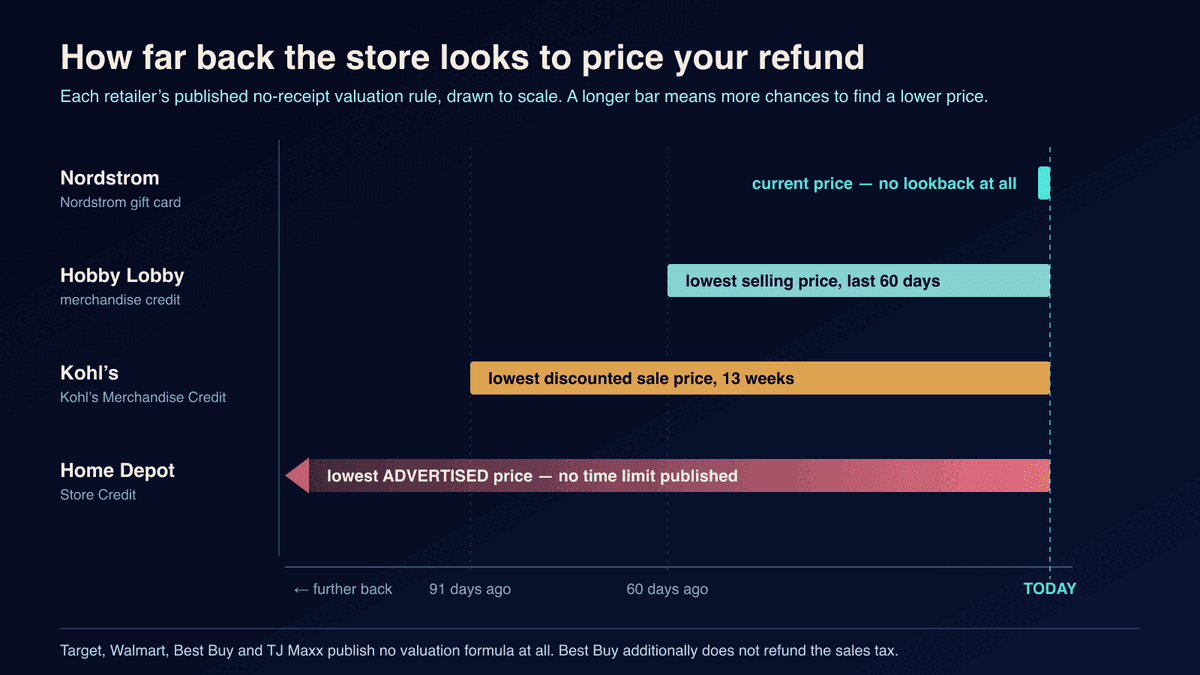
Four major retailers publish four genuinely different ways to price a no-receipt refund. Home Depot pays the lowest price the item was ever advertised at, with no time limit published. Kohl's pays the lowest sale price in the last 13 weeks. Hobby Lobby looks back 60 days. Nordstrom pays today's price. Four more retailers publish no valuation rule at all.
| Retailer | What you receive | How the amount is calculated | The policy's own words |
|---|---|---|---|
| Home Depot | Store Credit | Lowest advertised price — no time limit published | "Returns made without a valid proof or purchase [sic] may be refunded as a Store Credit at the lowest advertised price." |
| Kohl's | Kohl's Merchandise Credit | Lowest discounted price across 13 weeks | "you'll receive a Kohl's Merchandise Credit for the lowest discounted 13-week sale price" |
| Hobby Lobby | Merchandise credit | Lowest selling price in the last 60 days | "a merchandise credit based on the lowest selling price in the last 60 days" |
| Nordstrom | Nordstrom gift card | Current price | "a refund will be provided at the current price on a Nordstrom gift card" |
| Best Buy | Store credit | No formula published — and sales tax is not returned | "state sales taxes and fees will not be reimbursed" |
| Target | Merchandise Return Card | No formula on its policy page (re-checked 2026-10-28) | "may receive a refund in the form of a merchandise return card" |
| Walmart | Walmart gift card, Walmart Balance, exchange, or repair | No formula on its policy page (re-checked 2026-10-28) | "Get a Walmart gift card" |
| TJ Maxx | Merchandise credit | No formula on its policy page (re-checked 2026-10-28) | "Merchandise credit will be issued for … returns without a receipt" |
The differences between those four rules are not cosmetic, and one retailer adds a cost that has nothing to do with the formula at all.
Home Depot: the lowest advertised price, with no time limit
Home Depot's published policy says "lowest advertised price" and attaches no time window. That is the broadest of the four rules. Kohl's bounds its lookback at thirteen weeks and Hobby Lobby — whose policy we quote in full in our Hobby Lobby return policy guide — bounds its own at sixty days. Home Depot publishes no bound at all, which is not the same as publishing an unlimited one: it simply does not say. On an item that ran a deep promotion at some point, that silence is where the money goes.
Kohl's and Hobby Lobby: a bounded lookback
Kohl's pays "the lowest discounted 13-week sale price," and Hobby Lobby "a merchandise credit based on the lowest selling price in the last 60 days" (see the Hobby Lobby policy summary). Both are lowest-price rules, but a published bound is worth having: it caps how far back the store may reach for a cheaper number. A sweater that was marked down fourteen weeks ago is outside Kohl's window.
Nordstrom: today's price, which can run the other way
Current price is not a lowest price. If the item has gone up since you bought it, the arithmetic favors you; if it has been marked down, it does not. Nordstrom is also explicit that the refund is discretionary — "If we choose to provide a refund and no record of sale is available" — so the valuation only matters once the store has agreed to take the item at all.
Best Buy: no formula, but you also lose the sales tax
Best Buy publishes no valuation rule, and adds a cost no other policy here applies nationwide. Its return and exchange policy states that on returns lacking proof of purchase, "state sales taxes and fees will not be reimbursed." On a $400 television bought in a state with a 7% rate, that is roughly $28 that does not come back regardless of what the store decides the item is worth. Sales tax on returns is handled differently from state to state in the first place — our state-by-state return law guide walks through where the rules diverge — and Best Buy is the only policy here that withholds the tax on every no-receipt return. Walmart's corporate return policy has a narrower version: "A receipt with a valid transaction number is required to receive a refund on sales tax for returned items within the time period allowed by law in Connecticut, Massachusetts, and Rhode Island."
Can the store just look it up?
Often, yes — and this is the step most people skip. A "no receipt" return and a "no record" return are not the same thing. Most of these chains can reconstruct your purchase from a card number, a loyalty account or an app barcode, and if they succeed you are treated as an ordinary receipted return with an ordinary refund. The formulas above only apply once the lookup has failed.
What each store can search on
| Retailer | What they can search on | What the policy says |
|---|---|---|
| Target | Target Circle Card, or a third-party Visa, Mastercard, American Express or Discover credit card; the barcode in your Target account or app | "We can also attempt to look up the receipt for store and online purchases in store." |
| Kohl's | Order number, Kohl's Rewards account, credit card number, or the return barcode in the Kohl's app | "Most returns are accepted with or without a receipt." |
| Walmart | The debit or credit card used for a store purchase; the phone number or email on an online order; your Walmart.com purchase history | "No receipt? We can attempt to look up store purchases with a debit/credit card or online orders with a phone number or email." |
| Home Depot | A receipt or confirmation email — plus the card used and a photo ID | "Bring a copy of your receipt or shipping confirmation email, credit card you used for the item and valid I.D." |
| Nordstrom | Receipt or order number first, then "other ways" | "If you don't have a receipt, we should be able to find the purchase in other ways." |
| Best Buy | My Best Buy account; packing slip or the card used | "please bring your packing slip (if you received one), or your receipt" |
Two traps are worth knowing before you go.
Why cash and PIN debit are hard to look up
Home Depot is the most direct about it: "If you used a debit card with pin, cash, check, store credit, gift card, or Pro Xtra dollars, please bring your receipt to the store, and we'll happily process your refund for you." A card lookup works because the card number is the search key. Cash leaves no key. Target's published lookup list names third-party credit cards specifically, alongside its own Target Circle Card, while Walmart says it can search on "a debit/credit card." If you paid cash and have no app record, you are in genuine no-record territory and the formulas above apply.
Can a store look up an Apple Pay or Google Pay receipt?
Only from the phone you actually paid with. Home Depot is the one policy we read that spells this out: "For in-store mobile wallet purchases, Home Depot may need the device-specific account number or its last 4 digits to find your receipt. This information is only accessible from the physical device used for the purchase."
A mobile wallet never hands the merchant your real card number — it hands over a device-specific token. So the lookup needs that token, and the token lives only on the handset you tapped. Bring that exact phone, not a different device signed into the same account, and not the physical card whose number the store never saw.
No-receipt return policy by store: Target, Walmart, Home Depot and more
Everything below was read from the retailer's own published policy on 2026-10-14, and the Target, Walmart, Kohl's, Home Depot, TJ Maxx and Costco pages were re-checked on 2026-10-28. Where a figure that circulates widely is not in the policy, that is stated rather than guessed.
Target
Target's returns help article sets out a merchandise return card (MRC) for non-receipted returns: "A merchandise return card (MRC) is issued during non-receipted returns for Target products in store." Three conditions on that card matter more than the amount.
It is ID-bound at both ends. "A government issued ID is required for issuance," and — the clause people miss — "If you presented a government issued ID when we issued this card to you, we may require you to present the same valid ID to redeem this card." The card is not a bearer instrument you can hand to someone else.
It is store-only. "This card cannot be redeemed on Target.com or for cash or credit (except where required by law)." That parenthetical matters, because several states do require retailers to cash out small gift-card balances on request — California's threshold is covered in our refund versus store credit guide.
And you can only use one per transaction: "Redemption limited to one merchandise return card per transaction."
Two categories are excluded from no-receipt returns entirely. Items bought from Target's Shopping Lists "require a receipt or gift receipt for a return or exchange," and for Target Plus marketplace items "you must provide the proof of purchase." The one-year window on Target Owned Brand items — which Target grants only "with a receipt" — is the one worth knowing before you give up on finding yours: our Target return policy guide has it, and the Target policy summary gives the windows at a glance.
Walmart
Walmart's rule, in its refunds article, is one sentence and unusually candid about the mechanism: "If you don't have your receipt, show us your valid government-issued photo identification. We'll accept your return if your identification information matches with the one stored in our secured database." Its corporate return policy adds the limit nobody quotes a number for: "To help prevent fraud and abuse, Walmart limits the number and frequency of non-receipted returns a customer may complete." No number is published.
The published outcomes are narrower than most people expect. Under the heading "Return in-store items without a receipt," Walmart lists exactly three: "Exchange the item with another item. Get a Walmart gift card. If available, send the item to the manufacturer for repair." A cash refund is not among them. Separately, where a card refund fails, Walmart routes store purchases to "a Walmart Gift Card or Walmart Balance." Walmart's standard return windows are 90 days for most items, 30 days for most consumer electronics, and 14 days for wireless phones, with Marketplace seller items at 30 days. If you can still find proof of purchase, the receipted path is far better — see our Walmart return policy guide, or the Walmart policy summary for the windows alone.
Home Depot
Home Depot states the mechanism behind the counter more plainly than any other policy we read, in its published return policy: "We require a valid driver's license or government-issued photo identification for non-receipted returns and returns generated from purchases made with The Home Depot store credits. The Home Depot uses a third-party refund verification system. All returns are subject to verification system approval."
Note the second half of that first sentence. It covers returns of merchandise you originally bought with a Home Depot store credit — so a credit issued for one no-receipt return carries the ID requirement forward into your next return, not your next purchase. And the credit itself is final: "Sales of gift cards and store credits are final and can only be used for purchases."
Two 2026 changes are live and easy to miss. Effective July 7, 2026, "Halloween decor and Holiday decor must be returned to The Home Depot® within thirty (30) days—unused and with proof of purchase—to receive a full refund," and pumps, portable evaporation units and portable heaters dropped to a seven-day window on the same date. Both clauses require proof of purchase for a full refund, so a missing receipt on seasonal decor in October 2026 is a particularly bad combination. Those dated exceptions are tracked in our Home Depot return policy guide and the Home Depot policy summary.
Kohl's
Kohl's is the friendliest on paper — "Kohl's gladly accepts most returns with or without a receipt" — and it publishes the clearest disclosure of the data side of the transaction of any retailer in this guide:
"Verification Notice: Returns may be subject to third-party verification and system approval. Your ID information and return history may be collected where permitted by law. Kohl's reserves the right to limit or refuse refunds."
If the lookup fails, the formula applies: "you'll receive a Kohl's Merchandise Credit for the lowest discounted 13-week sale price. A valid photo ID may be required." Standard windows are 90 days, or 120 days if you paid with a Kohl's Card, with Premium Electronics and Watches cut to 30 days. EBT purchases always refund to merchandise credit. Sephora at Kohl's is the clearest exception: it needs "a valid receipt or account lookup," and Kohl's states "Returns without a receipt are not accepted" — the 13-week credit is no fallback for beauty purchases. Premium Electronics and Watches, and mattresses, carry the same "valid receipt or account lookup" condition. The clock also starts at different moments depending on fulfillment — purchase date in store, ship date for shipped online orders, and ready-for-pickup date for buy-online-pickup-in-store, which quietly shortens the window on anything that sat in transit. Our Kohl's return policy guide works through it, and the Kohl's policy summary lists the windows.
Best Buy
Best Buy's policy section is titled "Returns lacking proof of purchase" and is short enough to quote nearly whole: reimbursements "may require an email address," "will be in the form of store credit, may be denied or limited," and "state sales taxes and fees will not be reimbursed."
"May be denied or limited" is doing a lot of work, and the tax clause is the broadest of its kind in this guide; Walmart's equivalent applies only in Connecticut, Massachusetts and Rhode Island. Best Buy's receipted windows are 15 days as standard and 60 days for My Best Buy Plus and My Best Buy Total members — but activatable devices such as phones are 14 days for members and non-members alike (30 days for Verizon devices), which no membership extends. That carve-out catches people who assume paid membership covers a phone: our Best Buy return policy guide and the Best Buy policy summary both spell it out.
Nordstrom
Nordstrom runs on discretion rather than rules: "We handle returns on a case-by-case basis with the ultimate goal of making our customers happy." For a no-record return, the policy is specific: "If we choose to provide a refund and no record of sale is available, we'll ask for personal identification and a refund will be provided at the current price on a Nordstrom gift card."
Asked directly why it wants your ID, Nordstrom answers in its own FAQ: "Because of our liberal return philosophy, we have this internal auditing procedure to give us the ability to monitor and investigate refunds and returns without a record of sale." It is a candid statement of the trade — a generous policy funded by an audit trail. Because so much rests on discretion, it helps to know what the stated policy actually promises: our Nordstrom return policy guide and the Nordstrom policy summary.
TJ Maxx (and the TJX sister brands)
TJ Maxx asks for the most personal data of any retailer in this guide: "Your signature is required for any in store return. For returns without a receipt, you'll need to provide a valid government issued photo ID, name, address, and signature." That is four separate pieces of information, and the policy links straight to its privacy notice in the same breath.
TJ Maxx also publishes the clearest receipt ladder in this guide — four tiers on one question. Note that these tiers come from its online-orders policy and are keyed to the order date, not to an in-store purchase date:
| Your proof (online orders) | What you get |
|---|---|
| Receipt, within 40 days of order date | "a refund back to the original tender" |
| Receipt, more than 40 days after order date | Merchandise credit |
| Gift receipt | Merchandise credit |
| No receipt | Merchandise credit in store; "Refunds by mail without a receipt are not allowed." |
In-store purchases run on a shorter clock: 40 days for online orders but 30 days in store, so the ladder above does not map onto a till receipt from your local branch. TJ Maxx's in-store return policy says "Merchandise credit will be issued for all returns over 30 days, returns with a gift receipt, and returns without a receipt" — and the photo ID, name, address and signature you give to get that credit "will be required for use of the resulting merchandise credit." Returns by mail cost $11.99, "deducted from your refund or store credit."
Marshalls and HomeGoods run similar programs, but we read only TJ Maxx's page — and the policy is explicit that purchases are not cross-brand returnable: "[I]tems purchased at tjmaxx.com may not be returned to Marshalls or any of our other sister brands." TJ Maxx also notes that its policies "are always subject to local, state and federal restrictions." Our TJ Maxx return policy guide covers the receipted side, and the TJ Maxx policy summary carries the windows.
Costco
Costco is the genuine outlier, and for an instructive reason: its published return policy does not mention receipts at all. The guarantee is stated without a proof-of-purchase condition: "We guarantee your satisfaction on every product we sell, and will refund your purchase price," with an asterisk that reads "*Limitations apply. See the membership counter or Costco.com for details." Costco does publish a 90-day limit on a named electronics list: "Televisions, Projectors, Major Appliances (…), Computers, Touchscreen Tablets, Smart Wearable Devices, Cameras, Aerial Cameras (drones), Camcorders, MP3 players and Cellular Phones (…)." In-warehouse purchases go back in person: "Products purchased at a Costco location need to be returned at the returns counter at any Costco warehouse." That electronics list is the main exception to an otherwise open-ended guarantee — our Costco electronics return guide covers it in detail, and the Costco policy summary gives the short version.
Costco publishes no no-receipt clause, so the policy page sets no receipt condition at all; ask at the membership counter what your warehouse needs.
2026 holiday return windows (and the no-receipt catch)
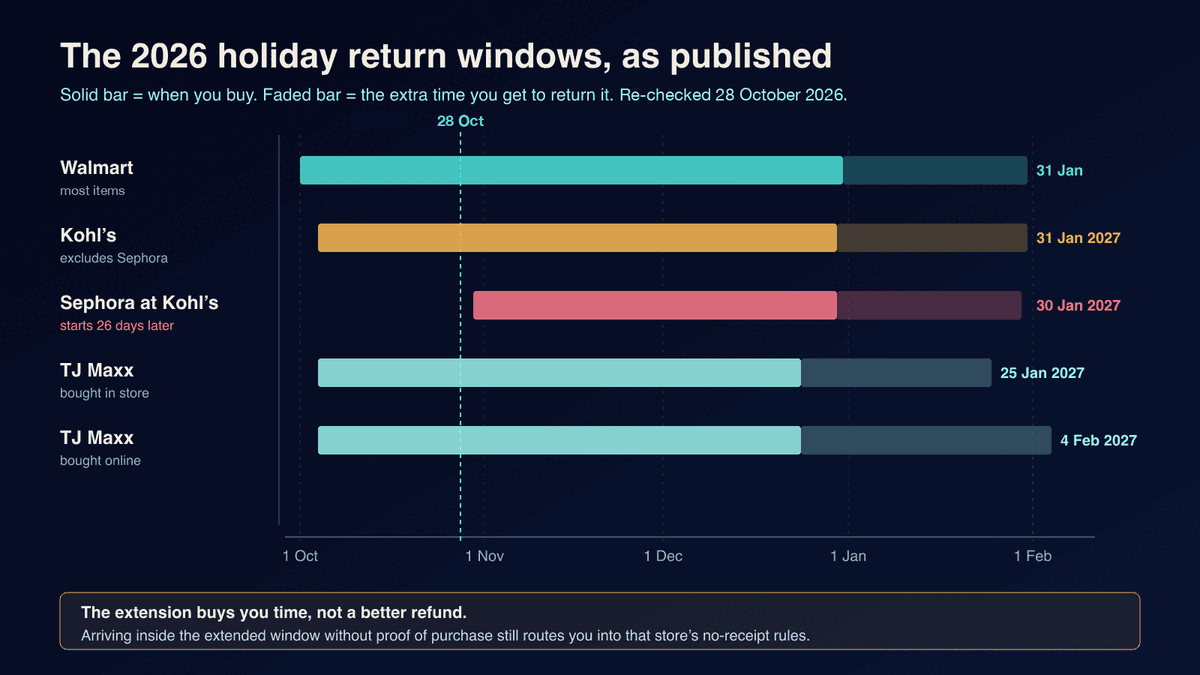
The 2026 extended holiday windows have already opened at most of these chains, which makes a gift receipt worth more now than at any other point in the year. Every date below was read from the retailer's own page; all of them were re-checked on 28 October 2026.
| Retailer | Purchases made | Returnable through |
|---|---|---|
| Walmart (most items; exceptions may include wireless phones, protection plans, major appliances, Dyson products and select seasonal and luxury goods; Marketplace seller participation varies) | October 1 – December 31, 2026 | January 31, 2027 |
| Kohl's (excluding Sephora) | October 4 – December 30, 2026 | January 31, 2027 |
| Sephora at Kohl's (opens October 30) | October 30 – December 30, 2026 | January 30, 2027 |
| TJ Maxx, in store | October 4 – December 24, 2026 | January 25, 2027 |
| TJ Maxx, online | October 4 – December 24, 2026 | February 4, 2027 |
| Target: electronics & entertainment (not Apple or Beats), most Target Plus items | November 1 – December 24, 2026 (window begins December 26) | January 24, 2027 |
| Target: Apple & Beats, unlocked or prepaid phones | November 1 – December 24, 2026 (window begins December 26) | January 8, 2027 |
Three things to notice. Kohl's excludes Sephora from the main extension and gives it a separate, later start date, so a beauty gift bought on October 10 is not covered by the extension that covers the sweater bought beside it. Kohl's Sephora section gives January 30, 2027 as the last day while the holiday summary at the top of the same page says January 31 — plan on the earlier date — and Sephora at Kohl's takes no return without a receipt or account lookup at any time of year. Target's extension is the narrowest: it covers only the categories its holiday page lists — electronics and entertainment, Apple and Beats, unlocked or prepaid phones and most Target Plus items (seasonal holiday décor excluded) — and the clock starts on December 26 rather than at purchase. And TJ Maxx's online window runs ten days longer than its in-store one on identical merchandise.
A gift receipt is worth more than a regular one here. At TJ Maxx a gift receipt still lands you merchandise credit rather than cash — but it establishes the purchase, which keeps you out of the no-record formulas entirely.
Why stores scan your ID for a return — and what the law allows
Nearly every no-receipt policy checked here asks for identification: Target, Walmart, Home Depot and TJ Maxx require government-issued ID, Kohl's says a photo ID "may be required," Nordstrom asks for "personal identification," Hobby Lobby says "A valid ID is required," and Best Buy asks only for an email address. Three retailers go further and say in writing that the ID is checked against a system: Walmart matches it "with the one stored in our secured database," Home Depot uses "a third-party refund verification system," and Kohl's says your "ID information and return history may be collected where permitted by law."
That last phrase is not boilerplate. It points at a real statutory limit, and California's is the clearest example. California Civil Code § 1798.90.1 sits under a title named "Confidentiality of Driver's License Information" and lists the only purposes for which a business may scan your license. One of them is squarely this situation:
"(D) To collect or disclose personal information that is required for reporting, investigating, or preventing fraud, abuse, or material misrepresentation."
So the scan is lawful in California for that purpose. A later subdivision then limits what may be kept or done with the data: "A business … shall not retain or use any of the information obtained by that electronic means for any purpose other than as provided herein." Violating it "constitutes a misdemeanor punishable by imprisonment in a county jail for no more than one year, or by a fine of no more than ten thousand dollars ($10,000), or by both." That section was last amended by Stats. 2018, Ch. 548 (AB 2769), effective January 1, 2019.
This is California's statute, and the rules differ by state — treat the specifics above as Californian rather than national.
On the system doing the checking: the Consumer Financial Protection Bureau includes The Retail Equation in its official List of Consumer Reporting Companies, under the market-area heading "Retail," describing it as a company that "Monitors and reports to merchants retail product return and suspected exchange fraud and abuse," recording the owner as "Appriss, Inc." (the company now sits under Appriss Retail — our Retail Equation guide traces the ownership history), and stating plainly: "The company will provide a free report if you request it."
The Retail Equation's own position is worth setting beside that, because both things are true and they are often conflated. Asked whether its recommendations affect your credit score, the company answers: "No. TRE provides return-recommendations and related services to its retailer customers. It does not provide information related to consumer creditworthiness." Being listed by the CFPB as a consumer reporting company is not the same as being a credit bureau, and a return denial does not touch your credit score.
If you have been warned or denied, you can ask for your file. The company's own instructions: "You may request a copy of your Retail Activity Report (RAR) from our online portal up to 60 days after your transaction was processed," using "your Transaction ID (this is the ID located on the receipt that was provided when your transaction was warned or denied)," or by writing to consumerinquiry@theretailequation.com. Past sixty days that portal route closes, but the Fair Credit Reporting Act's annual free-file route does not — our dedicated guide to return tracking and The Retail Equation walks through both paths and the dispute process, and what happens to returned items covers where the merchandise itself goes.
No-receipt return limits that aren't real (5 myths checked)
These figures circulate widely, including in earlier versions of this guide. We checked each against the retailer's own policy page on 2026-10-14 (Target, Walmart, Kohl's and Home Depot again on 2026-10-28) and could not find them. They may reflect internal practice that is simply unpublished — but they should not be relied on as policy, and we are not going to restate them as fact.
| The claim | What the published policy actually says |
|---|---|
| Target limits you to $100 of no-receipt returns per year | Target's returns policy publishes no number — only that "Returns and exchanges without a receipt may be limited" and that it "reserves the right to deny returns, refunds, and exchanges." |
| Walmart refunds cash under $10 and a gift card above it | Walmart publishes no dollar threshold and no cash option. The three listed outcomes are exchange, gift card, or manufacturer repair. |
| Walmart allows 3 no-receipt returns in 45 days | No numeric cap appears in Walmart's policy. Its corporate return policy says Walmart "limits the number and frequency of non-receipted returns a customer may complete," with eligibility "determined through Walmart's refund verification process," but gives no number. |
| Home Depot pays the lowest price from the last 90 days | Home Depot's policy says "the lowest advertised price" with no time window attached. The 90-day figure is its standard return window, not a pricing lookback. |
| Kohl's can look up purchases for 180 days | Kohl's publishes 90 days as standard and 120 days for Kohl's Card holders. No 180-day lookup period appears in its policy. |
The pattern is the same in all five cases: a real rule exists, and a specific-sounding number has attached itself to that rule somewhere along the way. Where a retailer genuinely does publish a bound — Kohl's thirteen weeks and Hobby Lobby's sixty days — we have quoted it in the table above.
How to never need a receipt again
The cheapest fix is to make the lookup succeed. Most of the big chains here can reconstruct a purchase from a card number, a loyalty account or an app barcode, and a successful lookup pays you what you actually paid instead of a lowest-price formula. Seven habits that keep you out of the no-receipt track entirely:
- Pay with a credit card, not cash or PIN debit. The card number is the lookup key, and a successful lookup keeps you out of the no-receipt rules altogether. Home Depot, Target, Kohl's and Walmart all publish card lookup as a route to recovering the receipt, and for third-party cards Target's list names credit cards only.
- Scan the loyalty account every single time, including on cash purchases. Kohl's can search on a Kohl's Rewards account, Target on your account or app barcode, Best Buy on My Best Buy. This is the one step that rescues a cash purchase.
- If you tapped a phone, keep that phone. A mobile-wallet lookup needs the device-specific account number, which exists only on the device you paid with.
- Take the emailed receipt over the printed one. Home Depot accepts a shipping confirmation email as part of its proof bundle, and TJ Maxx asks shoppers to "provide your Shipping Confirmation email (printed or on mobile device)" for in-store returns of online orders.
- Keep gift receipts separately. A gift receipt usually still means store credit, but it proves the purchase and keeps you out of the lowest-price formulas.
- Photograph the receipt at the register for anything over about $50, before it has a chance to fade or vanish.
- Let your inbox do it. Most purchases already generate an email trail. Purchy keeps those receipts on file and can put each purchase's return reminder on your calendar, since a forgotten return is the failure mode that actually costs people money — our guide to tracking receipts digitally covers the setup, and how long a refund takes covers what happens after the return is accepted.
Frequently Asked Questions
Can you return to Walmart without a receipt?
Yes. Walmart's published rule is to "show us your valid government-issued photo identification," and it will accept the return "if your identification information matches with the one stored in our secured database." For in-store items the three published outcomes are an exchange, a Walmart gift card, or a manufacturer repair. Walmart publishes no cash option and no number, but its corporate return policy says it "limits the number and frequency of non-receipted returns a customer may complete."
Does Target give cash back without a receipt?
No. Target issues a merchandise return card for non-receipted returns, and its policy states the card "cannot be redeemed on Target.com or for cash or credit (except where required by law)." A government-issued ID is required to be issued the card, and Target may require the same ID again when you spend it.
Can I return something without a receipt if I paid cash?
Usually yes, but cash is the hardest purchase to look up because there is no card number to search on. Home Depot asks cash, PIN-debit, check and gift-card customers to "bring your receipt to the store." If you scanned a loyalty account or app barcode at checkout, that record can still rescue a cash purchase.
How many times can you return without a receipt?
No retailer checked for this guide publishes a numeric limit. Walmart publishes no number but says it "limits the number and frequency of non-receipted returns a customer may complete," and Target states no dollar limit either: its policy says "Returns and exchanges without a receipt may be limited" and that Target "reserves the right to deny returns, refunds, and exchanges." In practice the limit is set by a third-party verification system rather than a published number, which is why a return can be denied without a stated reason.
Can a store legally refuse a return without a receipt?
Yes. No federal law requires a retailer to accept returns of non-defective merchandise, so a store sets its own policy, and nearly every policy checked for this guide reserves the right to refuse. Kohl's "reserves the right to limit or refuse refunds"; Best Buy says no-proof returns "may be denied or limited." State law governs disclosure of the policy rather than requiring refunds — see our state-by-state guide.
Will I get cash back without a receipt?
Almost never. Every retailer policy checked for this guide that addresses no-receipt returns pays them out in store credit, a merchandise credit, or a store gift card; Costco's policy does not mention receipts at all and promises to "refund your purchase price," with a footnote that "Limitations apply." Walmart's three published options for in-store items are exchange, gift card, or manufacturer repair — cash is not among them. TJ Maxx pays "a refund back to the original tender" only on a receipted return — within 40 days of the order date for online orders, 30 days for in-store purchases.
Why do stores scan my driver's license for a return?
To check the return against a verification system. Home Depot says it "uses a third-party refund verification system" and that "all returns are subject to verification system approval." Kohl's says your "ID information and return history may be collected where permitted by law." Nordstrom calls it "this internal auditing procedure to give us the ability to monitor and investigate refunds and returns without a record of sale."
How much will the store credit be worth?
It depends entirely on which store. Home Depot pays the lowest advertised price with no published lookback limit, Kohl's the lowest discounted price over thirteen weeks, Hobby Lobby the lowest selling price in the last sixty days, and Nordstrom the current price. Target, Walmart, Best Buy and TJ Maxx publish no formula on their policy pages. Only Nordstrom's rule is not a lowest-price rule.
Does a no-receipt return affect my credit score?
No. The Retail Equation, which scores returns for many major retailers, states that it "does not provide information related to consumer creditworthiness" and does not share data with consumer reporting agencies for credit decisions. It is listed by the CFPB as a consumer reporting company in the "Retail" market area, and that list records that it will provide a free report on request — though the underlying access right comes from the Fair Credit Reporting Act, not from the listing itself. That is a separate thing from a credit report.
How do I get my Retail Equation return history report?
Request it free from The Retail Equation. The CFPB's list states that The Retail Equation "will provide a free report if you request it." The company says you can request your Retail Activity Report through its online portal "up to 60 days after your transaction was processed," using the Transaction ID printed on the receipt from the warned or denied return, or by emailing consumerinquiry@theretailequation.com.
Do I lose the sales tax if I have no receipt?
At Best Buy, yes — its policy states that on returns lacking proof of purchase, "state sales taxes and fees will not be reimbursed." On a $400 purchase in a 7% state, that is about $28. Walmart's corporate return policy says a receipt "is required to receive a refund on sales tax" in Connecticut, Massachusetts, and Rhode Island. No other retailer checked for this guide publishes such a clause, but none publishes a promise to return the tax either.
Can I return a TJ Maxx item to Marshalls?
No. Despite near-identical policies across the TJX brands, the policy states that "items purchased at tjmaxx.com may not be returned to Marshalls or any of our other sister brands." Take the item back to the brand that sold it.
Can a store look up my receipt if I paid with Apple Pay?
Only if you bring the same phone you paid with. Home Depot's policy explains that for in-store mobile wallet purchases it "may need the device-specific account number or its last 4 digits," and that this "is only accessible from the physical device used for the purchase." The wallet tokenizes your card, so the token — not your card number — is the search key.
Do holiday return extensions apply without a receipt?
The extension lengthens the window, not the refund. Most Walmart items bought October 1 – December 31 are returnable until January 31 (Walmart says exceptions may include wireless phones, protection plans, major appliances, Dyson products and select seasonal and luxury goods, and that Marketplace seller participation varies), and Kohl's October 4 – December 30 purchases through January 31, 2027 — but arriving without proof of purchase still routes you into that store's no-receipt rules. Note that Kohl's excludes Sephora from the main extension, and Sephora at Kohl's accepts no return without a receipt or account lookup. Target's extension covers November 1 – December 24 purchases of electronics and entertainment, Apple and Beats, unlocked or prepaid phones and most Target Plus items, with the window starting December 26.
Your receipts and recurring charges in one place.
Purchy reads the receipts in your inbox and the charges on your bank account, files each purchase with a return reminder, and flags upcoming renewals on the recurring charges it finds.
Scan to get Purchy on your phone
Purchy is free to download. Purchy Pro is $12.99 a month or $99.99 a year. There is no free trial. Cancel any time from the App Store or Google Play. Read-only access to your email and bank.