Magnuson-Moss Warranty Act (2026): Your Federal Rights
The federal law behind every U.S. consumer-product warranty: 'Full' vs 'Limited' designations, the tie-in prohibition, and the refund right most buyers miss.
If you have ever bought a stand mixer, a riding mower, a laptop, a smartphone, a refrigerator, or a car, you are protected by a federal statute that almost no one can name. The Magnuson-Moss Warranty Act, codified at 15 U.S.C. §§ 2301–2312, is the federal warranty law of the United States. It tells warrantors what their written warranties must say, what minimum standards a warranty has to meet before it can be called "full," prohibits the most common manufacturer trick used to void coverage (the "you used a non-brand-name part" excuse), saves the state-law implied warranty of merchantability from being disclaimed away, and gives consumers a private right to sue plus a fee-shifting provision that makes those suits economically viable. This is the 2026 plain-English guide to what the Act actually says — every threshold, definition, and operative provision quoted verbatim from the United States Code as published by the Legal Information Institute at Cornell Law School — and how to put it to work the next time a warrantor tells you "sorry, that's not covered."
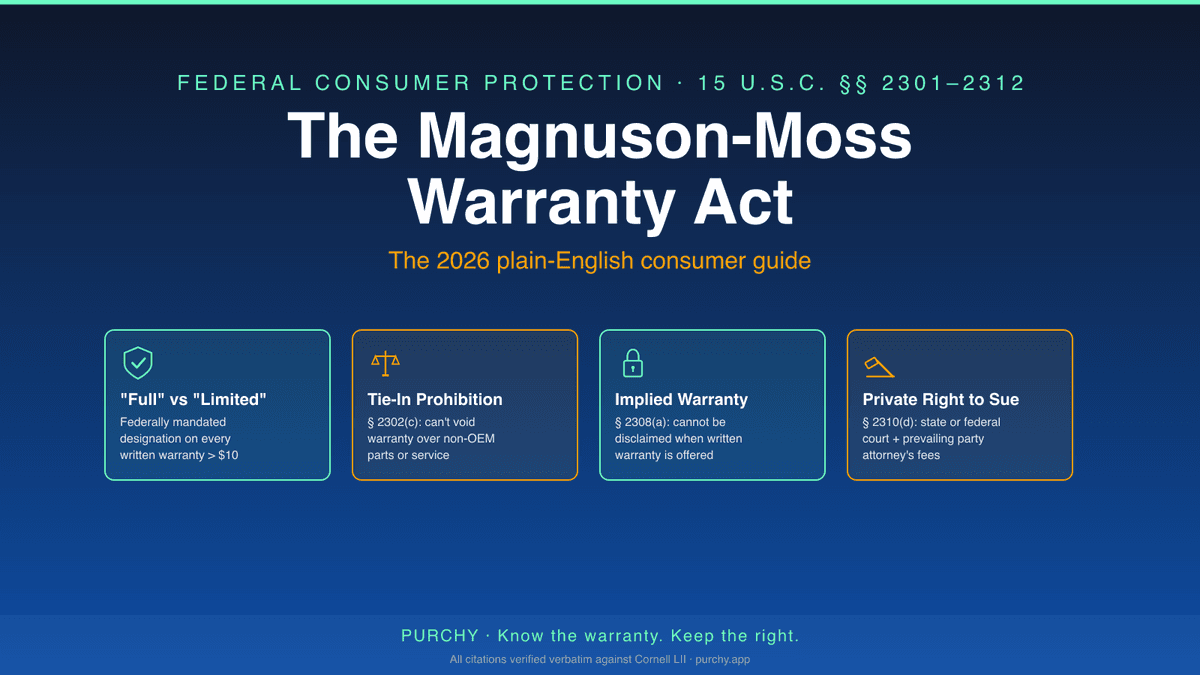
Table of Contents
- TL;DR: Magnuson-Moss in One Glance
- What the Act Actually Is
- What Counts as a "Written Warranty"
- "Full" vs "Limited" Warranty: The Federal Designation Rule
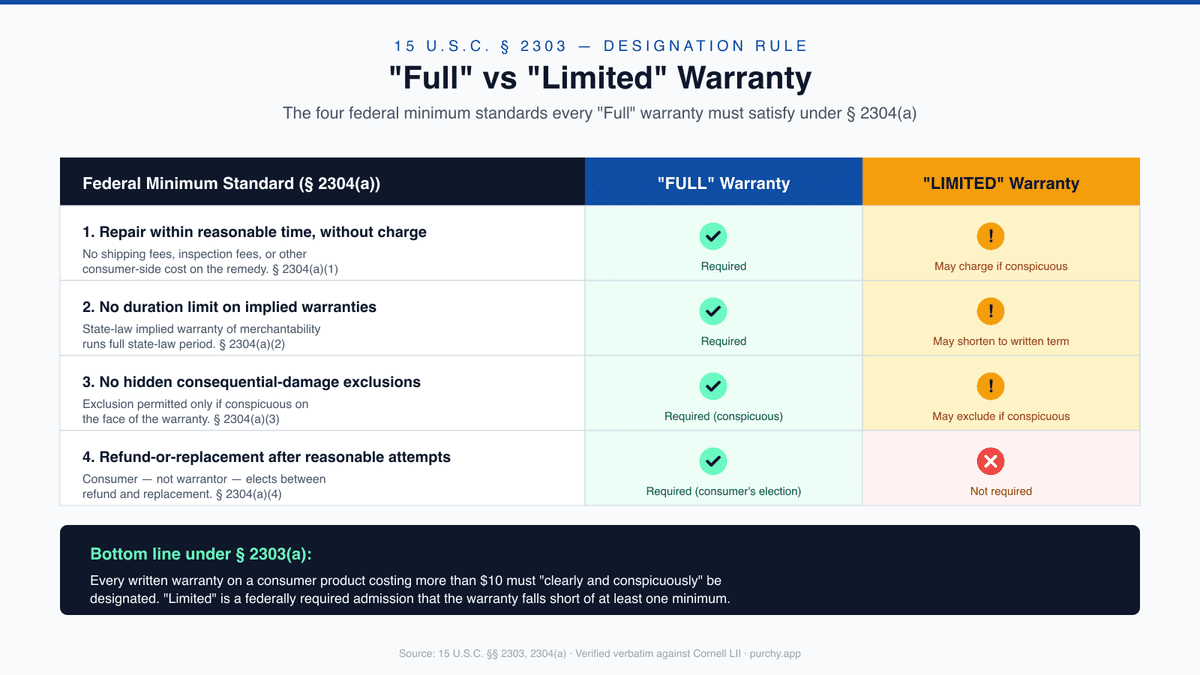
- The Four Federal Minimum Standards for a "Full" Warranty
- The Tie-In Sales Prohibition: Your Right to Use Non-OEM Parts
- Implied Warranties: What the Act Saves From State Law
- The Pre-Sale Availability Rule
- The "Reasonable Number of Attempts" Refund-or-Replacement Right
- The $5 / $10 Cost Thresholds
- What Voids Coverage: Consumer Damage and "Unreasonable Use"
- Civil Enforcement: Your Right to Sue + Attorney's Fees
- How the Act Interacts With State UCC Warranties
- How the Act Interacts With State Lemon Laws
- Magnuson-Moss vs Extended Warranties and Service Contracts
- How to Use the Act: Step-by-Step
- Common Warrantor Violations to Watch For
- How Purchy Helps Track Warranty Coverage
- Frequently Asked Questions
- The Bottom Line
TL;DR: Magnuson-Moss in One Glance
| Question | Answer under 15 U.S.C. §§ 2301–2312 |
|---|---|
| What does the Act cover? | Written warranties on consumer products — tangible personal property normally used for personal, family, or household purposes (§ 2301(1)). |
| Does it require a manufacturer to offer a warranty? | No. But if a written warranty is offered on a product costing more than $10, it must be designated "full" or "limited" (§ 2303(a), (d)). |
| What is a "full" warranty? | A warranty that meets four federal minimum standards: repair within a reasonable time and without charge, no time limit on implied warranties, consequential-damage exclusions only if conspicuous, and refund-or-replacement election after a reasonable number of failed repair attempts (§ 2304(a)). |
| Can a warrantor require me to use OEM parts to keep coverage? | No. Section 2302(c) prohibits warranty terms that condition coverage on the consumer's use of any article or service "identified by brand, trade, or corporate name" — unless the brand-name article or service is provided without charge. |
| Can a manufacturer disclaim the implied warranty of merchantability? | Not if it offers a written warranty. Section 2308(a) prohibits the disclaimer or modification of any implied warranty whenever a supplier provides a written warranty or sells a service contract within 90 days of the sale. |
| Can I sue under the Act? | Yes. Section 2310(d) creates a private right of action in any state court of competent jurisdiction or, subject to amount-in-controversy thresholds, in federal district court — and § 2310(d)(2) awards prevailing consumers their attorney's fees. |
What the Act Actually Is
The Magnuson-Moss Warranty—Federal Trade Commission Improvement Act was enacted in 1975 in response to a long pattern of consumer-product warranties that promised much, delivered little, and used legalese to nullify whatever was promised. The legislative model is unusual. Congress did not federalize warranty law. The Uniform Commercial Code, adopted in some form in every state, still controls the implied warranty of merchantability, the implied warranty of fitness for a particular purpose, and the substantive content of express warranties between sellers and buyers. What Magnuson-Moss does instead is layer a federal disclosure-and-minimum-standards regime on top of state warranty law for one specific category of product (consumer products) and one specific type of warranty (written warranties).
The Act has three operative tasks. First, it forces written warranties on consumer products to use a federally standardized "full" or "limited" designation, so a buyer can tell at a glance whether the warranty meets federal minimums (15 U.S.C. § 2303). Second, it prohibits the most abusive warranty clauses — pre-sale concealment of warranty terms, disclaimers of state-law implied warranties, and "tie-in" requirements that force consumers to use the warrantor's brand-name parts or service to keep coverage (§ 2302, § 2308). Third, it gives consumers a private right to sue under federal law if a warrantor violates the Act or fails to comply with its own written warranty, with a one-way attorney's-fees provision that makes those suits economically viable for everyday products (§ 2310(d)).
The Federal Trade Commission is the Act's primary enforcer and rulemaker. The FTC's implementing rules are in 16 CFR Parts 700 (interpretations), 701 (disclosure of written consumer-product warranty terms), and 702 (pre-sale availability). The Cornell LII publishes both the statute and the FTC regulations in their current text.
What Counts as a "Written Warranty"
The Act's coverage hinges on the statutory definition of a "written warranty." Section 2301(6) defines it in two alternative parts — only one needs to be satisfied for the Act to attach:
"any written affirmation of fact or written promise made in connection with the sale of a consumer product by a supplier to a buyer which relates to the nature of the material or workmanship and affirms or promises that such material or workmanship is defect free or will meet a specified level of performance over a specified period of time" — or — "any undertaking in writing in connection with the sale by a supplier of a consumer product to refund, repair, replace, or take other remedial action with respect to such product in the event that such product fails to meet the specifications set forth in the undertaking."
Two things follow. First, the written warranty does not have to use the word "warranty" to be a warranty. A "Lifetime Promise" tag, a "100% satisfaction guaranteed" card in the box, a "30-day money-back" badge on a product page — if it is in writing, made in connection with the sale of a consumer product, and either affirms a level of performance or undertakes remedial action, it is a written warranty under § 2301(6).
Second, the Act covers only consumer products. Section 2301(1) defines a consumer product as "any tangible personal property which is distributed in commerce and which is normally used for personal, family, or household purposes." The "normally used" test is functional, not subjective: a commercial-grade refrigerator sold to a restaurant might fall outside the Act if it is not normally used in households, but the same fridge sold to a homeowner stays covered if the model is normally used by households.
"Full" vs "Limited" Warranty: The Federal Designation Rule
Section 2303 is the labeling rule that gives the Act its consumer-facing visibility. Subsection (a) requires that any warrantor warranting a consumer product to a consumer "by means of a written warranty" must "clearly and conspicuously designate" the warranty as either:
- "Full (statement of duration) warranty" — if the warranty meets the federal minimum standards in § 2304, or
- "Limited warranty" — if it does not.
The designation requirement applies only to written warranties on consumer products "actually costing the consumer more than $10" (§ 2303(d)). Below that price point the labeling rule does not bite, although the substantive provisions of the Act (including the tie-in prohibition and the implied-warranty rules) still apply at the lower $5 threshold of § 2302(e).
The plain-English consequence is the part most buyers never think through: every time you read "limited warranty" on a product carton or in a manual, the manufacturer is admitting, by federal mandate, that its warranty does not meet the federal minimum standards. "Limited" is not just marketing softness. It is a legally required disclosure that the warranty falls short of one or more of the four federal minimums catalogued below.
The Four Federal Minimum Standards for a "Full" Warranty
Section 2304(a) sets four minimum requirements. Every one of them must be satisfied before a written warranty can be designated "full." Falling short of any one means the warranty has to be labeled "limited."
Standard 1: Repair Within a Reasonable Time and Without Charge
The statutory language at § 2304(a)(1) is precise:
"such warrantor must as a minimum remedy such consumer product within a reasonable time and without charge, in the case of a defect, malfunction, or failure to conform with such written warranty."
"Without charge" is the operative phrase. A "full" warranty cannot impose shipping fees, inspection fees, restocking fees, or any other consumer-side cost on the remedy. "Reasonable time" is fact-specific, but the FTC's interpretations have consistently treated weeks-long delays without a substitute or loaner as presumptively unreasonable for everyday consumer goods.
Standard 2: No Limits on Implied-Warranty Duration
Section 2304(a)(2) provides that "such warrantor may not impose any limitation on the duration of any implied warranty on the product." Under § 2308(b) a limited warrantor can shorten the duration of state-law implied warranties to the duration of its written warranty if the shortening is conscionable and conspicuously disclosed. A "full" warrantor cannot. The implied warranty of merchantability runs as long as state law says it runs — and the warrantor cannot federalize it down to its own warranty period.
Standard 3: No Hidden Consequential-Damage Exclusions
Section 2304(a)(3) blocks any "full" warrantor from excluding or limiting consequential damages for breach of any written or implied warranty on the product "unless such exclusion or limitation conspicuously appears on the face of the warranty." Two things follow. First, the exclusion is allowed — but only if it screams its presence on the warranty face. Second, even when conspicuously disclosed, state-law unconscionability doctrine still applies and many state courts strike down consequential-damage exclusions in consumer-product warranties as unenforceable. The federal floor is conspicuousness; the state-law ceiling can be much higher.
Standard 4: Refund-or-Replacement After a Reasonable Number of Attempts
The single most powerful provision in the entire Act is § 2304(a)(4). The verbatim text:
"if the product (or a component part thereof) contains a defect or malfunction after a reasonable number of attempts by the warrantor to remedy defects or malfunctions in such product, such warrantor must permit the consumer to elect either a refund for, or replacement without charge of, such product or part."
This is the federal "lemon law" provision baked into Magnuson-Moss for every consumer product carrying a "full" warranty. After a reasonable number of failed repairs, the choice between a refund and a replacement is the consumer's, not the warrantor's. The Act does not put a number on "reasonable" — the leading interpretation is that three to four attempts at the same defect, or a single attempt followed by extended downtime, will support an election in most cases — but the structure puts the burden of proving reasonableness on the warrantor once the consumer documents the failed-repair history.
The Tie-In Sales Prohibition: Your Right to Use Non-OEM Parts
If any single Magnuson-Moss provision is worth memorizing, it is § 2302(c). The verbatim language:
"No warrantor of a consumer product may condition his written or implied warranty of such product on the consumer's using, in connection with such product, any article or service (other than article or service provided without charge under the terms of the warranty) which is identified by brand, trade, or corporate name…"
The FTC's implementing interpretation at 16 CFR § 700.10 spells out the consequence for everyday warranty language:
"No warrantor may condition the continued validity of a warranty on the use of only authorized repair service and/or authorized replacement parts for non-warranty service and maintenance."
The FTC's regulation goes further and identifies, by example, the specific warranty language that violates the Act: "This warranty is void if service is performed by anyone other than an authorized 'ABC' dealer and all replacement parts must be genuine 'ABC' parts."
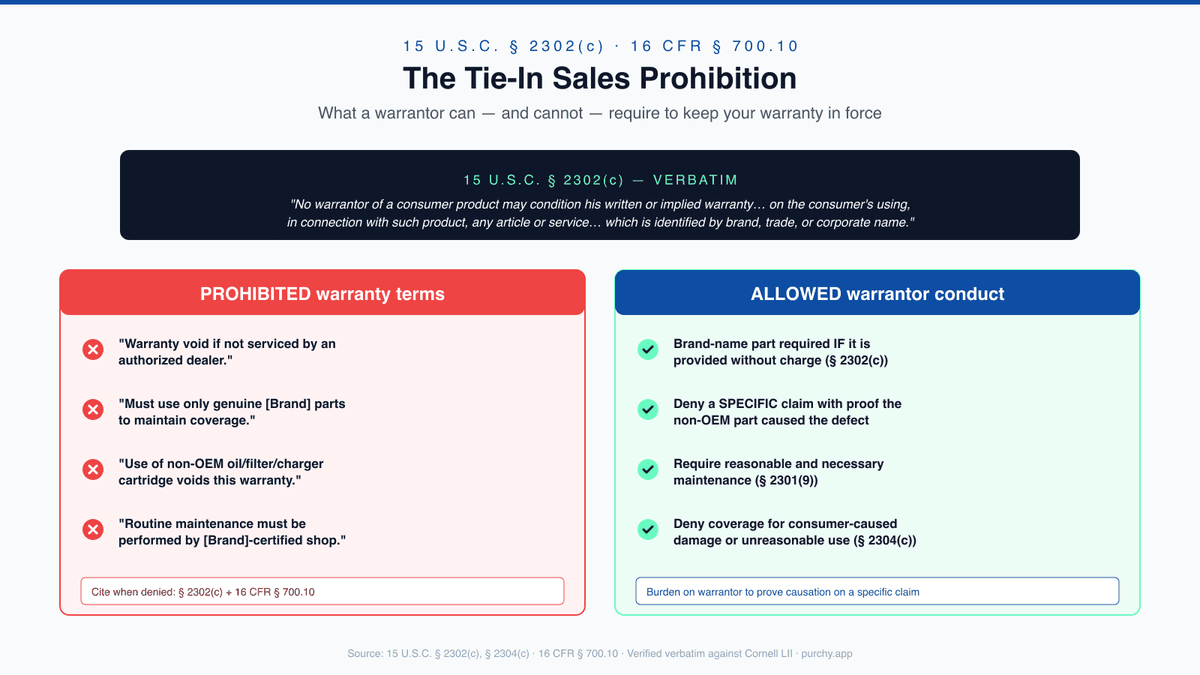
The plain-English translation is the contrarian fact that drives this entire blog post: your manufacturer cannot void your warranty because you used a non-OEM oil filter, non-OEM brake pads, a non-OEM phone charger, a third-party screen protector, or had a routine repair done at an independent shop. The Act explicitly allows tie-ins only in one narrow circumstance — when the brand-name article or service is provided to you free of charge under the warranty itself (a free first-year oil change with manufacturer-branded oil, for example). Outside that exception, conditioning warranty validity on brand-name parts or "authorized" service is a federal trade-law violation.
Two practical clarifications matter. First, the prohibition does not stop the warrantor from denying coverage of a specific claim if the warrantor can affirmatively prove that the non-OEM part actually caused the damage — § 2304(c) preserves the warrantor's right to refuse remedy "if such warrantor can show that the defect, malfunction, or failure of any warranty obligation… was caused by damage (not resulting from defect or malfunction) while in the possession of the consumer, or unreasonable use." But the burden is on the warrantor, with evidence, on a particular claim. Blanket "use our parts or warranty is void" language is forbidden by § 2302(c) regardless of whether any specific defect actually occurred.
Second, the prohibition applies to service as well as parts. A car dealer cannot tell you your warranty will be voided because you had an oil change at Jiffy Lube. A laptop manufacturer cannot tell you opening the case to swap RAM voids coverage (although it can require that the new RAM not be the cause of any specific defect being claimed). A printer manufacturer cannot tell you a third-party toner cartridge voids the warranty as a categorical matter.
Implied Warranties: What the Act Saves From State Law
State law (specifically UCC §§ 2-314 and 2-315 as adopted in each state) creates two implied warranties at the moment of sale by a merchant: the implied warranty of merchantability (the goods are fit for the ordinary purposes for which goods of that kind are used) and the implied warranty of fitness for a particular purpose (when the seller knows the buyer's particular purpose and the buyer relies on the seller's skill in selecting suitable goods). The state UCC also lets a merchant disclaim those implied warranties by conspicuous language using the word "merchantability" or a "with all faults" / "as is" notice.
Section 2308(a) of Magnuson-Moss blocks that state-law disclaimer route whenever a written warranty is offered:
"No supplier may disclaim or modify (except as provided in subsection (b)) any implied warranty to a consumer with respect to such consumer product if (1) such supplier makes any written warranty to the consumer with respect to such consumer product, or (2) at the time of sale, or within 90 days thereafter, such supplier enters into a service contract with the consumer which applies to such consumer product."
The exception in subsection (b) is narrow: a limited warrantor can shorten — not eliminate — the duration of implied warranties to the duration of its written warranty, provided the limitation is conscionable, in clear and unmistakable language, and prominently displayed on the warranty face. A "full" warrantor cannot do even that.
Section 2308(c) supplies the consequence for violations: any disclaimer, modification, or limitation made in violation of § 2308 "shall be ineffective for purposes of this chapter and State law." A defective disclaimer does not just fail under federal law — it is also stripped of effect under the state UCC, which means the buyer's UCC implied-warranty rights are restored in full.
The practical importance is large. The implied warranty of merchantability is a powerful, free-standing remedy independent of the written warranty's exclusions. A toaster that fails to toast bread, a refrigerator that fails to refrigerate, a phone that fails to make calls — all are presumptively unmerchantable, and Magnuson-Moss prevents the manufacturer's "limited warranty" from quietly wiping that remedy off the table.
The Pre-Sale Availability Rule
Section 2302(b) directs the FTC to write rules requiring warranty terms to be "made available to the consumer (or prospective consumer) prior to the sale of the product." The implementing rule is 16 CFR Part 702. Three things follow.
First, retailers (sellers) — not just manufacturers (warrantors) — bear responsibility. A retailer selling a product priced above $15 has to make the warranty available for the consumer to review pre-purchase, either by displaying the warranty on or near the product, by providing it on request, or — for many products — by linking it from the product's online listing.
Second, the rule covers terms, not just the existence of a warranty. "There's a one-year warranty, the details are in the box" is not compliance. The actual text of the warranty has to be available before you buy.
Third, the rule allows electronic compliance. The FTC's 2016 amendments to Part 702 expressly permit warrantors to satisfy the pre-sale availability rule via posted full warranty text on the warrantor's website, with packaging that points the consumer to the URL and provides the warrantor's contact information.
The "Reasonable Number of Attempts" Refund-or-Replacement Right
Section 2304(a)(4) — already quoted above — creates the consumer's most powerful single remedy under the Act, but only for products covered by a "full" warranty. The mechanics are worth unpacking.
The trigger is a defect or malfunction that persists "after a reasonable number of attempts by the warrantor to remedy" it. "Reasonable number" is not defined by statute; courts have generally held that three attempts at the same defect, or one attempt that fails to fix the problem combined with a long out-of-service period, suffice on most consumer products. State lemon laws often define "reasonable number" by statute for motor vehicles (often four attempts at the same defect, or an aggregate of 30+ days out of service in the first year or two of ownership) and supply per-state numerical floors that the Magnuson-Moss "reasonable number" standard borrows from in practice.
The election is the consumer's. Once the trigger is met, § 2304(a)(4) gives the consumer — not the warrantor — the choice between a refund and a replacement. "Without charge" means without any consumer-side fees. A warrantor that insists on a third repair attempt after two failed ones, or that unilaterally substitutes a partial credit for a refund, is in violation of § 2304(a)(4).
The trade-off the consumer accepts in electing refund-or-replacement is the loss of the original unit. If you elect a replacement, you receive a replacement consumer product (typically of like kind and quality). If you elect a refund, you return the unit and receive your purchase price back. Either way, the right vests once the "reasonable number of attempts" threshold is crossed — and many warrantors quietly comply with it once the consumer cites the statute and documents the attempt count, precisely to avoid being on the receiving end of a § 2310(d) suit.
The $5 / $10 Cost Thresholds
Two product-price thresholds gate which Magnuson-Moss provisions apply.
$5 — the substantive-rule threshold (§ 2302(e)). The disclosure requirements of § 2302, the tie-in prohibition of § 2302(c), and the implied-warranty rules of § 2308 apply only to "warranties which pertain to consumer products actually costing the consumer more than $5." Below $5, the Act's substantive provisions do not bite. In practice, virtually every consumer product carrying a written warranty costs more than $5, so the threshold is rarely litigated.
$10 — the designation-rule threshold (§ 2303(d)). The "full" vs "limited" designation requirement of § 2303 applies only to written warranties on consumer products "actually costing the consumer more than $10" and that are not designated as full warranties. Below $10, the warrantor need not use either federally standardized label.
Both thresholds use the same operative phrase — "actually costing the consumer" — which refers to the price the consumer paid, net of discounts, not the manufacturer's suggested retail price.
What Voids Coverage: Consumer Damage and "Unreasonable Use"
Magnuson-Moss does not turn the warrantor into an unlimited insurer. Section 2304(c) preserves the warrantor's ability to deny remedy on a specific claim "if such warrantor can show that the defect, malfunction, or failure of any warranty obligation… was caused by damage (not resulting from defect or malfunction) while in the possession of the consumer, or unreasonable use, including failure to provide reasonable and necessary maintenance."
"Reasonable and necessary maintenance" is defined back at § 2301(9) as "those operations (A) which the consumer reasonably can be expected to perform or have performed and (B) which are necessary to keep any consumer product performing its intended function." The structure is important. The warrantor can deny a specific claim on the basis of consumer-caused damage or unreasonable use — but it bears the evidentiary burden of showing causation, and the denial reaches only the specific defect at issue, not the entire warranty.
Two contrasts make the operative scope clearer. Section 2304(c) is a case-by-case denial standard; § 2302(c) is a blanket-prohibition standard on warranty terms. A warrantor can argue, with evidence, that the specific failure in your car was caused by a non-OEM oil filter that disintegrated and clogged the engine. A warrantor cannot say that your entire warranty is void because you ever used a non-OEM oil filter at any point. Those are different rules, and conflating them is the trick at the heart of most unlawful "use our parts or you lose coverage" denial letters.
Don't let another federal warranty right quietly expire.
Purchy reads your purchase emails as they arrive and tracks every warranty period and return deadline — so when a warrantor stalls, denies, or runs out the clock, you have the dates and the receipt to push back with.
Try Purchy free →Civil Enforcement: Your Right to Sue + Attorney's Fees
Section 2310(d) gives a consumer "damaged by the failure of a supplier, warrantor, or service contractor to comply with any obligation under this chapter, or under a written warranty, implied warranty, or service contract" a private right of action. Two forums are available:
- State court — "in any court of competent jurisdiction in any State or the District of Columbia," with no statutory amount-in-controversy floor. State small-claims courts are the most common forum for everyday consumer claims and the most accessible.
- Federal district court — available only above strict amount-in-controversy thresholds. The individual claim must exceed $25, the total amount in controversy must exceed $50,000 (exclusive of interest and costs), and a class action requires "one hundred" or more named plaintiffs to be filed in federal court.
The economic engine that makes those suits viable is § 2310(d)(2), the fee-shifting provision. If a consumer "finally prevails," the court may allow as part of the judgment "a sum equal to the aggregate amount of cost and expenses (including attorneys' fees based on actual time expended)" reasonably incurred in connection with the suit. The provision runs in one direction only — there is no comparable fee-shift against losing consumer plaintiffs in the statute — and a meaningful number of consumer-rights attorneys take Magnuson-Moss cases on contingency precisely because the prevailing-party fee-shift makes them economically viable on products as inexpensive as a few hundred dollars.
One procedural prerequisite to know: § 2310(e) requires the warrantor to be given "a reasonable opportunity to cure" before suit is filed in many cases, particularly class actions. The Act's structure favors negotiated remedies under the warranty before federal-court intervention.
How the Act Interacts With State UCC Warranties
Magnuson-Moss does not replace state UCC warranty law. It supplements it. The relationship runs along three axes:
- Implied warranties stay state-law. Section 2301(7) defines "implied warranty" as "an implied warranty arising under State law (as modified by sections 2308 and 2304(a) of this title) in connection with the sale by a supplier of a consumer product." Magnuson-Moss does not create implied warranties — it borrows them from state UCC § 2-314 and § 2-315 and then locks the warrantor's ability to disclaim or shorten them.
- Written warranties are partially federalized. The substantive content of a written warranty (what it promises) remains a matter of state contract law and the warrantor's own language. What Magnuson-Moss adds is a federal disclosure and minimum-standards layer through §§ 2302–2304.
- Federal remedies are concurrent with state remedies. A consumer alleging breach of warranty can sue under the state UCC, under Magnuson-Moss, and under state consumer-protection (UDAP) statutes in the same complaint. Most consumer-warranty complaints filed today plead multiple counts precisely to capture the strongest remedy available under each statute.
How the Act Interacts With State Lemon Laws
Every state has a "lemon law" of some form covering at minimum new motor vehicles. Lemon laws supply state-specific numerical definitions of "reasonable number of repair attempts" (often four attempts on a serious safety defect, or an aggregate of 30+ days out of service during a defined warranty period) and a refund-or-replacement remedy with state-specified deduction formulas for the consumer's use of the vehicle before the trigger event.
The federal Magnuson-Moss "reasonable number of attempts" right under § 2304(a)(4) and the state lemon-law right are parallel and cumulative. A consumer can elect to proceed under either or both. The strategic choice typically turns on three considerations:
- Numerical floor. A state lemon law with a defined attempt count is a brighter line to satisfy than the Magnuson-Moss "reasonable number" standard.
- Fee-shifting. Some state lemon laws include their own fee-shifting; many do not. Magnuson-Moss § 2310(d)(2) supplies fee-shifting in either path.
- Vehicle coverage. State lemon laws often cover only new motor vehicles. Magnuson-Moss covers any consumer product with a written warranty, including used vehicles still under a manufacturer or dealer written warranty.
Magnuson-Moss vs Extended Warranties and Service Contracts
The Act draws a sharp line between written warranties and service contracts. Section 2301(8) defines a service contract as "a contract in writing to perform, over a fixed period of time or for a specified duration, services relating to the maintenance or repair (or both) of a consumer product." The product-protection plan you are pitched at checkout — "would you like to add 3 years of extended coverage for $99" — is a service contract, not a written warranty.
The Act applies to service contracts but applies different rules. Service contracts must comply with the disclosure requirements of § 2306 and FTC Part 700 interpretations. Most relevantly, § 2308(a)(2) treats the existence of a service contract entered within 90 days of sale as equivalent to a written warranty for purposes of the implied-warranty disclaimer bar — meaning a supplier that sells you an extended-coverage plan at checkout cannot then disclaim the state-law implied warranty of merchantability.
Two practical implications for buyers. First, the "warranty" you bought as an upsell is legally a service contract, not a § 2301(6) written warranty, and the federal "full" vs "limited" designation regime does not apply to it. Second, the substantive coverage of a service contract is whatever the contract says — there is no federal floor analogous to § 2304(a)'s minimum standards. Read the contract.
How to Use the Act: Step-by-Step
The Act is a structural protection that runs on documentation. When a warrantor stalls, denies, or runs out the clock, the consumer's burden is to surface the right citation against the right fact pattern, in writing, before escalating. The following sequence has worked across thousands of small-claims actions filed under the statute.
- Locate the written warranty. Pull the warranty text from the product box, the manufacturer's website, or — under the pre-sale availability rule — from the retailer that sold you the product. Note the designation: "Full" (with stated duration) or "Limited."
- Identify which Magnuson-Moss provision applies. If the denial is "you used a non-OEM part" or "you used an unauthorized repair shop," cite § 2302(c) and 16 CFR § 700.10. If the denial is a fourth failed repair attempt on a "Full" warranty, cite § 2304(a)(4). If the denial includes a disclaimer of implied warranties, cite § 2308.
- Send a written demand letter. Identify the product, the defect, the warranty terms, the violation, and the Magnuson-Moss citation. Demand a specific remedy (repair, refund, or replacement) and give a specific deadline (15 to 30 days is the norm). Send by a method that creates a delivery record (certified mail or trackable email).
- Document the warrantor's response. Save every email, every chat transcript, and every repair invoice. If the warrantor offers partial relief, document it; if the warrantor stalls, document it.
- File the suit. Most everyday consumer-product warranty disputes are best filed in state small-claims court — no attorney is required in most states, filing fees are modest, and the court schedule is fast. Larger disputes (or class actions) can be filed in state superior court or, above the § 2310(d) thresholds, in federal court.
- Claim attorney's fees. If you retained counsel and prevailed, file a fee petition under § 2310(d)(2). The fee-shift is the structural feature that makes counsel willing to take everyday consumer-warranty claims on contingency.
Common Warrantor Violations to Watch For
The following five patterns recur in everyday warranty denials. Each one violates a specific Magnuson-Moss provision. Citing the provision in your first demand letter, in writing, resolves most claims before they require any forum beyond the warrantor's customer-service queue.
- "Your warranty is void because you used non-OEM parts/service." Violation of § 2302(c) and 16 CFR § 700.10. The blanket void is unlawful regardless of whether the non-OEM part caused any specific defect.
- "We are not covering this because our warranty disclaims the implied warranty of merchantability." Violation of § 2308(a). Any written warranty disables that disclaimer route; the implied warranty survives.
- "You'll need to ship the unit to us at your own cost for inspection." If the warranty is designated "Full," violation of § 2304(a)(1)'s "without charge" requirement. If the warranty is "Limited," the cost is allowed only if conspicuously disclosed in the warranty itself.
- "You don't get a refund — we get to try a fourth repair." If the warranty is designated "Full," violation of § 2304(a)(4). The election after a reasonable number of attempts is the consumer's, not the warrantor's.
- "That's a hidden defect we never disclosed coverage for." Coupled with a "limited" disclaimer of consequential damages, may be a § 2304(a)(3) violation if the exclusion is not "conspicuous on the face of the warranty," and a § 2308 violation if the disclaimer reaches the implied warranty of merchantability.
How Purchy Helps Track Warranty Coverage
The Magnuson-Moss Warranty Act is structurally biased in the consumer's favor — but every single remedy it provides depends on the consumer knowing what the warranty period is, when it started, what the warranty document said, and what repair attempts have been documented. In a household with a dozen consumer products carrying overlapping warranty periods, that record-keeping is the hard part.
That is precisely the problem Purchy solves. Purchy reads your purchase-confirmation emails as they arrive and pulls out the dates that govern your warranty rights: the purchase date that anchors the warranty period, the warranty length the manufacturer printed in the listing, the service-contract upsell terms if you accepted one, and the credit-card extended-warranty benefit on the card you paid with. You see a single clean list of your active product warranties with the expiration dates highlighted — so when a refrigerator fails in month 13 and you think you are out of warranty, Purchy is the place that surfaces the extra 12 months of credit-card extended coverage you forgot you had.
For more on the federal and state rights that govern your other purchases, see:
- The 2026 warranty tracking guide
- The FTC 30-day shipping rule: federal auto-refund right
- The FTC Cooling-Off Rule: the real 3-day right to cancel
- How to dispute a credit card charge in 2026
- Debit vs. credit card disputes: Reg E vs Reg Z
- The FTC junk-fees rule, one year later
- AppleCare+ refund policy: the 30-day rule and 17 state laws
- Restocking fees: the 2026 complete guide
Frequently Asked Questions
Does Magnuson-Moss require manufacturers to offer a warranty?
No. The Act is a disclosure-and-minimum-standards regime; it does not federalize the substantive duty to warrant. A manufacturer is free to sell a consumer product "as is" with no written warranty at all — although doing so for a product where the state UCC implied warranty of merchantability applies remains a substantial liability exposure under state law.
Can a manufacturer void my entire warranty because I used an aftermarket part?
No. Section 2302(c) and 16 CFR § 700.10 prohibit blanket warranty-void clauses tied to brand-name parts or service. The manufacturer retains the right to deny coverage of a specific claim if it can prove the non-OEM part caused the specific defect at issue (§ 2304(c)), but that is a case-by-case showing on a specific defect, not a categorical voiding of the entire warranty.
What is the difference between a "full" and "limited" warranty?
"Full" means the warranty meets the four federal minimum standards in § 2304(a): repair within a reasonable time without charge, no implied-warranty duration limits, no hidden consequential-damage exclusions, and refund-or-replacement election after a reasonable number of failed repair attempts. "Limited" means the warranty falls short of at least one of those standards. The designation has to be "clearly and conspicuously" displayed on any written warranty for a consumer product costing more than $10.
Can a "limited" warranty disclaim the implied warranty of merchantability?
No. Section 2308(a) prohibits any supplier offering a written warranty from disclaiming or modifying any implied warranty. A "limited" warrantor can shorten the implied warranty's duration to the duration of the written warranty (§ 2308(b)) if the shortening is conscionable and conspicuously disclosed — but it cannot eliminate the implied warranty entirely.
Does the Act apply to used products?
Yes, if the used product is sold with a written warranty. The Act covers the warranty that is offered, not the new-vs-used status of the product. A used vehicle sold with a 30-day dealer warranty falls squarely within § 2301(6) and § 2303.
Does the Act apply to service contracts I bought separately?
The Act applies, but it applies different rules. A service contract is defined separately at § 2301(8) and is not subject to the "full" vs "limited" designation regime of § 2303 or the four federal minimum standards of § 2304. Section 2308(a)(2) does treat a service contract entered within 90 days of sale as a trigger for the implied-warranty disclaimer bar.
Can I sue under Magnuson-Moss in small-claims court?
Yes. Section 2310(d) authorizes suit in "any court of competent jurisdiction in any State or the District of Columbia." Small-claims courts in every state are courts of competent jurisdiction for claims within their monetary limits — typically $5,000 to $25,000 depending on state — and most everyday consumer-warranty disputes fit comfortably within those limits.
What does "prevailing party" attorney's fees mean under § 2310(d)(2)?
It means that if you "finally prevail" in your Magnuson-Moss suit, the court may award you the reasonable attorney's fees you incurred (based on actual time expended) as part of the judgment, in addition to your damages. The fee-shift runs in one direction only — the statute does not symmetrically award fees to defendants who defeat a consumer claim. This is the provision that makes Magnuson-Moss claims viable on inexpensive products: a consumer-rights attorney can litigate a $400 case to verdict because the fee-shift compensates the time independently of the damage award.
How many repair attempts is a "reasonable number" under § 2304(a)(4)?
The statute does not put a number on it. Courts have generally held that three attempts at the same defect, or one attempt followed by an extended out-of-service period, will support an election in most cases. State lemon laws often supply a per-state numerical floor (commonly four attempts on a serious safety defect, or 30+ aggregate days out of service in the first warranty period). The burden of proving that the number of attempts to date is not yet "reasonable" rests with the warrantor.
Is there a deadline to bring a Magnuson-Moss claim?
The Act does not include its own statute of limitations. Courts apply the borrowed state statute of limitations for breach of warranty under the UCC, which is generally four years from the date of tender of delivery, although the period may be shortened by contract to one year under UCC § 2-725(1) in many states. Discovery and tolling rules vary by state.
Does the Act apply to products I bought outside the U.S.?
The Act applies to consumer products "distributed in commerce" — meaning sold or distributed for sale to or use by consumers — within the United States. A product purchased abroad and brought into the U.S. is generally outside the Act's coverage, although a warranty extended by a U.S. manufacturer to U.S. consumers on the same product remains covered.
Does the Act preempt stronger state warranty laws?
No. Section 2311(c) expressly preserves state warranty law that provides equal or greater consumer protection. Magnuson-Moss is a floor, not a ceiling. State UDAP statutes, state lemon laws, and state UCC remedies all remain available concurrently.
The Bottom Line
The Magnuson-Moss Warranty Act is fifty years old, fifty pages long in the U.S. Code, and structurally the strongest federal consumer-product warranty regime in the world. It does not write the warranty for you — that is the manufacturer's job — but it polices what the warranty can say, what minimum standards it has to meet to wear the "Full" label, what state-law implied warranties survive any disclaimer, and what conduct (the "use our parts or your warranty is void" blanket void) is a federal trade-law violation regardless of what the warranty document recites.
The reason the Act is underused is the same reason most federal consumer-protection statutes are underused: invisibility. The consumer does not know the designation rule, does not know the tie-in prohibition, does not know the refund-or-replacement election, and does not know the fee-shifting provision. The warrantor knows all four, and quietly counts on the consumer not knowing any of them. Track the warranty dates, save the receipt, save the warranty document, and the Act does the rest. Know the citations and most warranty denials resolve in the customer-service queue, before any forum ever has to convene.
Know the warranty. Keep the right.
Purchy reads your purchase emails and tracks every warranty period, return deadline, and refund clock — automatically, so federal protections like the Magnuson-Moss Act never lapse unnoticed.
Try Purchy free →This article is informational, not legal advice. All thresholds, definitions, and quoted statutory provisions were verified verbatim against 15 U.S.C. §§ 2301, 2302, 2303, 2304, 2308, and 2310 and 16 CFR Part 700 as published by the Legal Information Institute at Cornell Law School on May 17, 2026. State warranty, lemon-law, and consumer-protection statutes vary; for guidance on a specific transaction, consult an attorney admitted in your state or contact your state attorney general's consumer-protection division. To report a warrantor for violations of the Magnuson-Moss Warranty Act, file a complaint at ReportFraud.ftc.gov.
Wake to one edition. Only what matters.
$12.99 a month or $99.99 a year. Cancel any time from the App Store or Google Play.