Mattress Trial Periods 2026: Return Rules & Hidden Catches
Casper offers 100 nights, Saatva 365 — but every brand hides a break-in period and pickup fees in the fine print. The 2026 mattress trial period guide.
Mattress shopping in 2026 looks deceptively simple. Casper advertises a 100-night trial, Purple offers 100 calendar days, Tempur-Pedic posts a 90-night sleep trial, and Saatva headlines a 365-night home trial. What none of those promotional banners surface is the 21-to-30-night minimum break-in period before you're even allowed to start a return, the transportation fees some brands deduct from your refund, the donation receipt you may have to produce for the cashier, or the once-per-12-months limit on free pickups. The result: every year, thousands of buyers blow past their real return windows or absorb hidden fees on $1,500-$3,000 mattresses. This guide walks through the 2026 mattress trial period landscape — what each major brand actually requires, what the FTC's "cooling-off rule" doesn't cover, and how to recover every dollar you're owed.
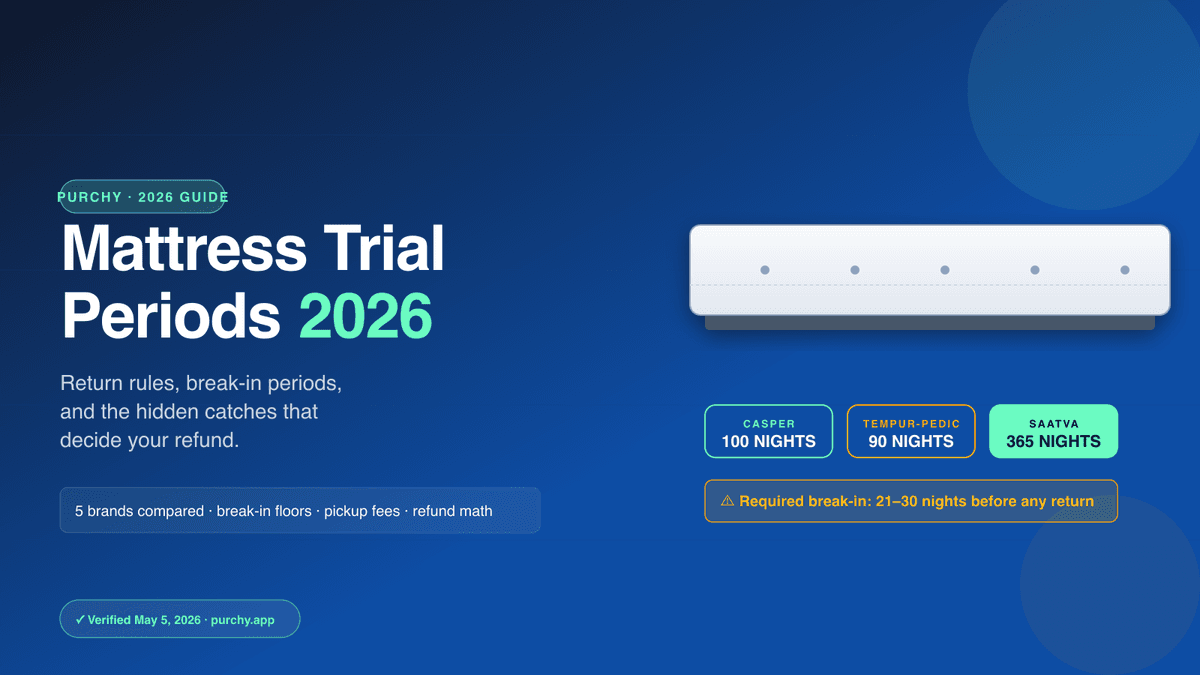
Table of Contents
- The Math: What a Mattress Refund Is Actually Worth
- The 2026 Trial Period Comparison
- Why Every Brand Has a "Break-In Period"
- The Hidden Costs That Eat Your Refund
- The FTC Cooling-Off Rule Myth
- How to Get Your Refund Without Friction (5 Steps)
- What Happens to Returned Mattresses
- If Your Return Is Denied
- Why Tracking Your Trial Window Matters
- FAQ
The Math: What a Mattress Refund Is Actually Worth
A mattress isn't a $40 bedsheet — it's one of the highest-AOV (average order value) consumer purchases most households make all year. Skipping a trial deadline isn't a $20 mistake; it's frequently a four-figure one.
- A queen Casper Original retails around $1,295 as of mid-2026; the Casper Wave Hybrid Snow runs $2,995.
- A queen Purple Restore Plus is $2,995; the Purple Rejuvenate Plus is $3,995.
- A queen Tempur-Pedic ProAdapt runs about $3,499; the LuxeBreeze hits $4,799.
- A queen Saatva Classic is $1,995; their Solaire adjustable line goes north of $3,500.
- A queen Tuft & Needle Original is $895; the Mint comes in around $1,295.
The NRF's 2025 Retail Returns Landscape (produced with Happy Returns) puts total U.S. returns at $849.9 billion in 2025, with 19.3% of online sales coming back. Furniture and bedding aren't broken out separately in the public NRF summary, but they're consistently among the highest-AOV return categories tracked by industry surveys.
Why this matters: A missed return on a $40 t-shirt is annoying. A missed return on a $2,500 mattress is a meaningful percentage of an emergency fund. Yet the same kind of "oh, I'll get to it next week" behavior that costs you nothing on the t-shirt costs you four figures on the mattress, because the trial windows are long enough to make the deadline feel infinitely far away — until it's gone.
The 2026 Trial Period Comparison
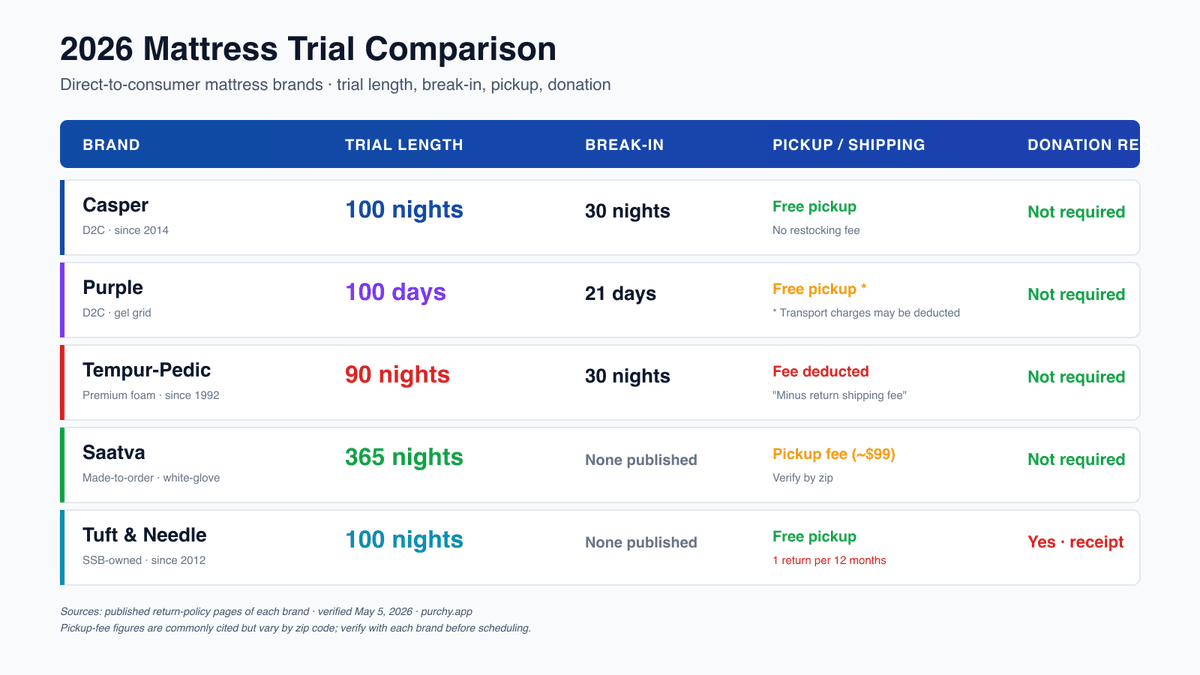
Here's how five of the most-shopped U.S. direct-to-consumer mattress brands stack up in 2026, sourced directly from each company's published return policy as of May 2026:
| Brand | Trial length | Break-in required | Return shipping / pickup | Donation receipt? | Per-year limit |
|---|---|---|---|---|---|
| Casper | 100 nights | 30 nights | Free (UPS drop-off small items; pickup for mattresses) | Not required by policy | None published |
| Purple | 100 calendar days | 21 days | Free pickup; transportation charges up to standard freight rate may be deducted | Not required by policy | None published |
| Tempur-Pedic | 90 nights | 30 nights | "Return shipping fee" deducted from refund (amount not published) | Not required by policy | None published |
| Saatva | 365 nights | None published | Pickup fee charged (commonly cited as $99 in 2026) | Not required | None published |
| Tuft & Needle | 100 nights | None published as nights | Free pickup | Yes — donation receipt required for used items | 1 return / exchange per 12 months |
Sources: casper.com/returns, purple.com/return-policy, tempurpedic.com/customer-service/return-policy, tuftandneedle.com/returns, saatva.com. Verified May 5, 2026.
Casper — 100 Nights, 30-Night Break-In, Free
Casper, founded in 2014 and acquired by Carpenter Co. in October 2024, runs the most permissive return mechanics of the major D2C brands. From Casper's published policy: "It can take the body at least 30 days to adjust to a new mattress." Customer service won't initiate a mattress return until day 30. After that, you have until day 100 to return for a full refund, with free pickup through Casper's logistics partners. No restocking fee is published. Note that Casper's other product categories — pillows, bedding, dog beds, Glow lights, mattress toppers — carry shorter 30-night windows; bundles inherit the longest applicable window.
Purple — 100 Days, 21-Day Break-In, Pickup Fee Cap
Purple's policy uses calendar days (not nights), starting from the delivery date. The required break-in is shorter than Casper's at 21 days. The catch is in the refund math: Purple "arranges and covers" pickup, but the refund is reduced by transportation charges capped at "Purple's then-standard freight charges." On a $2,995 Restore Plus, the pickup deduction matters less than the principle: Purple's freight charges are not published in the policy, so check before scheduling pickup if you want a precise refund preview.
Tempur-Pedic — 90 Nights, 30-Night Break-In, Shipping Fee Deducted
Tempur-Pedic's window is the shortest of the major brands at 90 nights. The 30-night break-in is identical to Casper's, leaving a 60-day usable return window. Critically, the policy explicitly says refunds are "minus the return shipping fee" — the fee amount is not published, so it's discovered at the point of return. Closeout mattresses are excluded from the trial entirely (10-year limited warranty still applies). And unlike the D2C-only brands, products purchased from a third-party retailer follow that retailer's policy — buying a Tempur-Pedic at Mattress Firm or Costco doesn't give you the 90-night sleep trial; it gives you Mattress Firm's or Costco's return rules instead.
Saatva — 365 Nights, White-Glove Both Ways
Saatva's 365-night home trial is the longest in the mainstream D2C industry. Saatva delivers via white-glove service (in-room setup, removal of old mattress) and uses the same network for pickup. The trade-off: Saatva charges a pickup transportation fee for trial returns (commonly cited as $99 in 2026; verify the exact figure with Saatva when you call to schedule, as it can vary by zip code and product). No mandatory break-in period is published, though the company's comfort guidance recommends sleeping on a new mattress for 30 days before judging firmness.
Tuft & Needle — 100 Nights, but Read the Fine Print
T&N's policy carries two restrictions the others don't:
- Donation receipt required for used products. Per Tuft & Needle's policy: "We encourage donation and there are many organizations around the country who accept our gently used products." Customers must obtain a signed donation receipt before refunds are processed. T&N's customer-service team will help locate a participating local charity.
- One return or exchange per 12 months. Buy a T&N mattress in March 2026, return it in May 2026, then buy a different T&N model in July — your second return inside the 12-month window won't be honored under the trial.
Tuft & Needle is owned by Serta Simmons Bedding, which acquired the company in 2018. Mattresses purchased through Amazon, Crate & Barrel, or other resellers fall outside the brand's direct policy and follow the reseller's terms.
Why Every Brand Has a "Break-In Period"
The break-in clause is not a sales tactic — it has both physical and policy logic, and understanding why it exists tells you when and how to push back if a return gets prematurely denied.
The physical reason: Foam mattresses (memory foam, polyfoam, hybrid) genuinely soften over the first 2-4 weeks of use as the cell structure compresses. A mattress that feels too firm on night three may feel correct on night thirty. The same is true in reverse for ultra-plush feels — your body adapts to a new sleep surface in roughly the same timeframe.
The policy reason: Without a break-in floor, brands would absorb thousands of returns from buyers who simply didn't like the feel on the first night. The break-in period filters out impulse returns and leaves behind genuine fit issues. For the brand, it's a deductible against return rates. For you, it means you can't legally invoke the trial in the first 21-30 nights regardless of how the mattress feels.
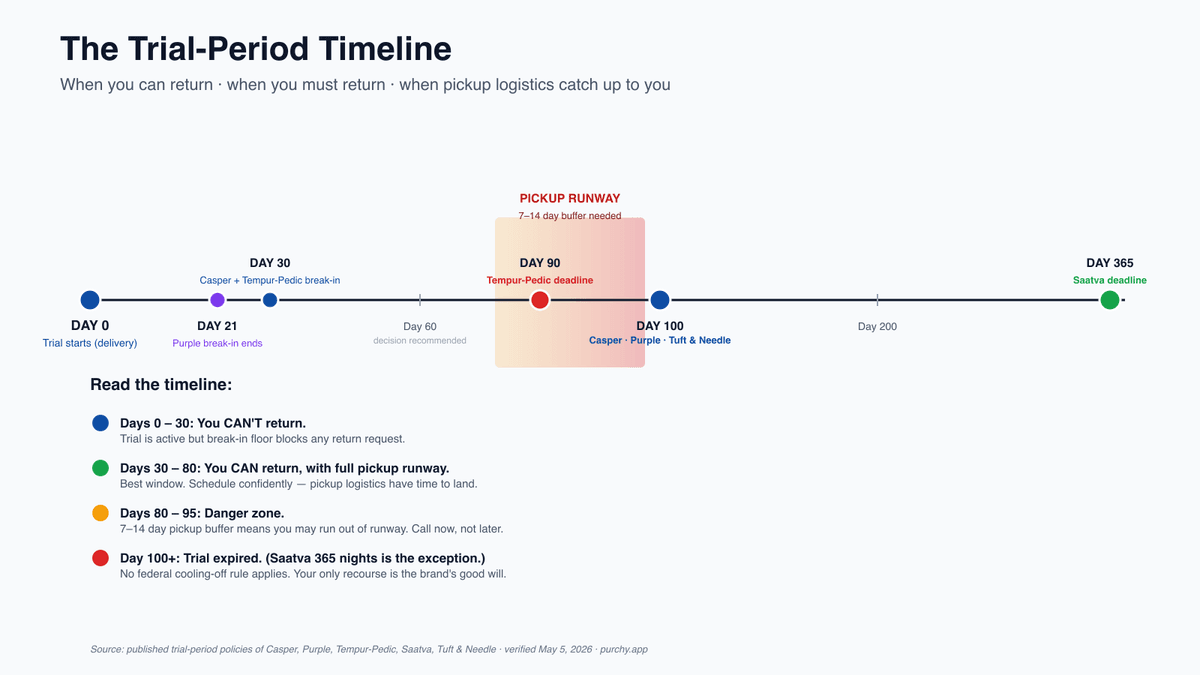
Practical tip: If a Casper or Tempur-Pedic mattress feels wrong on night five, your option isn't "start the return now." It's "sleep on it through night thirty, then call." If the feel hasn't improved by night 30, the trial-period clock has 60-70 nights of usable runway. If you wait until night 80 to call, you have 10-20 nights — and pickup logistics often take 7-14 days.
The Hidden Costs That Eat Your Refund
A $1,995 mattress doesn't always refund $1,995. Here's the line-item math you should expect, by brand category:
1. Transportation / pickup fees
- Free: Casper, Tuft & Needle, Purple's floor (free pickup, but the refund itself can be reduced by transportation charges in the fine print).
- Deducted from refund: Tempur-Pedic ("minus the return shipping fee"), Saatva (pickup fee).
- Variable: Many smaller brands and most resellers (Mattress Firm, Costco mattress orders) charge $99-$249 depending on zip code and product weight.
2. White-glove vs. ship-yourself
For mattress-in-a-box products (Casper, Purple, Tuft & Needle, Nectar, Helix), the brand arranges pickup via UPS Freight, FedEx Freight, or a third-party logistics partner. You don't have to box anything — but you do have to be home for the pickup window, which is typically a 4-hour slot.
For premium spring or hybrid mattresses (Saatva, Tempur-Pedic at retail price points), white-glove pickup is the standard process: two-person team comes to your bedroom, removes the mattress, and hauls it out. The fee covers the labor — but the upside is no driveway curb-side coordination.
3. Mandatory donation requirement
Tuft & Needle is the explicit example, but several smaller brands operate the same way: rather than reverse-logistics the mattress to a warehouse (which is uneconomic at $50-$100 in freight per unit), they require you to donate the mattress to a participating charity and produce a signed donation receipt as proof. The brand then refunds you against that receipt.
This is operationally fine — most cities have mattress-accepting charities like Goodwill, Salvation Army, Habitat for Humanity ReStore, or local homeless shelters. The friction is that donation slots fill up fast and many charities require 1-2 weeks lead time. If you wait until day 95 of a 100-day trial, you may not be able to schedule the donation in time.
4. The "one return per year" rule
Tuft & Needle is the only major brand to publish this in plain language, but the same pattern shows up in fine print at several others — typically buried under "Frequent return abuse" clauses. Translation: if you buy, return, and re-buy from the same brand inside 12 months, the second return may be denied.
5. Restocking fees from third-party resellers
Buying a brand-name mattress through Amazon, Costco, Mattress Firm, or another reseller does not give you the brand's trial period. It gives you the reseller's return policy, which may or may not include any sleep trial — and may include a restocking fee of 5-20%. We covered this pattern more broadly in Restocking Fees 2026: Complete Guide. For mattresses specifically, the rule is simple: buy direct from the brand to get the brand's trial.
Join the Purchy waitlist → and we'll track every return-window deadline — including the 21- and 30-night break-in milestones — automatically from your purchase email.
The FTC Cooling-Off Rule Myth
A common belief is that you have an automatic 3-day right of rescission on any large purchase, including a mattress. You do not.
The FTC's Cooling-Off Rule is narrowly tailored. It applies to sales of $25 or more that occur:
- At your home
- At a workplace or dormitory
- At a temporary location (rented hotel meeting room, fairground, restaurant, convention center, etc.) where the seller does not have a permanent place of business
It explicitly does not apply to:
- Sales made entirely online
- Sales made entirely by phone or mail
- Sales made at the seller's permanent place of business (their store, showroom, etc.)
- Vehicle sales, real estate, insurance, and securities
- Goods you buy for less than $25 at home (or less than $130 at a temporary location)
In plain English: a mattress purchased on casper.com, in a Casper retail store, or at a Mattress Firm gets zero automatic cooling-off period under federal law. Your only refund route is the brand's trial-period policy. Some U.S. states have additional cooling-off statutes for specific high-pressure sales (door-to-door, time-share, gym memberships), but no major state extends a 3-day rescission to in-store mattress purchases.
Bottom line: The trial-period policy is the consumer-protection mechanism for mattresses. There is no federal back-stop. If you blow past Casper's 100-night window, the FTC has nothing for you.
How to Get Your Refund Without Friction (5 Steps)
Once you've decided to return, the process is the same shape across brands. Here's the friction-minimum sequence:
Step 1 — Confirm you're past the break-in floor
Pull up your delivery date. Add the brand's break-in nights (21 for Purple, 30 for Casper / Tempur-Pedic, none published for Saatva or T&N as a hard floor). If you're calling on day 18 of a Purple trial, customer service will tell you to call back on day 21. Don't waste the call.
Step 2 — Confirm you're inside the trial window
Same calculation, against the trial ceiling. Purple uses calendar days from delivery; Casper, Tempur-Pedic, Saatva, and T&N use nights from delivery. Calendar days are stricter — a 100-night trial bought December 15 expires March 25; a 100-day trial bought December 15 expires March 24 (one day earlier in a leap year, none in a regular year, but the wording matters in edge cases).
Step 3 — Call or chat — don't email
For mattress returns, every brand routes you through a phone or live-chat agent (not a self-serve return portal). Going straight to the right channel saves 24-72 hours over the email path. Casper, Purple, Tempur-Pedic, Saatva, and Tuft & Needle each publish a returns-specific phone number — call it directly.
Step 4 — Document everything
- Photos: Take photos of the mattress in its current condition, the original tag, and the delivery box if you still have it. Keep them in case there's a damage dispute.
- Email confirmation: Get every step of the return — RMA number, pickup date, refund amount — confirmed in writing via email after the call. Don't rely on phone notes.
- Donation receipt (if required): For T&N or any brand that asks for one, get the charity's signed receipt with the date, charity name, and condition statement. Photograph it the moment you receive it.
Step 5 — Track the refund timeline
Refunds typically post 5-14 business days after pickup or donation receipt. Set a calendar reminder for day 21. If the refund hasn't posted by then, call — not email — and reference your RMA number and pickup-confirmation date. If the brand stalls past 30 days, you have card-issuer leverage: file a billing-error dispute under the Fair Credit Billing Act (we cover the full process in How to Dispute a Credit Card Charge).
What Happens to Returned Mattresses
A reasonable consumer question: where does the mattress actually go? The answer affects what brands can offer and is part of why fees and donation requirements exist.
Federal law in the U.S. does not allow a returned mattress to be resold as new. Under 16 CFR Part 1633 (the federal mattress flammability standard) and accompanying state-level used-bedding laws (which exist in roughly two-thirds of states), a mattress that has been slept on must either be:
- Sold as "used" or "refurbished" with explicit consumer disclosure — typically through clearance channels or third-party liquidators.
- Donated to a charity that handles bedding.
- Recycled through a mattress-deconstruction program. Cores are stripped for steel, foam, and fiber.
- Disposed of as commercial waste — the most expensive option, which is why brands prefer 1-3.
This is why Tuft & Needle defaults to donation: it's by far the cheapest disposition path that's compliant with state used-bedding laws and avoids the $50-$100 reverse-freight cost. It's also why Saatva and Tempur-Pedic charge transport fees — they actually move the mattress to a regional center for grading and disposal. From the brand's perspective, the donation route is a cost-saver; from the consumer's perspective, it's a small extra step in exchange for the trial-period option.
If Your Return Is Denied
Mattress returns are denied less often than apparel returns (mattresses don't get scored by The Retail Equation) but it does happen. The most common reasons and the dispute path for each:
- "You're past the trial window." Pull your delivery confirmation email and count days. If the brand miscounted (e.g., counted from order date instead of delivery), email customer service with the delivery confirmation attached. This is usually resolved on the second contact.
- "The mattress shows damage / staining." Mattresses with stains, burns, or pet damage are typically excluded. Push back if the staining was a manufacturing defect or pre-existing — your delivery photos are critical here.
- "You used a third-party reseller." Confirmed: the brand's policy doesn't apply. Your remedy is the reseller's return policy, plus any purchase protection on your credit card if applicable.
- "You've already used your one return this year." If this applies to you and the policy was published at purchase time, you have limited recourse. If the policy was buried or post-purchase, an FCBA chargeback on the basis of failure to disclose material terms is possible but not guaranteed.
If informal escalation fails, your remedies stack as: (1) Better Business Bureau complaint, (2) state attorney general consumer-protection complaint, (3) FCBA billing-error dispute through your card issuer (60 days from the statement date the charge appeared on), (4) small-claims court if the amount justifies it (most states' small-claims caps cover $1,500-$3,500 mattresses).
Why Tracking Your Trial Window Matters
The hardest part of a mattress trial isn't the return logistics — it's remembering. A 100-night trial feels infinitely long on day 7. By day 70 you've forgotten the exact delivery date. By day 95 you're scrambling to find the original confirmation email and figure out whether you have 5 days or 10.
This is exactly the failure mode Purchy was built to solve. Every retailer sends a delivery confirmation email. Every email has a delivery date and the brand identifier. From those two facts, the trial period and the break-in floor are derivable for every major mattress brand. Purchy's product:
- Captures the delivery email automatically (no manual entry).
- Tags the purchase as a mattress and looks up the brand's published trial mechanics.
- Sets two reminders: one when you cross the break-in floor (so you know when you can return), and one 14 days before the trial expires (so you have logistics runway).
- If you decide to return, surfaces the refund-friction line items (pickup fee, donation requirement, etc.) so you go in informed.
This isn't unique to mattresses — the same pattern applies to anything with a delivery-tied return window. We cover the full receipt-tracking economy in Best Receipt Tracker Apps 2026, but mattresses are the highest-stakes single-item category in the consumer corpus.
FAQ
Can I return a mattress if I've taken off the law tag?
Yes, in almost every case. The "do not remove" tag is for the seller, not the consumer — once the mattress is yours, you can remove it. Brands won't deny a trial return because the law tag is missing. (They may want photos of the original packaging, but that's a different ask.)
Does the trial period apply to mattresses bought on sale?
In nearly every case, yes — trial-period rules are part of the brand's standard terms and apply across promotional periods. The exceptions are explicit "closeout" or "as-is" inventory, which Tempur-Pedic excludes from the 90-night trial in their policy. Read the product page footer for any mattress at >40% off; closeout language is usually disclosed there.
Can I exchange a mattress for a different model instead of returning?
Most brands allow this and prefer it (lower friction, no refund processing). Casper, Purple, Tempur-Pedic, and Saatva all support exchanges within the trial window. The new mattress typically does not restart the trial clock — you're still bound by the original 90- or 100-night window from the first mattress's delivery date. Saatva's 365-night trial is a notable exception with more flexibility on exchanges.
Do I have to keep the original packaging?
No, but it helps. None of the major brands require the original box for a trial return — the brand arranges pickup and handles disposal. If you have the box, photographing the model number and serial label saves a phone call.
Are mattress returns tracked the way clothing returns are?
The Retail Equation system that scores apparel and small-electronics returns at major retail chains does not extend to mattress D2C returns. Each mattress brand maintains its own internal records (so multiple returns to the same brand will likely be flagged), but cross-brand tracking like TRE's apparel network doesn't exist for mattresses as of 2026.
What if my mattress is delivered damaged?
That's not a trial return — it's a damage claim, which is a different and faster process. Document the damage with photos at delivery (or refuse delivery if it's egregious) and file a damage claim with the brand within 48-72 hours. Damage claims do not consume your trial window.
Are bed frames, foundations, and adjustable bases included in the mattress trial?
Usually no, or under different terms. Casper's furniture line carries a 30-night trial, extended to 100 nights only when bundled with a mattress. Tempur-Pedic adjustable bases are typically excluded from the 90-night trial entirely. Always check the product-specific trial terms before bundling.
How does Costco's mattress return policy compare?
Costco offers an effectively unlimited return window on most merchandise — including mattresses — with a small set of category-specific exceptions. Functionally, a Costco-purchased mattress has a longer practical return runway than any brand's direct trial. The trade-off is that you don't get the brand's white-glove pickup or model exchange — Costco handles the return, but on Costco's logistics. We cover this in Costco's Return Policy.
The 2026 Bottom Line
The mattress industry's "100-night trial" marketing is real but partial. The two numbers that actually determine whether you get your money back are the break-in floor (typically 21-30 nights) and the trial ceiling (90, 100, or 365 nights). The hidden costs — pickup fees, donation requirements, once-per-year limits — are line items inside that window, not after it.
Two highest-leverage actions for a 2026 mattress shopper:
- Buy direct from the brand, not through a reseller. The trial belongs to the brand's relationship with you; reselling channels strip it.
- Calendar the break-in date and the trial deadline the day the mattress arrives. Most missed-trial regret comes from a single forgotten date — and a calendar reminder takes 30 seconds to set.
Purchy automates step 2 from your delivery email — no manual entry, no spreadsheets. If you've ever thought "I'll deal with the return next week" and then noticed your trial expired, you know exactly the problem we're solving.
Join the Purchy waitlist → and never miss a 100-night, 90-day, or 365-night deadline again.
Related Articles
- Restocking Fees 2026: Complete Guide to Avoiding Them
- How to Dispute a Credit Card Charge: 2026 Refund Guide
- Best Credit Cards for Purchase Protection 2026
- Costco Return Policy 2026
- Return Tracking 2026: How Retailers Score You
- Wayfair Return Policy 2026
- Best Receipt Tracker Apps 2026: Honest Comparison
Last updated: May 5, 2026 · Verified against official policy pages from Casper, Purple, Tempur-Pedic, Tuft & Needle, and Saatva, plus the NRF 2025 Retail Returns Landscape report and the FTC's published Cooling-Off Rule guidance. Brand prices and pickup-fee figures cited as of May 2026 and may change; verify with each brand's current published policy before relying on a specific dollar amount.
Wake to one edition. Only what matters.
$12.99 a month or $99.99 a year. Cancel any time from your Apple Account.
Download on iOS →