Burlington Return Policy 2026: 30 Days, ID & Store Credit
Burlington gives shoppers 30 days for a full refund. After that, you'll need a photo ID — and you'll get merchandise credit at the lowest sale price.
The Burlington return policy for 2026 is the strictest of the four big off-price chains — shorter than TJX, tighter on documentation than Ross, and built around a third-party verification system that quietly tracks every return you make. Get the timing right and you walk out with a refund on your original card; miss the 30-day window and the rules change quickly, the refund method changes, and the math changes too.
This guide walks through the Burlington return policy for 2026 the way you'd actually use it: the 30-day clock for a full refund, what happens between days 31 and 60 if you still have the receipt, the photo-ID rule that kicks in for non-receipted returns and anything past 60 days, the third-party verification system that decides whether a return goes through or gets bounced at the register, how Burlington's mostly-in-store business model changes the conversation about mail returns, and why off-price-savvy shoppers should treat Burlington's window very differently from a TJ Maxx or Marshalls window. Every direct policy quote below is verified against Burlington's own published Return Policy page.
The 30-Day Burlington Return Window
The standard Burlington return policy is 30 days from the date of purchase, and the policy page is unambiguous about it: "All items must be returned within 30 days of purchase." That window applies to everything Burlington sells — apparel, shoes, home goods, beauty, baby gear, accessories — and there is no separate department-by-department schedule the way Target and Best Buy have for electronics.
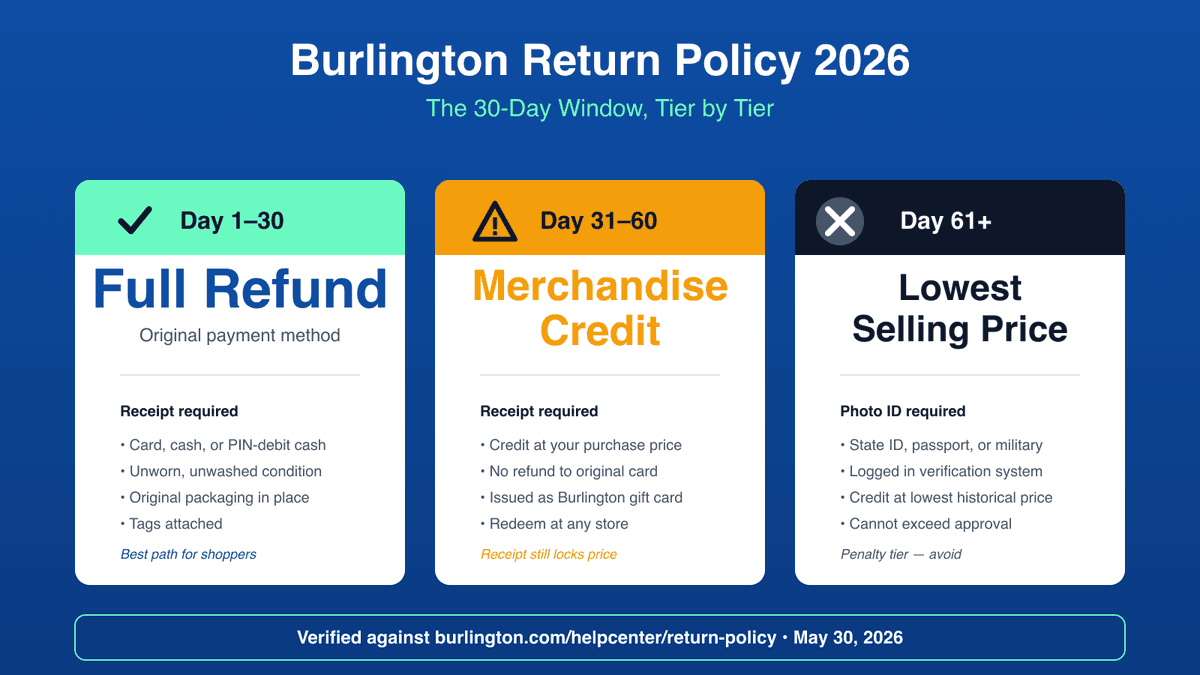
That 30-day window is shorter than every other major off-price chain in the United States. TJ Maxx's effective window is 30 days for the original payment method but extends with merchandise credit beyond that, Ross gives shoppers a similar 30-day clock with its own post-window store-credit path, and Marshalls follows the shared TJX schedule since both belong to the same parent company. Burlington alone treats day 31 as a hard tier change, with a stricter set of documentation rules waiting on the other side.
There are two reasons the window matters so much for Burlington shoppers:
- The refund method changes after day 30. Within 30 days, with a receipt and unwashed merchandise, the refund posts back to the original form of payment — your card, your bank account, or cash for a debit-with-PIN purchase. After day 30, that pathway closes and the refund becomes merchandise credit only, even if you still have the receipt.
- Photo ID becomes mandatory at day 61. Returns after 60 days do not just shift refund method — they require a government-issued photo ID and are paid out at the lowest selling price of the item, not the price you paid. That gap between what you paid and what you get back can be significant on clearance merchandise.
If you're not sure how many days have passed since purchase, the receipt has the date stamped at the bottom. The clock runs from that purchase date, not from when the item was delivered or when you first opened the bag at home.
The "New Condition" Rule, in Practice
Burlington's condition language is one sentence that does a lot of work: "Merchandise must be in new condition, unused and unwashed and in its original packaging."
In practical terms, that means three things:
- Tags should still be attached. Burlington's hangtags and price tags are how the cashier confirms the item is the one on the receipt and confirms the original ticketed price (which matters if you bought it on sale). A snipped or missing tag does not automatically void the return, but it makes the verification path messier and gives the store discretion to refuse.
- The item cannot have been worn or washed. Burlington's wording — "unused and unwashed" — is the same template the off-price industry shares. A shirt run through a single laundry cycle, a pair of pants worn outside the home, or a candle that's been lit all fail the condition test. Trying on at home is fine; wearing in public is the line.
- Original packaging matters more than people expect. Burlington explicitly requires the original packaging — the shoebox for footwear, the original blister pack for accessories, the manufacturer's box for housewares and small appliances. Cracking the seal on a beauty product or losing the box for a kitchen item moves the return into the gray zone where the cashier and the third-party verification system make a judgment call.
Burlington's policy also includes the line: "We reserve the right to limit or refuse any refund." That's not boilerplate. In combination with the verification system (see below), the store has explicit standing to bounce a return that doesn't pass either the condition test or the system check, even if the calendar and receipt look fine.
Burlington vs. Ross, TJ Maxx, Marshalls — the Off-Price Comparison
If you shop the off-price quadrant — Burlington, Ross, TJ Maxx, and Marshalls — you've probably noticed that none of them publishes the kind of generous return policy that anchored retail in the 1990s. They all run on tight windows, all require receipts, and all use third-party verification systems. But the details differ in ways that matter when you're standing at the customer-service counter with an out-of-window receipt.
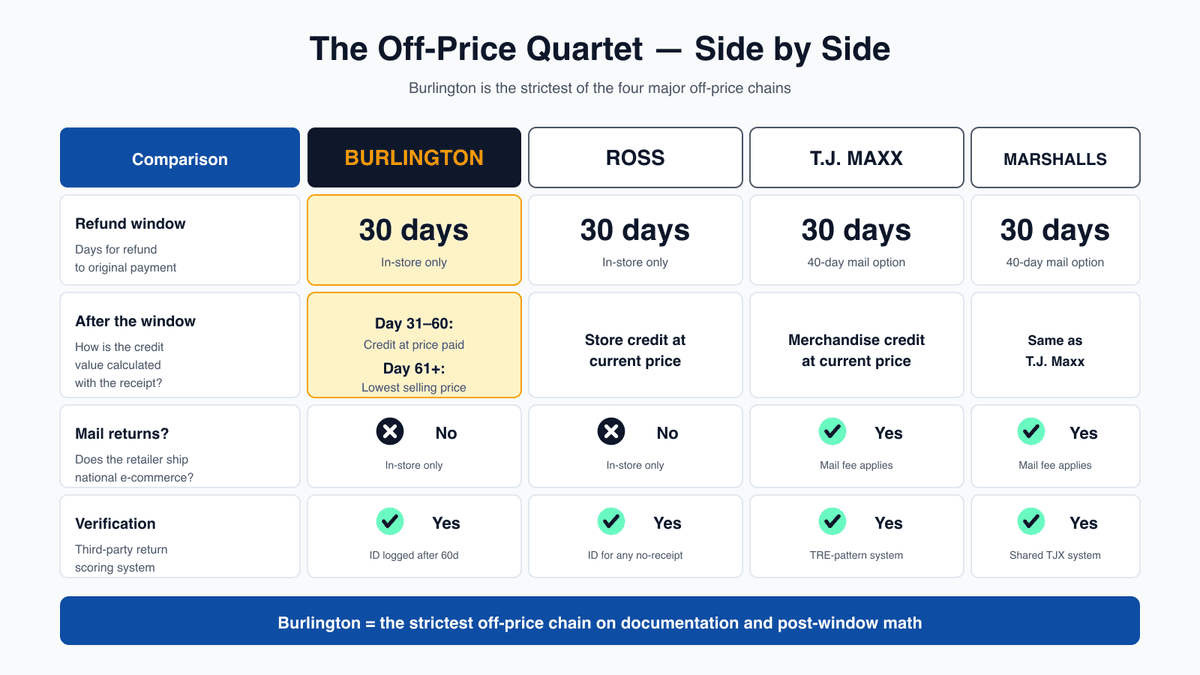
| Retailer | Standard window | Post-window outcome | ID requirement | Mail returns? |
|---|---|---|---|---|
| Burlington | 30 days for refund | Day 31–60: merchandise credit. Day 61+: lowest selling price + ID | Required for non-receipted and 60+ day returns | No — in-store only |
| Ross | 30 days for refund | After 30 days: store credit at current selling price | Required for any non-receipted return | No — in-store only |
| TJ Maxx | 30 days in-store; 40 days for mail | After 30 days: merchandise credit at current price | Required for non-receipted returns | Yes — $11.99 fee on mailed returns |
| Marshalls | Same as TJ Maxx (shared TJX policy) | Same as TJ Maxx | Required for non-receipted returns | Yes — through marshalls.com |
The pattern that emerges: Burlington is the strictest of the four on documentation, the most penal on out-of-window returns, and the only one that doesn't ship online orders at all. Ross is comparable on the window but more forgiving on post-window refund value (current price vs. lowest selling price). TJX is the most flexible because mail returns exist as an option and the mail window stretches a bit longer than the in-store window.
That doesn't make Burlington a bad place to shop — the inventory model genuinely produces deep discounts on name brands — but it does mean the return policy should change how you treat the buying decision. If you're not sure about a size or fit, Burlington is a place to make decisions inside the 30-day window, not let items sit in the closet until December.
For a broader comparison across non-off-price retailers, see our best return policies of 2026 comparison and the full return policy comparison chart.
Refund Methods: Card, Check, PIN Debit, Cash
Inside the 30-day window with a valid receipt, Burlington's policy is straightforward: "Refunds will be issued in the original form of payment." That's the same rule TJX, Ross, and most mainstream retailers use.
But the original-form-of-payment rule has some quirks that catch shoppers by surprise, and Burlington publishes them line by line:
- Credit-card purchases are credited back to the card on file. Refund timing depends on your bank — typically 3 to 7 business days for the refund to post after the return scans through.
- Debit-card purchases with a PIN entered at checkout get refunded as cash at the register. This is unusual — most retailers refund debit purchases back to the debit card. Burlington specifically calls out PIN-debit returns: "Debit cards using PIN will receive cash." That's an advantage if you need the money in your wallet immediately rather than waiting for it to settle in a bank account.
- Debit-card purchases without a PIN (signature-based) follow the credit-card pattern — refunded to the card.
- Check purchases are credited back to the bank account the check was drawn on: "Returns from a check purchase will be credited to the original account." Burlington reserves the right to require a waiting period on check purchases to confirm the check cleared.
- Cash purchases are refunded in cash at the register, full stop.
If your original payment method has been canceled or closed — a card that's been replaced, a closed bank account — the cashier and the system will typically default to merchandise credit issued on a Burlington gift card, since refunding to a card that no longer exists is not actually possible. Bring the new card or be ready to accept the credit.
Returns Without a Receipt: Photo ID Required
Burlington allows non-receipted returns, but the rules tighten significantly. The policy is explicit: "Non-receipted returns, accompanied by a photo ID (driver's license, state issued non-driver ID, passport, or military ID) and returns after 60 days will receive a merchandise credit for the lowest selling price."
Three things to understand about the non-receipted path:
- A photo ID is mandatory. Burlington lists the acceptable forms: a state driver's license, a state-issued non-driver ID, a U.S. passport, or a military ID. Other forms (employer badges, student IDs, debit cards) do not satisfy the requirement.
- The refund is merchandise credit only. No cash back, no refund to your card, even if you can prove you paid by card via a bank statement.
- The credit is calculated at the lowest selling price of the item. That phrase matters. Burlington marks merchandise down repeatedly between the initial floor date and the clearance rack. If the item ever hit a lower price during its retail life, the non-receipted refund is calculated against that lower number — often a fraction of what you actually paid.
The combination — ID required, merchandise credit only, lowest selling price — makes the non-receipted return path the most expensive way to return at Burlington. If you can locate the receipt (paper, in an email, or on the Burlington app), do it before standing in the customer-service line.
The receipt is the single biggest variable in a Burlington return. With it, inside 30 days, the policy is straightforward and friendly. Without it, the return becomes a documented, ID-recorded, merchandise-credit-at-lowest-price transaction that can lose you real money on a clearance purchase.
Returns Between Day 31 and Day 60 (With Receipt)
This is the band where the Burlington policy quietly reroutes you off the original-payment-method path. The policy says: "Receipted returns after 30 days will receive refunds in the form of a merchandise credit."
What that means in practice:
- You can still return the item with the receipt between day 31 and day 60.
- The refund will not go back to your card, your bank account, or your wallet as cash.
- The refund will be issued as a Burlington merchandise credit — a store credit you can redeem at any Burlington location.
- The credit is for the price you paid (not the lowest selling price), because you have the receipt.
That last point is the meaningful upside of keeping the receipt past day 30. If you paid full ticket and the item was later marked down — even by a lot — your receipt locks in your purchase price. Without the receipt, that protection disappears, and the lowest-selling-price math takes over.
The merchandise credit Burlington issues is typically loaded onto a physical gift card at the register. Treat the gift card like cash — there is no way to convert it back to a card refund later, and it's redeemable across all Burlington locations.
Returns After 60 Days: Lowest Selling Price
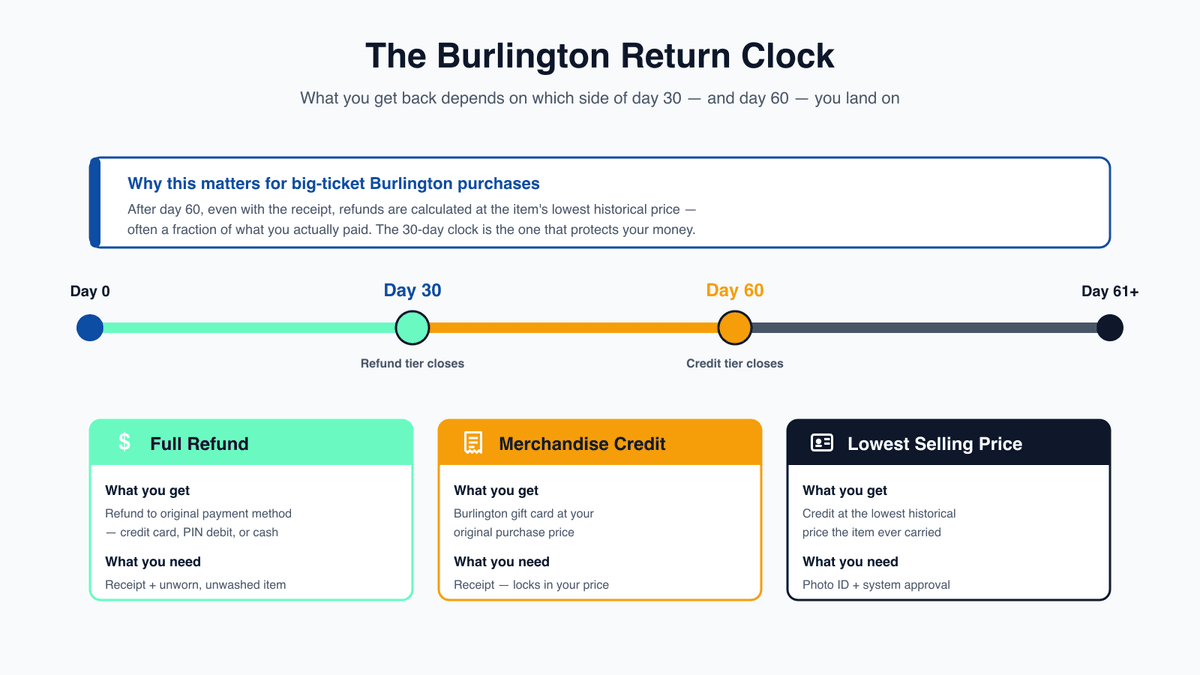
Past 60 days, the policy treats the return the same way it treats a non-receipted return. From the published policy: "Non-receipted returns, accompanied by a photo ID...and returns after 60 days will receive a merchandise credit for the lowest selling price."
So the day-61 return looks like this:
- A photo ID is required, even with the receipt in hand.
- The refund is issued as merchandise credit.
- The credit value is calculated at the lowest selling price the item ever carried — which may be substantially less than what you paid.
In a real example: if you bought a $40 jacket in mid-November and the same SKU was marked down to $18 during Burlington's January clearance, an after-60-day return — even with the receipt — would credit you $18, not $40. The receipt doesn't override the lowest-selling-price rule once the calendar passes the 60-day mark. That's why the 30-day clock is the one that really matters for big-ticket Burlington purchases.
If you've blown past 60 days on a higher-value item, the practical play is often to keep the item, take a clear photo of the receipt, and use it as the baseline for a price-adjustment claim at a different retailer when the same brand surfaces. Burlington itself does not publish a post-purchase price-adjustment policy on its main help center page.
The Third-Party Verification System, Explained
Burlington's policy ends with a paragraph most shoppers skim past: "All returns are subject to a third party verification process and system approval. Your ID information and return transaction history may be collected and entered into our processor's system where permitted by law. We reserve the right to limit or refuse any refund."
That language describes a return-tracking system of the kind used by Best Buy, Macy's, Sephora, Athleta, Home Depot, and many of the largest U.S. retailers. The dominant player in this space is The Retail Equation (TRE), and while Burlington does not publish the vendor name, the policy language matches the TRE template very closely.
How a system like this actually works on the floor:
- When a return is rung up, the cashier scans the receipt or asks for ID.
- The system pulls a return-activity score for that ID or for the receipt's customer record.
- Based on the score — built from frequency, dollar volume, return ratio, and behavior patterns — the system returns one of three signals to the register: approve, warn, or decline.
- If the signal is "decline," the cashier will typically tell you the return cannot be processed at this time and hand you a form letter explaining how to contact the verification vendor directly to request your activity report.
For most Burlington shoppers, the verification system runs invisibly — a normal return scans through the way any other transaction does. The shoppers most likely to encounter declines are those who return frequently at multiple retailers within a short window, especially if many of those returns are non-receipted or near the dollar threshold the system is calibrated against.
Our deep guide to the return-tracking industry, The Retail Equation and how return scoring works, covers the underlying mechanics: which retailers contribute data, how scores are calculated, and how to request your own activity report under the Fair Credit Reporting Act (FCRA). If a Burlington return has ever been declined on you, that guide is the starting point for getting an explanation.
Tired of guessing the return window? Purchy automatically tracks every receipt — from Burlington, Ross, TJ Maxx, and 500+ retailers — and pings you before the 30-day clock runs out. Get Purchy →
Layaway Returns and Service Fees
Burlington still runs a layaway program, which is unusual in 2026 — most national chains discontinued layaway after the rise of buy-now-pay-later. Burlington's program allows shoppers to reserve in-store merchandise with installment payments over a set holding period.
The policy line for layaway returns is specific: "Layaway deposits, payments and returned Layaway merchandise, as well as receipted returns after 30 days, will receive a merchandise credit (less service fees)."
So for a returned layaway, three things happen:
- The deposit and any subsequent payments are aggregated.
- A service fee is deducted from that total. Burlington does not publish the specific dollar amount on the general policy page; it is typically posted at the customer-service counter and on the layaway agreement at the time of the original transaction.
- The remainder is issued as a Burlington merchandise credit, not a refund to the original payment method.
For a comparison with buy-now-pay-later alternatives, our guide to BNPL refunds and the FTC Holder Rule walks through how returns work when you've paid via Klarna, Affirm, or Afterpay — none of which Burlington accepts in-store, though that has been shifting at off-price chains recently.
Burlington Credit Card Returns and 5% Rewards
Burlington partners with a financial services provider to issue a co-branded Burlington Credit Card that earns 5% back in Rewards on Burlington purchases. The reward structure is: 100 points = $5 Reward, with rewards delivered as a merchandise credit on the card account.
When you return a purchase that earned Burlington Rewards points, the points associated with that transaction are typically reversed automatically — the system credits back the refund amount and removes the corresponding points from your account in the same transaction. If a return causes your point balance to go negative, future purchases will rebuild the balance back to zero before earning fresh rewards.
A few credit-card-specific notes:
- A refund to the Burlington Credit Card lands as a credit on your statement, not as a cash refund. If you had already paid off the original purchase, you'll see a credit balance on the card, which you can carry as a future-purchase credit or request as a check back from the card issuer.
- The 5% rewards do not stack with non-Rewards offers in the same return calculation — you don't get to "keep" rewards on the portion of a purchase you returned.
- Burlington's policy reserving the right to refuse refunds applies to credit-card transactions the same way it applies to cash transactions; using the store card does not exempt you from the verification system.
Gift Returns and Gift Card Refunds
Burlington does not publish a separate gift-return tier on its main return-policy page, which leaves the rules to be deduced from the general policy and from store practice:
- A gift returned with the receipt or gift receipt typically goes back as merchandise credit issued on a Burlington gift card, since the original payment method belonged to the gift-giver and refunding the giver directly would defeat the surprise of the gift.
- A gift returned without any receipt falls under the non-receipted rules: photo ID required, merchandise credit at lowest selling price.
- Gift cards themselves are not refundable for cash in most U.S. states. The federal CARD Act (15 U.S.C. § 1693l-1) sets a floor on gift-card consumer protections — most notably that gift cards cannot expire less than five years from the date of purchase — but does not require retailers to refund unspent balances in cash. State law occasionally requires cash refunds below a certain low threshold (California's threshold is $10 under Cal. Civ. Code § 1749.5(b)(2)), but Burlington's standard practice is to maintain the balance on the card indefinitely rather than convert it.
If you received a Burlington gift card you no longer want, the practical paths are to use it as the merchandise credit on a future purchase, sell it through a secondary-market gift-card exchange (typically at a discount of 5–15%), or — in California and a handful of other states — request a cash refund at the customer-service counter if the balance is under the state-specific threshold.
For more on how state laws treat refund and gift-card rules, see our guide to return-policy laws by state.
Does Burlington Ship Online Orders?
The short answer: Burlington is essentially an in-store-only retailer in 2026. Unlike TJX (which runs full e-commerce sites for T.J. Maxx, Marshalls, HomeGoods, and Sierra), Burlington has historically avoided national e-commerce and continues that pattern today. Burlington.com showcases inventory available at the closest store to your zip code, sells gift cards online for digital and physical delivery, and runs the loyalty program through the web, but it does not ship general merchandise from the catalog to home.
That has real consequences for the return policy:
- There are no mail returns to discuss for general merchandise. The return channel is the in-store customer-service counter, period.
- The 30-day window starts the day you walk out of the store with the item. There is no shipping-delay debate, no "what counts as the purchase date" gray zone the way there is on Amazon orders.
- There is no return-shipping fee to deduct from a refund. This is one of the few advantages Burlington has over TJX, where mailed returns typically cost $11.99 by 2026 and have been creeping upward as part of the paid-returns trend across the industry.
If you bought a Burlington gift card online, those are refundable per the gift-card rules above and the federal CARD Act.
Exchanges, Price Adjustments, and Bringing Items to a Different Store
A few tactical pieces of the Burlington return puzzle that aren't called out in the headline policy:
Exchanges. Burlington does not maintain a separate exchange system; an exchange is processed as a return followed by a new purchase. That has two practical implications: the return half of the transaction is governed by the standard 30-day window, and the new-purchase half rings up at the current selling price, not the price you paid for the original. If you bought a coat on sale and want to swap it for the same coat in a different size that is no longer on sale, you'll be paying the difference.
Price adjustments. Burlington does not publish a post-purchase price-adjustment policy. If an item you bought is marked down a few days later, the practical recourse is to return the original within 30 days (with the receipt, for a full refund) and re-buy it at the lower price. That works as long as the item is still in stock — and at Burlington's off-price inventory model, it often isn't.
Bringing items to a different Burlington store. Returns can be processed at any U.S. Burlington location, not only the store of original purchase. The receipt is what ties the transaction to the system; the store of origin doesn't matter. With over 1,000 Burlington locations in the United States, this rarely creates friction for shoppers who move between regions or travel during the return window.
How Long Burlington Refunds Take
For in-store returns at the cashier, the refund is initiated on the spot. The lag between "the return scans through" and "the money appears in your account" depends on the payment method:
- Cash and PIN-debit refunds are handed back at the register, same minute.
- Credit-card refunds typically appear on the card within 3 to 7 business days, though the exact timing is set by the issuing bank and not by Burlington. Some banks post refunds nearly instantly; others wait until the next billing cycle.
- Signature-debit refunds follow the credit-card pattern — 3 to 7 business days.
- Check-purchase refunds are credited back to the bank account the check was drawn on; processing can take longer to clear because Burlington verifies the original check first.
- Burlington Credit Card refunds show up on the next billing cycle as a credit on your statement.
For a deeper look at refund-timing rules across payment methods and retailers, our guide to how long a refund actually takes in 2026 covers card-network rules, Reg E timing, and the gap between "merchant refund" and "bank-posted refund."
7 Ways to Never Lose a Burlington Return
- Photograph the receipt the moment you walk out of the store. Burlington's receipt thermal paper fades, and a missing receipt drops you into the non-receipted refund tier — merchandise credit at lowest selling price. A phone-camera photo (or a digital tracker like Purchy) makes this a non-issue.
- Set a 25-day alarm, not a 30-day one. Give yourself a five-day cushion before the window closes. The line at customer service on a Saturday afternoon can eat 30 minutes, and bumping up against the deadline is how returns get pushed into the merchandise-credit tier.
- Leave the tags attached until you're sure. Burlington's "new condition" rule is enforced by tags. Trying clothing on at home is fine; clipping the tag converts the item to "used" in the cashier's eyes.
- Keep the original packaging for the first 30 days. Shoeboxes, beauty product seals, blister packs — they all count. If you're keeping the item past 30 days, you can recycle the box, but inside the window, hang on to it.
- Carry photo ID for any non-receipted return. Skipping this turns a 10-minute transaction into a wasted trip. Burlington requires state ID, passport, or military ID — not a debit card, employer badge, or student ID.
- Batch returns into a single transaction. Each return triggers a verification-system check. Multiple separate trips back to the customer-service counter on different days look noisier to the system than one trip with three items.
- Use the Burlington Credit Card for big purchases inside a 30-day window. The 5% rewards apply even on items you might return, and if you do return inside the window, the points reverse cleanly. Outside the window, the rewards already earned typically stay attached to non-returned items.
Frequently Asked Questions
How many days do I have to return to Burlington?
The Burlington return policy gives shoppers 30 days from the date of purchase for a refund in the original form of payment. Receipted returns between day 31 and day 60 are paid out as merchandise credit at the price you paid. Returns after 60 days require a photo ID and are paid at the lowest selling price.
Can I return to Burlington without a receipt?
Yes. Burlington allows non-receipted returns, but they require a government-issued photo ID — a state driver's license, a state-issued non-driver ID, a U.S. passport, or a military ID — and the refund is issued as merchandise credit at the lowest selling price of the item.
Does Burlington accept mail or online returns?
Burlington is an in-store-only retailer for general merchandise in 2026 and does not ship items from a national e-commerce catalog. Returns are handled at the customer-service counter of any U.S. Burlington store, which means there is no return-shipping fee — but there is also no mail-in option.
Why does Burlington ask for ID on returns?
Burlington uses a third-party verification system — the same kind used by Best Buy, Macy's, and most large U.S. retailers — to score return transactions and identify potential abuse patterns. The ID is recorded by that system. The policy is explicit: "Your ID information and return transaction history may be collected and entered into our processor's system."
How long does a Burlington credit-card refund take?
Burlington initiates the refund at the register the moment the return scans through. The credit appears on your card statement typically within 3 to 7 business days, depending on the issuing bank. Some banks post refunds nearly instantly; others wait until the next billing cycle.
Can I get a cash refund on a Burlington gift card?
Generally no. Federal law does not require gift-card cash refunds, and Burlington's standard practice is to maintain the balance on the card indefinitely. A handful of states — most notably California, under Cal. Civ. Code § 1749.5(b)(2) — require cash refunds on gift-card balances below a low threshold. Check your state's rules at the customer-service counter.
Can I return to a different Burlington store?
Yes. Returns can be processed at any of Burlington's 1,000+ U.S. locations regardless of which store you originally purchased from. The receipt ties the transaction to the system; the store of origin doesn't matter for the verification or the refund.
Does Burlington do exchanges?
Burlington does not run a dedicated exchange program. An exchange is processed as a return of the original item followed by a new purchase. The new item rings up at the current selling price, so a sale-priced original swapped for a regular-priced replacement requires paying the difference.
Does Burlington have final-sale items?
Burlington's published return policy does not call out specific final-sale categories the way department stores do for cosmetics or fragrances. In practice, items marked as clearance with explicit "final sale" tickets at the floor or at the register may be excluded, and the store's general right-to-refuse clause applies. When in doubt, ask before purchasing.
The Burlington return policy in 2026 rewards shoppers who stay inside the 30-day window with a receipt and penalizes everyone else — through merchandise credit, lowest-selling-price math, and ID-recorded verification. The single most valuable habit you can build is automatic receipt capture and a return-deadline reminder that fires well inside 30 days, not at the deadline.
That's exactly what Purchy is designed for. Snap or forward a receipt and Purchy locks in the purchase date, surfaces the Burlington 30-day deadline (plus the schedules for every other store you shop), and pings you days before the window closes. Get Purchy — it's live on iPhone and Android.
Verification note. Every policy quote in this guide is verbatim from the Burlington Return Policy page at burlington.com/helpcenter/return-policy, captured on May 30, 2026. Off-price competitor figures referenced in the comparison table are sourced from prior corpus posts on TJ Maxx, Marshalls, and Ross; confirm the current policy directly at each retailer for high-value purchases. The third-party verification system described in Burlington's policy is consistent with The Retail Equation's industry pattern, though Burlington does not publish the vendor name.
Wake to one edition. Only what matters.
$12.99 a month or $99.99 a year. Cancel any time from the App Store or Google Play.