eBay Return Policy 2026: 30 Days, Money Back Guarantee
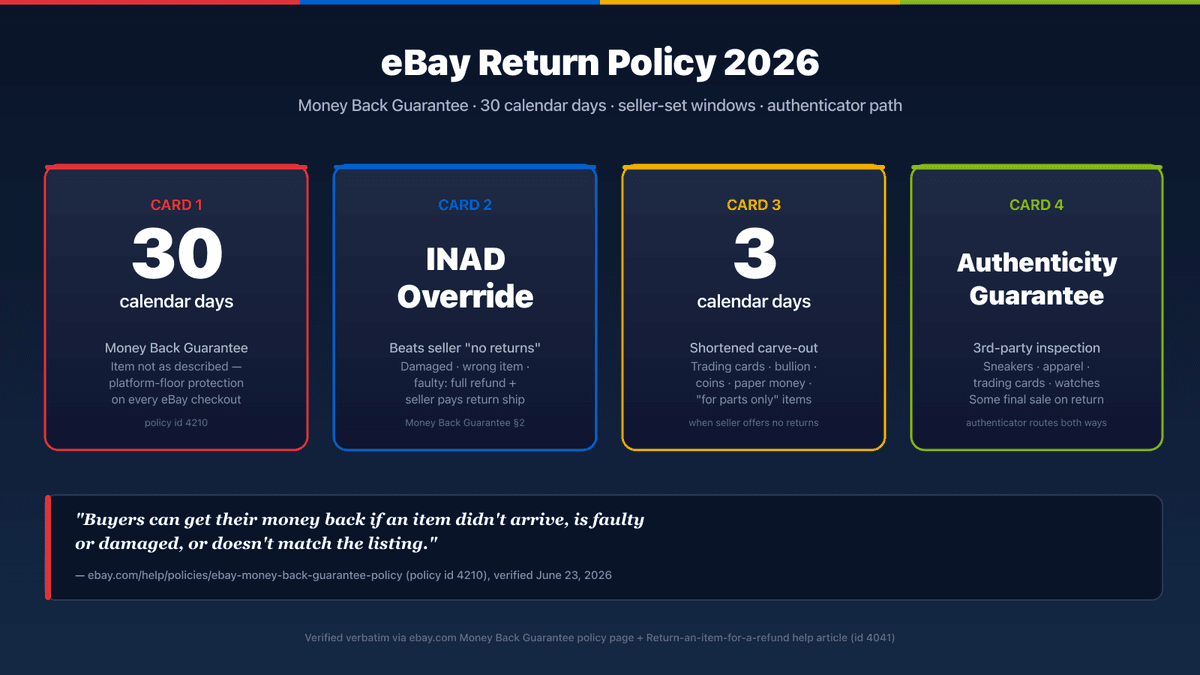
eBay's Money Back Guarantee gives buyers 30 calendar days to return any item that doesn't match the listing — even on seller 'no returns' listings.
Most published guides to the eBay return policy stop at "30 days, Money Back Guarantee" and move on. The full text on ebay.com — across the Money Back Guarantee policy page and the consumer-facing Return an item for a refund help article — runs more than ten thousand words, and a careful read shows that eBay's return system is genuinely unlike anything else in our corpus. It is not one return window. It is a Money Back Guarantee that floats above whatever return policy the seller set in the listing, with mandatory override rules when an item doesn't match the listing, shortened windows for trading cards and bullion, a third-party authentication path for sneakers and watches, a payment-method gotcha that strips coverage from bank transfers and cash, and a chargeback clause that quietly closes a buyer's case the moment they call their credit-card issuer.
This guide walks through the eBay return policy for 2026 clause by verbatim clause — the 30-calendar-day Money Back Guarantee window, the "not as described" override that beats any "no returns" listing, the 3-calendar-day carve-out for trading cards and coins, the seller's 3-business-day response deadline, the 2-business-day refund deadline, the eBay step-in arbitration path, the chargeback rule that closes the MBG case, the Authenticity Guarantee inspection flow for sneakers and watches, the excluded item list (real estate, services, NFTs, industrial equipment), the eligible payment-method list (PayPal, Apple Pay, Venmo, Klarna — but not bank transfers), the international purchase rule when shipping crosses sites, the 30-calendar-day appeals window, and how eBay compares to Amazon, Etsy, Temu, and TikTok Shop. Every fact below is verified against ebay.com on June 23, 2026, with the policy ID (4210) and help-article ID (4041) cited inline.
The 2026 eBay return policy at a glance
For a 2026 eBay purchase, here is the short version every buyer should know before they click Buy It Now:
- Money Back Guarantee window: 30 calendar days from the estimated or actual delivery date, or within the seller's stated returns window, whichever is longer — verbatim from the policy text, for items that don't match the listing.
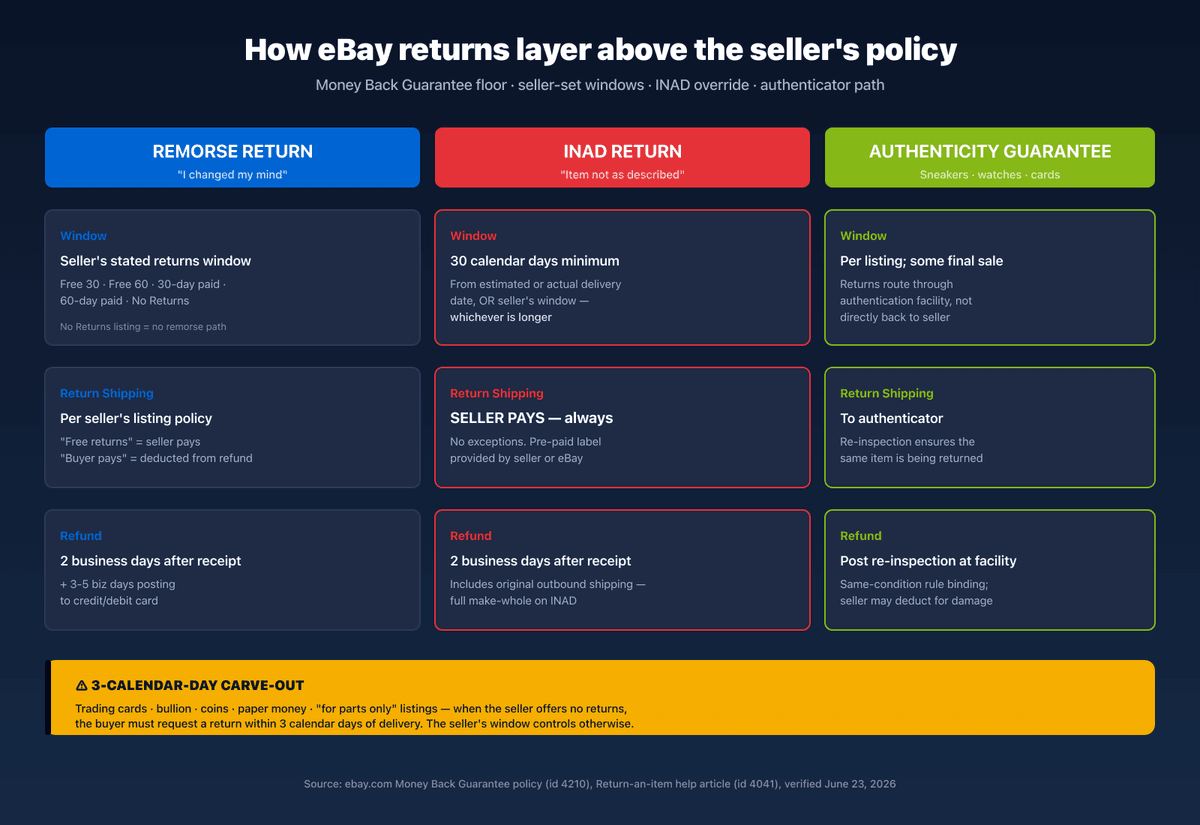
- Seller's return window: Separate clock. Sellers choose Free 30-day, Free 60-day, 30-day buyer-pays, 60-day buyer-pays, or No Returns. The seller's window controls remorse (change-of-mind) returns.
- The override: If the item doesn't match the listing, arrives broken, damaged, or faulty, the buyer is entitled to return it for a refund even if the seller doesn't offer returns — verbatim. Money Back Guarantee outranks the seller's "no returns" setting.
- Shortened window: 3 calendar days to request a return on trading cards, bullion, coins, paper money, and items sold as "not working or for parts only" when the seller doesn't offer returns.
- Authenticity Guarantee: Items with the badge ship to an eBay-contracted authenticator first, then to the buyer. Returns ship back to the authentication facility, not the seller. Some Authenticity Guarantee categories are final sale.
- Return shipping: Seller pays when the item doesn't match the listing. Per the seller's listed policy for remorse returns — either "free returns" or "buyer pays."
- Refund time: Seller must refund within 2 business days of receiving the return. Money lands in the buyer's payment method 3 to 5 business days later, per eBay's published flow.
- Seller response deadline: 3 business days to respond to the return request. If the seller goes silent, the buyer can ask eBay to step in.
- Excluded items: Real estate, websites, businesses for sale, digital content, NFTs, classified ads, services, travel tickets, industrial equipment, and motor vehicles (covered separately under eBay Motors).
- Payment method gotcha: Any payment completed outside eBay checkout — bank transfer, cash, money orders, escrow services — is not covered by the Money Back Guarantee at all.
- Chargeback rule: Filing a chargeback with your card issuer for the same transaction closes your Money Back Guarantee case automatically.
The TL;DR: eBay runs the most layered return system in U.S. e-commerce — a platform-wide guarantee that overrides individual seller policies for damaged or misrepresented items, layered on top of seller-set windows for change-of-mind returns, with a third-party authentication path for high-risk categories and a payment-method gate that strips coverage from anything paid for outside eBay's checkout. Most aggregator articles quote "30 days, Money Back Guarantee" as the headline and miss the override, the 3-day carve-out, the authenticator flow, the chargeback trap, and the excluded-items list. The full policy is more nuanced than that — and the nuance is what protects (or fails to protect) a buyer in a dispute.
How the Money Back Guarantee works
The Money Back Guarantee (MBG) is the foundation of the entire eBay return system. The policy's opening line, verbatim:
"eBay Money Back Guarantee covers most transactions on eBay. It means buyers can get their money back if an item didn't arrive, is faulty or damaged, or doesn't match the listing."
Three categories of buyer-protected events sit under the guarantee:
1. The buyer doesn't receive an item. Tracking shows no delivery, no collection, or the item never arrived. The buyer reports the issue. eBay looks for evidence of successful delivery. If the seller cannot produce it, the buyer gets a full refund including original shipping.
2. The item doesn't match the listing — "INAD" (Item Not As Described). The wrong item arrived, the item is broken or damaged or faulty (and the listing didn't disclose that), or the listing description was materially inaccurate. The buyer can return the item for a refund.
3. The seller doesn't fulfill their return policy as stated in the listing. If the seller's listing promised free 30-day returns and the seller refuses to accept a timely in-window return, eBay steps in.
The policy adds the eligibility framing, verbatim:
"As a buyer, for your transaction to be eligible for eBay Money Back Guarantee: You must complete and pay for your purchase on eBay.com using an eligible payment method at checkout; You must meet the requirements specified in this policy, including taking action within the required time frames; The item may not be an excluded item or subject to any additional exclusions; and You may not seek resolution for the same issue by another resolution method."
That last phrase — "may not seek resolution for the same issue by another resolution method" — is the chargeback trap baked into the eligibility test. Once a buyer files a chargeback with their card issuer or files a PayPal Buyer Protection claim, the eBay case is closed because the same dispute is already being pursued in another forum. See the chargeback section below for the verbatim clause and the practical workaround.
What the MBG is not. The Money Back Guarantee is not a buyer's-remorse policy. A buyer who simply changes their mind ("the color isn't quite right," "I found one cheaper elsewhere," "I didn't realize how big it would be") is not protected by the MBG — they are protected only by whatever return policy the individual seller chose in the listing. If the seller chose "No Returns" for that listing, the change-of-mind buyer has no platform-level remedy. The MBG is reserved for items that genuinely don't match what was sold, or that didn't arrive at all.
What the MBG covers in dollar terms. Unlike a credit card's $50 fraud-liability cap or PayPal Buyer Protection's certain limits, the MBG covers the full purchase price plus original shipping for INAD and non-delivery cases — eBay doesn't publish a per-transaction dollar cap. The cap that does exist is procedural: missing the deadlines (3-business-day response on certain windows, 30-calendar-day filing on most) ends coverage.
The 30-calendar-day clock, verbatim
The most important window in the entire system is the one for "not as described" returns. The policy text, verbatim:
"The buyer requests a return — Start a return request — Latest: 30 calendar days after the estimated or actual delivery date or within the seller's stated returns window, whichever is longer. Certain items have a more limited return window. See Exclusions and special coverage."
Four phrases to read carefully:
1. "30 calendar days." Not 30 business days. Weekends and federal holidays count against the buyer. A package delivered on a Friday gives you exactly 30 calendar days that include the next four weekends and any holidays in between. If the calendar runs out on a Sunday, the deadline is that Sunday — not the following Monday.
2. "Estimated or actual delivery date." eBay uses whichever applies in your case. For shipped items, the "actual delivery date" is what shows in the carrier tracking record. For items still in transit on the date the buyer reports, the "estimated delivery date" from the order details is the reference. The buyer-favorable read: if the carrier delivered on a date later than eBay's estimate, the later (actual) date controls and the clock starts then.
3. "Within the seller's stated returns window, whichever is longer." This is the consumer-favorable layering. If the seller advertised "Free 60-Day Returns" in the listing, the buyer has 60 days for a not-as-described claim — not 30. If the seller advertised 14 days, the buyer still has the platform-minimum 30 because "whichever is longer" controls. The seller cannot contract around the 30-calendar-day floor.
4. "Certain items have a more limited return window." This is the pointer to the 3-calendar-day carve-out for trading cards, bullion, coins, paper money, and parts-only listings — see the carve-out section for the verbatim exclusions text.
The Item-Not-Received clock. A different 30-calendar-day clock applies when a package never arrives. The policy text, verbatim:
"The buyer reports that the item hasn't arrived or was not available for collection — Earliest: Once the estimated or actual delivery/collection date has passed — Latest: 30 calendar days after the estimated or actual delivery/collection date has passed."
For the non-delivery case, the clock starts the day the estimated delivery date passes (or actual delivery date if tracking shows non-receipt), and runs for 30 calendar days. Reporting earlier is impossible — eBay won't accept a not-received claim before the seller's estimated window expires. Reporting later than 30 days after the deadline is too late.
What the 30-day window means in practice. A package delivered on Day 1 of a month, with INAD reported on Day 31, is in window if Day 31 is a Wednesday — but missing if Day 31 is a Sunday and the buyer waited until Monday. The clock does not pause for weekends. The clock does not pause for vacations. The clock does not pause for "I was traveling and didn't open the box until I got home." The only stop is filing the return request.
No business-day caveat. The policy says "30 calendar days" — emphatically not "30 business days." This is unusual relative to peer marketplaces. Amazon's standard 30-day window is similarly calendar-day-based for most categories; Etsy's return policy ties to seller policy plus eBay-style platform protection. The 30-calendar-day floor is the eBay-platform-level guarantee and it cannot be shortened by the seller.
Seller-set return policies and the four common windows
Every eBay listing has a return-policy field the seller sets at listing time. The choice is largely binary — accept returns or don't — with sub-options on window length and who pays for return shipping. The four most common settings buyers will see in listings:
1. Free 30-Day Returns. Seller accepts returns within 30 days of delivery for any reason (including remorse), and pays for the return shipping label. This is the most consumer-favorable seller policy and is what large managed-store sellers typically offer. Refund is full purchase price plus original shipping.
2. Free 60-Day Returns. Same as above but doubled window. Many established sellers in apparel, collectibles, and electronics use 60-day to differentiate. The policy's "whichever is longer" rule means MBG protection extends to the full 60 days when this is the listed setting.
3. 30-Day Returns, Buyer Pays Return Shipping. Seller accepts returns within 30 days for any reason but the buyer pays the return label. This is the most common setting from smaller and casual sellers. The buyer fronts the postage; eBay deducts it from the refund. Refund equals purchase price minus return shipping cost (the original outbound shipping is still refunded by the seller — typically).
4. No Returns. Seller does not accept change-of-mind returns. The verbatim policy text for this case:
"If the seller states in their return policy that they don't accept returns, you can ask them to see if they'll make an exception. If the item doesn't match the listing description, or if it is faulty or arrived damaged, you may be eligible for eBay Money Back Guarantee. This means that you can return it even if the seller's returns policy says they don't accept returns."
This is the INAD override — covered in detail in the next section.
Custom variations. Some sellers configure non-standard windows (14 days, 45 days, 90 days), restocking fees up to 20% on certain categories, or "exchange only" settings. The MBG 30-calendar-day floor still applies for INAD cases regardless of what the seller configured.
How to read the seller's policy before buying. Every listing's right rail (or "Shipping and payments" tab on the mobile app) shows the seller's chosen return policy with the exact phrasing eBay uses. Verbatim from the help article:
"Check the listing in your Purchases to see the seller's full return policy, including how long you have to request a return and any other conditions."
The seller's policy is binding for remorse returns. It can be overridden for INAD returns but only via the MBG path, which requires filing a return request through eBay (not directly contacting the seller off-platform).
The "not as described" override on no-returns listings
The single most misunderstood clause in the entire eBay system is what happens when a buyer needs to return an item from a "No Returns" listing because the item is damaged, wrong, or doesn't match the description. Aggregator articles and casual buyers commonly assume "No Returns means no returns, period." The published policy says otherwise. Verbatim:
"If the buyer receives the wrong item, or the item arrives broken, damaged, or faulty (and was not clearly described as such), they are entitled to return it for a refund, even if the seller doesn't offer returns."
And from the consumer-facing help article, verbatim:
"If the seller states in their return policy that they don't accept returns, you can ask them to see if they'll make an exception. If the item doesn't match the listing description, or if it is faulty or arrived damaged, you may be eligible for eBay Money Back Guarantee. This means that you can return it even if the seller's returns policy says they don't accept returns."
The override mechanism in plain English:
- Remorse return on a No-Returns listing: Seller can decline. Buyer has no platform remedy. The MBG does not cover change-of-mind.
- INAD return on a No-Returns listing: Seller cannot decline. The MBG override applies. The buyer is entitled to a full refund including return shipping paid by the seller.
- Damaged-in-transit on a No-Returns listing: Same as INAD. Covered. Seller pays return shipping.
Who pays return shipping in the override case. The policy is explicit, verbatim:
"If an item is being returned, the seller is responsible for return shipping."
That clause appears in the not-as-described section and applies to every INAD case, including overrides on No-Returns listings. The seller cannot deduct the return shipping cost from the buyer's refund in an INAD case.
The "what if the seller refuses?" path. Sellers sometimes attempt to enforce their No-Returns setting on an INAD case. The policy's response, verbatim from the help article:
"How they can respond depends on the reason for your return: ... Decline your return request – Sellers can decline your return request if you changed your mind about an item and they stated in the listing that they don't accept returns, or if you missed the seller's deadline to start a return."
Notice what's missing from the "can decline" list: the seller cannot decline an INAD return on a No-Returns listing. The eBay system enforces this. If the seller responds with a decline on an INAD case, the buyer's next step is to ask eBay to step in — see the step-in section.
The condition-on-return rule. The override is not unconditional. Verbatim from the help article:
"If you return the item used, damaged, missing parts, or if it gets damaged during return shipping, the seller may deduct an amount from your refund to cover the loss in the item's value."
Buyers exercising the INAD override are still bound by the "return the item in the same condition" rule. Photographs of the item as received (with packaging intact) are the typical buyer-protection move before sending the item back.
The 3-calendar-day carve-out: trading cards, coins, parts
Hidden inside the MBG exclusions section is one of the most consequential — and most-missed — clauses in the entire policy. Verbatim:
"Trading cards, bullion, coins, paper money, and items that are sold as not working or for parts only — Covered: If the seller doesn't offer returns, the buyer must request a return no later than 3 calendar days after the estimated or actual delivery date. If the seller offers returns, the buyer must request a return within the seller's stated return window."
Four categories are affected by the shortened window:
1. Trading cards. Magic: The Gathering, Pokémon, Yu-Gi-Oh, sports cards, vintage cards — the entire trading-card ecosystem. With a 3-day clock, the buyer must inspect immediately on receipt and file the claim within the long weekend. Sealed cards, graded cards, and ungraded cards are all subject to the carve-out.
2. Bullion. Gold, silver, platinum, palladium in coin or bar form. Investment-grade precious metals. Sold by both individual sellers and dedicated bullion dealers on eBay.
3. Coins and paper money. Numismatic items, raw coins, certified coins, banknotes, world paper money, U.S. paper money. The "coins" category is enormous on eBay and the 3-day clock applies across all of it when the seller offers no returns.
4. "Sold as not working or for parts only." Listings clearly described as broken, parts-only, or for-repair. The shortened window prevents a buyer from changing their mind 25 days into a deliberately as-is purchase.
The override note. The 3-day window applies only when the seller offers no returns. If the seller chose a return policy in the listing (Free 30, Free 60, paid 30, paid 60), the seller's window controls — not the 3-day cap. The 3-day cap is the platform's protection floor for these categories when the seller explicitly chose "No Returns."
Why the carve-out exists. Each of these categories shares a feature that makes after-the-fact authentication difficult: trading cards can be counterfeited at home and swapped with the same-looking card; bullion can be silver-plated tungsten or hollow; coins can be cleaned, repaired, or re-toned to inflate grade; and parts-only items by definition can't be tested by their advertised function. The 3-day window forces the buyer to inspect on arrival or accept the risk — a structural protection for sellers in high-counterfeit categories.
What 3 calendar days looks like in practice. A trading-card pack delivered on a Friday gives the buyer Friday, Saturday, Sunday. The deadline is Sunday 11:59 PM eBay-system-time (Pacific). A bullion bar delivered Wednesday gives Wednesday, Thursday, Friday — Friday end of day. There is no business-day adjustment. There is no holiday adjustment.
The buyer's defense in these categories. Two practical moves dominate the experienced-buyer playbook:
- Open and photograph on receipt. Take a video unboxing for high-dollar trading cards and bullion. The video timestamp is a buyer's strongest evidence in an INAD dispute.
- Use Authenticity Guarantee listings when available. Many sneaker, watch, handbag, and trading-card listings now ship through eBay's third-party authentication service — see the next section. The authenticator inspects before delivery, so the buyer's 3-day clock starts with confirmed-authentic merchandise.
This carve-out is virtually invisible in third-party "eBay return policy" summaries online. Print or screenshot the clause when buying trading cards or bullion from a No-Returns seller; it is the buyer's only timeline-of-record if a dispute arises.
eBay Authenticity Guarantee and the authenticator path
The eBay Authenticity Guarantee is a third-party physical-inspection service that sits between the seller and the buyer for high-value, high-counterfeit-risk categories. The policy text, verbatim:
"Items that display the Authenticity Guarantee badge in the listing are first shipped to an authenticator who inspects the item prior to delivery to the buyer. This inspection ensures that the item purchased matches the listing description and verifies the item's authenticity. Authenticity Guarantee purchases are covered by eBay Money Back Guarantee as detailed in this policy, with specific requirements and/or exclusions detailed below."
How the flow works in practice:
1. Listing badge. Eligible items show the green Authenticity Guarantee badge above the Buy It Now button. The buyer sees the badge before purchase; the protection is built into the listing, not a separate buyer election.
2. Seller ships to authenticator. When the listing sells, eBay routes the seller a shipping label to a third-party authentication facility (not the buyer's address). The seller ships the item there.
3. Authenticator inspects. Trained inspectors at the facility examine the item against the listing description and known authenticity markers — for sneakers, that includes box, packaging, tags, materials, stitching, sole construction, and color match. For watches, movement, case, dial, bezel, bracelet, paperwork, and serial numbers.
4. Pass: ship to buyer. Authentic items are repackaged with an Authenticity Guarantee verification card and forwarded to the buyer. Total transit time typically adds 1–3 business days versus a direct seller-to-buyer shipment.
5. Fail: refund the buyer, return to seller. Counterfeit or materially-non-matching items are refunded to the buyer immediately and returned to the seller at the seller's risk.
The category list. From the MBG policy text, four categories are explicitly named with their own "Final sale definitions by product category" section:
"Sneakers — Apparel — Trading cards — Watches"
For each category, the policy adds:
"The seller doesn't offer returns or the return window stated in the listing has passed"
In practice, the public-facing Authenticity Guarantee program covers sneakers above a dollar threshold, watches above a higher threshold, certain handbags, certain trading cards, certain jewelry, and certain apparel — eBay updates the exact qualifying thresholds and category boundaries periodically and the specific dollar floors are not in the static MBG policy text. The above hedge applies: confirm the badge appears on the specific listing before assuming Authenticity Guarantee coverage applies.
The return path is different. The policy is explicit about how returns work post-authentication:
"If an authenticated item is eligible to be returned, the buyer will be asked to ship the item back to the authentication facility for inspection to ensure that the item is being returned in the same condition."
The buyer ships the return to the authentication facility, not to the seller. The facility re-inspects to confirm the same item is coming back, that it hasn't been swapped, and that condition matches the as-delivered state. Once verified, the refund flows to the buyer and the item is returned to the seller (or, for confirmed authentic items being returned in change-of-mind cases, sometimes directly to the next buyer in inventory).
The final-sale carve-out. Critical clause, verbatim:
"Some purchases inspected under Authenticity Guarantee are considered final sale. eBay Money Back Guarantee does not cover final sale purchases on the basis that the item doesn't match the listing."
This is the gotcha. The policy then names the two exceptions to final-sale-no-protection, verbatim:
"Returns for final sale purchases are only eligible for coverage under eBay Money Back Guarantee when: The item was damaged during shipping, or The seller doesn't honor their stated returns policy."
In other words: an Authenticity Guarantee item flagged as final sale cannot be returned for changing one's mind and cannot be returned for "the listing wasn't accurate" unless the item was damaged in transit or the seller refuses to honor what they listed. This narrows the protection in the final-sale subset substantially.
Practical reading for the buyer. Authenticity Guarantee is a meaningful protection upgrade vs a non-authenticated listing — third-party inspection genuinely reduces counterfeit risk on sneakers and watches. But the final-sale carve-out on certain Authenticity Guarantee categories means the protection narrows once the item passes inspection. Read the specific listing's return policy in addition to the Authenticity Guarantee badge, and assume "final sale" is the default until verified otherwise.
Final sale: categories and exceptions
The MBG policy has a dedicated final-sale section that ties together the Authenticity Guarantee carve-out and a few other category-level exclusions. The framing, verbatim:
"eBay Money Back Guarantee does not cover final sale purchases on the basis that the item doesn't match the listing. Returns for final sale purchases are only eligible for coverage under eBay Money Back Guarantee when: The item was damaged during shipping, or The seller doesn't honor their stated returns policy."
Two exceptions are recognized — shipping damage and seller bad faith. Everything else, including the buyer's own dissatisfaction with how the item turned out, is buyer's risk on a final-sale listing.
Where "final sale" tags appear.
- Authenticity Guarantee listings in certain categories (see above) — when the seller selects no returns or when the listing's return window has expired.
- Listings the seller explicitly marked as final sale — eBay's listing tool allows sellers to mark certain offers as final sale, surfacing the tag on the listing page and at checkout.
- Auction-format listings with no-return seller policy — verbatim from the policy, auction wins with seller's "no returns" stance carry the same final-sale treatment as a Buy It Now no-returns listing.
- Items where the listing explicitly disclosed condition issues — "for parts only," "broken," "not working" listings are treated as as-is sales and the buyer cannot return for the disclosed condition issue.
The shipping-damage carve-out is real but evidence-heavy. Establishing "damaged during shipping" on a final-sale item requires photographs of the package on arrival, photographs of the item showing damage, and ideally a carrier damage report. The seller will challenge it; the burden of evidence falls on the buyer. Open final-sale shipments while a phone camera records.
The "seller doesn't honor stated returns policy" carve-out. This is the catch-all that prevents sellers from gaming the system by promising returns and refusing to honor them. If the listing said "30-day returns" and the seller refuses to accept a Day-15 return, the buyer is protected under the MBG even on what was tagged as a final-sale category — because the seller's misrepresentation of their own policy triggers MBG coverage.
Eligible payment methods, verbatim
The MBG only applies to eBay purchases paid for through eBay's checkout system using an eligible payment method. The policy enumerates the covered methods, verbatim:
"Eligible for coverage, when paid via eBay checkout: Credit card or debit card — PayPal or PayPal Credit — Apple Pay or Google Pay — Venmo — Klarna — Spendable funds — Alipay — Wire transfer facilitated by eBay — eBay gift card or eBay voucher or eBay Bucks."
And the explicit not-covered list, verbatim:
"Not covered: Items paid for where any part of the payment was completed outside of eBay (such as bank transfer, cash, money orders, escrow services)."
Three specific gotchas in this list:
1. Any portion paid outside eBay strips coverage. "Any part of the payment was completed outside of eBay." A buyer who paid 90% through eBay checkout and 10% via Venmo to the seller's personal account loses MBG coverage on the entire transaction. Splitting payment is a coverage-killer.
2. Bank transfers and wire transfers are different. "Bank transfer" via the buyer's bank to the seller's bank is not covered. But "Wire transfer facilitated by eBay" — a wire that goes through eBay's payment rails — is covered. The distinction is whether eBay processed the money or the buyer's bank processed it.
3. Cash in any form is not covered. Cash on collection, cash on delivery, in-person cash pickup, or anything described in the listing as "cash only" voids MBG. This includes meet-up local-pickup deals where the buyer hands the seller a bundle of bills at the curb — outside of eBay checkout, no coverage. The seller may offer a paper receipt but eBay's platform protection does not apply.
The practical implication. Any time a seller offers an off-eBay payment method to "save fees" or "speed things up," the buyer is being asked to surrender MBG protection. The policy is unambiguous: outside checkout means no coverage, regardless of how nice the seller seems. Pay through eBay's checkout exclusively to preserve protection.
Excluded items: real estate, NFTs, services
Beyond payment-method exclusions, certain entire categories are excluded from the MBG. The verbatim list:
"Excluded items: Real Estate, Websites, Businesses for Sale — Digital content, Intangible goods, Non-fungible tokens (NFTs) including physical items combined with or attached to NFTs — Classified Ads — Services — Sports trading card case breaks, box breaks, and pack breaks that are sold by pre-approved sellers — Travel tickets or vouchers — Industrial equipment."
Each exclusion has its own logic:
Real Estate, Websites, Businesses for Sale. These are high-dollar one-of-a-kind transactions that fall outside e-commerce protection norms. Real estate transactions go through escrow and title companies; business sales involve their own due-diligence processes. Buyers in these categories handle disputes through their state's commercial codes or contract litigation, not through MBG.
Digital content and intangible goods. Software downloads, e-book PDFs, digital music files, online course access codes, software keys, and gaming accounts. Eligibility verification is structurally hard once delivered (you can't return a downloaded file), so eBay excludes the category entirely.
NFTs including physical items attached to NFTs. The explicit NFT exclusion is recent and broad — even physical items "combined with or attached to" an NFT lose protection. Buyers in tokenized-collectible auctions are on their own.
Classified Ads. eBay Classifieds (and the small remaining classified-ad inventory in U.S. eBay) operate as "introduction" listings — they put buyers and sellers in touch but the transaction happens off-platform. MBG covers eBay-checkout transactions, not classified introductions.
Services. Tutoring sessions, consulting hours, "I'll do X for you" service listings. Service quality is subjective; eBay excludes the category.
Card breaks by pre-approved sellers. Sports trading-card pack-break and box-break listings — where one seller breaks a sealed pack on stream and buyers receive specific cards by random allocation — are excluded when sold by pre-approved sellers running these breaks. The randomness defeats "doesn't match the listing" claims.
Travel tickets and vouchers. Airline tickets, concert tickets, restaurant gift certificates. These have their own face-value transferability rules; eBay doesn't insure them under MBG.
Industrial equipment. Forklifts, manufacturing machinery, commercial-grade items. These are typically sold "as is" with on-site inspection expected before purchase.
Motor vehicles are addressed separately under eBay Motors with its own protection program — not under standard MBG.
Three ways to start an eBay return
The return flow starts the moment the buyer clicks "Return this item" or files a not-received report. The policy formalizes the action paths.
1. From My eBay → Purchases. The standard path for any post-purchase return:
"How to request a return through My eBay — Find the item in your Purchases."
From there, select "Return this item" → choose a reason from the dropdown → upload photos if requested (mandatory for damage claims) → submit. The seller receives a notification with the buyer's reason and any photos.
2. Open a return request directly. For mobile users, the same flow is accessible from the order details page in the eBay app.
3. Report an item that hasn't arrived. For non-delivery cases, the path is "Report an item that hasn't arrived" rather than a return request — a different button that triggers the not-received timeline (the buyer reports, the seller responds in 3 business days with tracking or a refund, etc.).
Combined purchases from the same seller. Buyers who placed multiple-line orders with the same seller can return each line individually. Verbatim:
"Combined purchases from the same seller – You can return each item individually. For example, you bought three different books from the seller's store and paid for them together at checkout."
The buyer is not forced to return the entire combined order to get a refund on one line item.
What the seller sees. Once the buyer files, the seller receives a return request with the buyer's reason, photos (if uploaded), and the request type ("changed my mind" vs "doesn't match listing" vs "arrived damaged"). The seller's response options are constrained by the request type — they cannot decline an INAD return on a No-Returns listing, but they can decline a remorse return on the same listing.
The seller's 3-business-day response deadline
Once the return request is filed, the seller is on the clock. The verbatim policy text:
"The seller responds to the buyer's request — The seller is required to respond and provide a solution to the buyer's issue. — Latest: 3 business days after the request date — In some cases, eBay may automatically accept the return on the seller's behalf."
Three business days. Saturdays, Sundays, and federal holidays don't count. A return filed Tuesday afternoon gives the seller through end-of-day Friday to respond. A return filed Thursday before a holiday Friday gives the seller through Wednesday of the following week.
What "respond" means. From the help article, verbatim:
"How the seller may respond to your request — The seller has 3 business days to get back to you. How they can respond depends on the reason for your return."
Options for the seller:
- Accept and provide a return shipping label (when seller pays return shipping per their policy).
- Accept and offer a partial refund without requiring the return ("keep the item, here's $X back").
- Decline (only on remorse returns from a No-Returns listing) — covered above.
- Send the buyer a message asking for more information ("can you send a better photo?") — but the 3-business-day clock keeps running.
- Offer an exchange or replacement — only with the buyer's consent.
Auto-acceptance. Verbatim:
"If the buyer pays the return shipping costs and the return request complies with the seller's return policy or the eBay Money Back Guarantee, the return may be automatically accepted."
In other words, if the buyer's return request matches the seller's stated policy exactly and the seller has opted into automation, eBay accepts on the seller's behalf within minutes — no waiting for human seller response.
What if the seller does nothing? The buyer's next step is to ask eBay to step in. The 3-business-day clock is the floor that triggers escalation rights — see the next section.
Asking eBay to step in
The "ask eBay to step in" function is the platform's arbitration mechanism. It is the buyer's primary remedy when the seller-buyer back-and-forth fails. The verbatim policy:
"Ask eBay to step in — If the seller hasn't responded or if the buyer and seller can't reach a resolution, they can ask us to step in and help. eBay may step in without the buyer asking if there is no valid tracking information available — Earliest: 3 business days after the report date — Latest: 21 business days after the report date."
The buyer's right to escalate kicks in 3 business days after the original request (matching the seller's response deadline) and persists for 18 additional business days after that. Outside that window, the case auto-closes.
What "step in" actually does. eBay's resolution team reviews the case file — the listing, the return request, photos, seller communication, tracking — and issues a binding decision. The decision typically includes one of:
- Refund the buyer in full. Most common in INAD cases where the seller has gone silent or unreasonably declined.
- Refund the buyer minus return shipping. When the buyer is in the wrong (the item matched the listing) but eBay still issues a goodwill refund.
- Side with the seller, close the case. Buyer must keep the item.
- Side with the seller, request more info. When evidence is ambiguous.
The decision is made by eBay's resolution team within hours to days of the step-in request; complex cases (high-dollar disputes, partial-shipment cases) can take longer.
For non-delivery cases. The eBay-may-step-in-without-asking clause is critical: if the seller cannot produce valid tracking, eBay can auto-refund the buyer without requiring the buyer to push for escalation.
Buyer evidence in a step-in. The strongest packages share three elements:
- Photos of the item as received with the packaging visible. Time-stamped if possible.
- The seller's listing screenshots showing the description that didn't match.
- A copy of the seller's messages showing the response (or non-response).
Lazy evidence (just "the item is bad," no photos) tends to lose. Detailed evidence packages tend to win.
Return shipping: who pays in each scenario
Return shipping is one of the most common buyer questions on eBay because the answer depends entirely on the request type. The verbatim summary from the MBG policy:
"Reason for return — Who is responsible for return shipping — Items that don't match the listing: Seller — 'Remorse' or 'change of mind' returns: Per the seller's return policy in the listing ('free returns' or 'buyer pays')."
Decoded into the four typical buyer scenarios:
Scenario 1: INAD case (item doesn't match listing). Seller pays return shipping. Always. No exceptions. The seller provides a pre-paid label or eBay generates one and bills the seller.
Scenario 2: Item arrived damaged. Seller pays return shipping. Same as INAD case.
Scenario 3: Remorse return on a "Free Returns" listing. Seller pays return shipping. The seller chose "free returns" as their listed policy and the buyer's change-of-mind return is subject to that promise.
Scenario 4: Remorse return on a "Buyer pays return shipping" listing. Buyer pays return shipping. Either the buyer provides their own carrier label or eBay generates a label and deducts the cost from the refund.
The refund math when the buyer pays. Verbatim from the help article:
"Once the item arrives at the seller's location, you will receive your refund minus the cost of the return shipping label."
So for a $100 item with a $7 return-shipping cost on a buyer-pays listing, the buyer receives a $93 refund.
The seller-may-deduct rule. Even when the seller pays return shipping, the seller can deduct from the buyer's refund if the returned item is damaged or in worse condition than received. Verbatim:
"If the returned item is used, damaged, missing parts, or is damaged during return shipping because it wasn't packaged correctly, the seller might deduct from the refund to cover the loss in the item's value."
This is the condition-on-return clause that bites careless buyers. Return the item in the as-received condition, in the original packaging when possible, to avoid deduction.
Proof of return delivery. Verbatim:
"Returns should be sent with tracked shipping that can be independently validated."
Untracked returns expose the buyer to a "didn't arrive" dispute. Always use tracked shipping for eBay returns — most eBay-generated labels include tracking by default.
Refund times and the 2-business-day rule
Once the item is back at the seller, the refund clock starts. Verbatim:
"The seller issues a refund — If return tracking shows the item was delivered, or if the item was shipped through eBay International Shipping, eBay may automatically issue a full refund on the seller's behalf. — Latest: 2 business days after receiving the returned item. — In some cases, sellers have additional time to issue the refund. — You can find the refund deadline in the return details."
Two business days. The seller is required to push the refund within 48 hours (excluding weekends and holidays) of the return arriving at their address.
If the seller misses the 2-day deadline. Verbatim:
"Ask eBay to step in — If the seller hasn't responded or hasn't issued a refund by the refund deadline, or if the buyer and seller can't reach a resolution, either party can ask us to step in and help."
eBay then issues the refund on the seller's behalf and bills the seller. The buyer doesn't wait for the seller to comply.
eBay-side refund timing. Once eBay issues the refund (either the seller pushed it or eBay overrode), the money posts to the buyer's payment method. Verbatim from the help article:
"We then issue the refund on the seller's behalf to your original or selected payment method, usually within 5 to 7 business days of receiving the item. — Refunds go back to your original or selected payment method and are typically available within 3-5 business days."
Refunds typically land in:
- Credit card: 3–5 business days
- Debit card: 3–5 business days (sometimes longer at smaller banks)
- PayPal balance: Within hours to 1 business day
- Apple Pay / Google Pay: Mapped to the underlying card method
- Klarna / Spendable funds: 3–5 business days
Currency exchange caveat. Verbatim:
"If a buyer chooses to use eBay currency conversion by selecting to pay in their local currency at checkout, the same exchange rate used at the time of purchase is applied when a refund is issued. eBay does not cover losses a buyer may sustain that are attributable to fluctuations in currency exchange rates applied to the refund by the buyer's bank, credit card issuer, or payment service provider."
International buyers using eBay's currency conversion are protected against exchange-rate fluctuations on the eBay side, but their bank may still charge a foreign-transaction fee on the original purchase that's not refunded.
The chargeback trap that closes your case
The single most damaging move a buyer can make during an active eBay dispute is to call their credit-card issuer and file a chargeback. The verbatim policy text:
"eBay may close a buyer's eBay Money Back Guarantee case if the buyer files a chargeback or buyer protection claim for the same transaction with their payment provider (such as a credit card issuer or payment service provider), regardless of whether the chargeback or buyer protection claim is for the full or partial amount of the transaction."
Three pieces to read carefully:
1. "May close." The phrase is permissive, but eBay's published practice is to close the MBG case once it learns of a parallel chargeback. The eligibility test elsewhere in the policy ("You may not seek resolution for the same issue by another resolution method") makes this a hard rule.
2. "Same transaction." Filing a chargeback for the same transaction trips the rule. Filing a chargeback for a different transaction does not (a chargeback on last month's purchase has no impact on this month's open eBay case).
3. "Full or partial amount." Even partial-amount chargebacks ("I only want half my money back") trigger the rule. The system doesn't distinguish between $50 partial disputes and full $200 refund disputes — any chargeback closes the case.
Why this matters. The eBay MBG path is typically faster and more buyer-favorable than a chargeback because:
- eBay's resolution team can rule in days; chargeback resolution typically takes 30–90 days.
- eBay's burden of proof is "did the item match the listing?"; chargeback burden of proof from the card network is "did the seller deliver something acceptable?" — narrower and more seller-favorable.
- Chargebacks blacklist the buyer with some sellers and the card network records the chargeback against the buyer's account history.
The clean play. Run the eBay MBG process to completion first. If eBay rules against the buyer, then consider a chargeback — at that point, the buyer has eBay's decision letter as evidence to present to the card issuer. Going chargeback-first closes the more buyer-favorable path before it can be used.
The PayPal-claim parallel. Filing a PayPal Buyer Protection claim has the same closing effect on an open eBay case. Use one resolution forum at a time.
Appeals and the 30-day window
Either the buyer or the seller can appeal an eBay step-in decision. The verbatim policy text:
"Appeals — When eBay decides the outcome of a transaction issue, the buyer or seller may submit an appeal within 30 calendar days of eBay's decision. As part of reviewing an appeal, we may ask the buyer or seller to provide additional documentation."
Thirty calendar days. The same calendar-day-not-business-day convention applies. Holidays and weekends count.
What the appeal can include. "Additional documentation" is the operative phrase. New evidence not available at the original decision is the strongest appeal — for buyers, that often means:
- Photos taken after the original decision that reveal additional defects.
- Carrier damage reports filed after the original decision.
- Written communications from the seller making admissions ("yeah, the item I sent was actually B-grade, sorry about that").
- Third-party authentication reports if the dispute is over authenticity (especially relevant for non-Authenticity Guarantee categories where the buyer has to authenticate independently).
Sellers' appeals. Sellers appeal when eBay refunded the buyer despite the seller's view that the item matched the listing. The verbatim policy text on the seller side:
"eBay reserves the right to seek reimbursement from the seller for amounts refunded to the buyer, if a buyer successfully appeals."
And:
"If a seller loses a chargeback they may be eligible for payment dispute seller protections."
Outcomes. Appeals can:
- Reverse the original decision. The party that won originally now loses; the refund (or non-refund) is reversed.
- Modify the decision. Partial-refund replaces full-refund, or vice versa.
- Confirm the original decision. No change; case stays closed.
The 30-day clock is final. After 30 calendar days from the original eBay decision, the case is permanently closed. New evidence after that point typically cannot reopen it.
International purchases and shipping programs
eBay operates 20+ country-specific sites worldwide. The MBG applies to U.S.-based eBay.com purchases, but the buyer-protection regime can shift when shipping crosses sites. Verbatim:
"When a seller offers an international shipping option (such as worldwide shipping), or doesn't exclude international shipping in their shipping settings, it may result in the buyer completing checkout on an eBay site other than the site used to create the listing. Buyers and sellers are subject to the eBay Money Back Guarantee or other buyer protection policy (if available) of the site where the buyer completed checkout, regardless of the eBay site used to list the item or the registration details of the buyer or seller."
The principle: the site of checkout controls the protection program. A U.S. buyer who completes checkout on eBay.com is protected by eBay.com's MBG, even if the listing was created on eBay.co.uk and the seller is in Germany.
Two eBay-managed international shipping programs. Both restructure the protection in important ways:
Global Shipping Program (GSP). Buyers see eligible international items with eBay-coordinated shipping. The seller ships to a U.S.-based eBay forwarding hub; eBay forwards to the international buyer. The forwarding leg is covered by eBay's MBG even though the seller-to-hub leg is the only leg the seller controls.
eBay International Shipping (EIS). The newer program that's gradually replacing GSP. Similar concept — seller ships domestically, eBay handles the international forwarding. Same protection coverage.
Forwarded-item coverage rule. Verbatim:
"The item was sent to another address after original delivery — Covered: The item was forwarded as part of an eBay program such as: Global Shipping Program, eBay International Shipping, Authenticity Guarantee. — Not covered: The buyer used third-party freight forwarding or mail redirection."
Buyers using eBay's own forwarding programs are covered. Buyers using third-party freight forwarders (myUS, Shipito, US Global Mail, etc.) are not — third-party redirection strips MBG protection on the forwarded leg.
Import duties trap. Verbatim:
"The item was shipped internationally and couldn't be delivered because import charges (customs duties, tariffs, taxes, or other applicable fees) weren't paid — Covered: The seller indicated that the item would be sent with import charges pre-paid. — The import charges were higher than expected because: The seller overstated the value of the item or The seller misrepresented the item's location or country of origin — Not covered: The buyer didn't pay applicable import charges for any other reason."
If the buyer simply refuses to pay legitimate import charges, the package is returned to sender at the seller's risk and the buyer's MBG claim is denied. If the seller's listing was misleading about origin or value, the buyer is covered.
Local-pickup-coverage rules. When a listing offers local pickup, the verification of receipt shifts:
"Proof that the buyer collected the item — For local pickup items, evidence that the buyer has received the item may include: A copy of the eBay order details, signed by the buyer at the time of collection — The seller using the eBay app to scan the buyer's QR code or manually enter the buyer's 6-digit pickup code at the time of collection."
The 6-digit pickup code is eBay's local-pickup verification system. The seller asks the buyer for the code at handoff; the seller enters it in the app. This creates the verifiable handover record. Buyers who refuse to share the code (or sellers who don't ask for it) lose the cleanest proof-of-delivery mechanism.
Fraudulent and abusive buyer behavior
The MBG includes carve-outs for buyer misbehavior. Verbatim:
"Fraudulent or abusive buyer behavior — Buyers will not be covered by eBay Money Back Guarantee if they make fraudulent claims or engage in activity as described in the Abusive buyer policy."
What counts as fraudulent or abusive:
- Fake INAD claims. Claiming an item didn't match the listing when photos and other evidence show it did.
- Empty-box scams. Returning an empty box or substituting a cheaper item in place of the authentic returned item.
- Serial chargeback abuse. Filing chargebacks on too many transactions in a short window.
- False not-received reports. Reporting an item as not received when carrier tracking shows delivery.
- Account-sharing abuse. Using another buyer's account history to escape eBay's pattern-detection systems.
Loss of coverage. Verbatim:
"Loss of coverage — Other terms and related policies."
Buyers flagged for abuse can lose MBG coverage for future purchases, lose the right to bid in certain categories, or in extreme cases be permanently restricted from the platform. eBay's algorithms cross-reference buyer history across accounts and addresses.
The seller-side protection. Sellers have their own protection program against abusive buyers, including reimbursement for items that were returned in worse condition than sent. The platform balances buyer-side MBG with seller-side protections to prevent gaming in either direction.
eBay vs Amazon, Etsy, Temu, TikTok Shop comparison
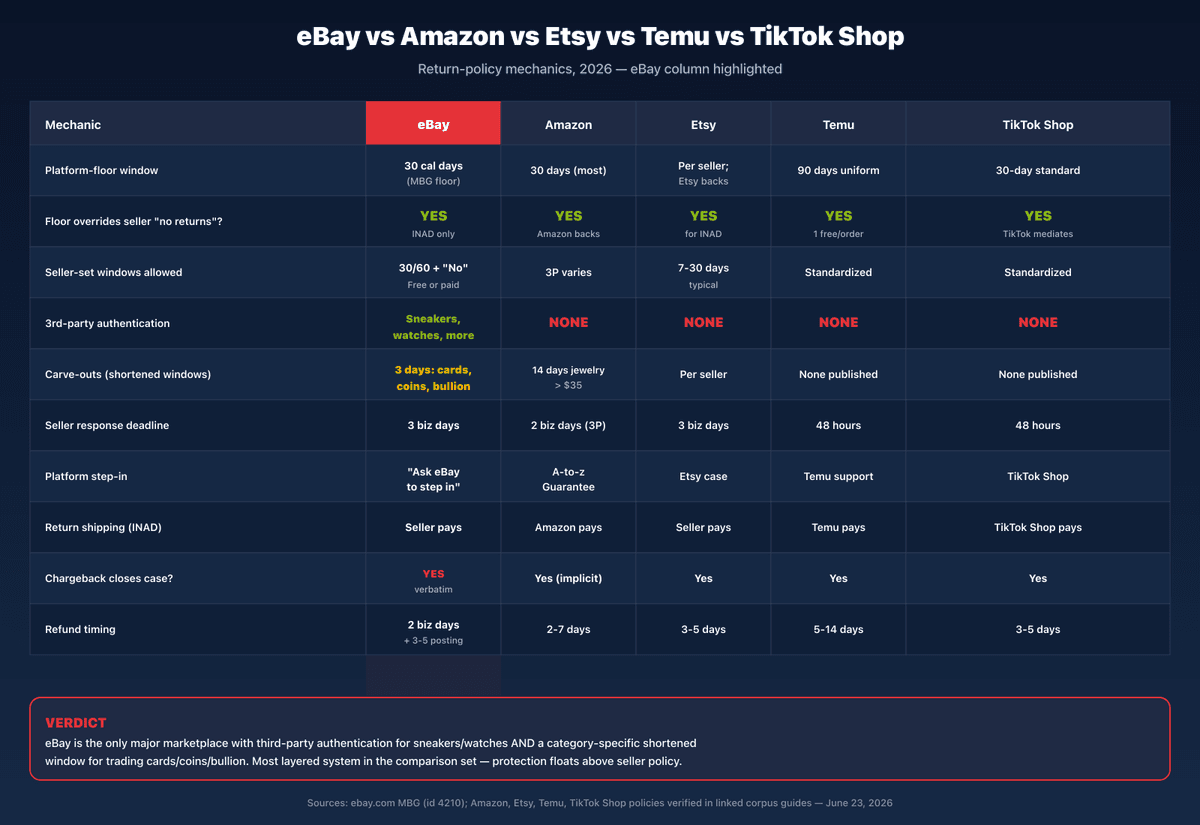
How does eBay's layered Money Back Guarantee + seller-set system stack up against other major marketplaces in our corpus? The table compares core return mechanics:
| Mechanic | eBay | Amazon | Etsy | Temu | TikTok Shop |
|---|---|---|---|---|---|
| Platform-floor window | 30 calendar days (MBG) | 30 days for most | Per seller (Etsy backs) | 90 days (uniform) | 30-day standard |
| Floor overrides seller "no returns"? | Yes (INAD only) | Yes (Amazon backs) | Yes for "doesn't match" | Yes (one free per order) | Yes (TikTok mediates) |
| Seller-set windows allowed | Yes — 30/60/90 + "No" | 3rd-party varies | Yes (typical 7–30 days) | Standardized 90-day | Standardized 30-day |
| 3rd-party authentication | Sneakers, watches, more | None (direct only) | None | None | None |
| Carve-outs (shortened windows) | 3 days: trading cards, coins, bullion | 14 days: jewelry over $35 | Per seller | None published | None published |
| Seller response deadline | 3 business days | 2 business days (3P) | 3 business days | 48 hours | 48 hours |
| Platform step-in | Yes — "Ask eBay to step in" | Yes — A-to-z Guarantee | Yes — Etsy case | Yes — Temu support | Yes — TikTok Shop |
| Return shipping (INAD) | Seller pays | Amazon pays (FBA) | Seller pays | Temu pays | TikTok Shop pays |
| Chargeback closes case? | Yes (verbatim) | Yes (implicit) | Yes | Yes | Yes |
| Refund timing | 2 biz days + 3–5 | 2–7 days | 3–5 days | 5–14 days | 3–5 days |
Comparison sources: Amazon return policy 2026, Etsy return policy 2026, Temu return policy 2026, TikTok Shop return policy 2026, and the eBay MBG policy text verified in this guide.
Verdict. eBay is the only major marketplace with a publicly published third-party authentication program for high-counterfeit-risk categories — Authenticity Guarantee is structural protection no other marketplace in the comparison offers. eBay is also the only marketplace with a category-specific shortened window (3 days for trading cards, coins, bullion, parts-only) that's hidden in the policy text and rarely surfaced by aggregators. eBay's MBG floor is the most layered system — it floats above seller-set policies rather than replacing them, which provides flexibility (sellers can offer 60-day windows that genuinely apply) at the cost of complexity (buyers must read both layers to know what protection they have). The TL;DR: eBay is friendlier than Amazon on long-window seller-set returns (60-day common), stricter than Amazon on hidden carve-outs (3-day for cards/coins/bullion), more layered than the Chinese marketplaces (Temu's 90-day uniform window is simpler), and structurally unique in offering authenticator-routed shipping for sneakers/watches.
Seven ways to never lose an eBay refund
The published policy is precise enough that a careful buyer can avoid every loss-of-refund scenario by following these rules:
1. Pay only through eBay checkout — never split payment off-platform. Any portion paid via personal Venmo, Zelle, bank transfer, or cash strips MBG coverage on the entire transaction. The seller's offer to "save fees" by paying outside eBay is the buyer's offer to surrender protection.
2. Read the seller's return policy before bidding. The right rail of every listing shows the seller's chosen policy: Free 30, Free 60, paid 30, paid 60, or No Returns. For high-dollar non-essential purchases, prefer Free 30 or Free 60 listings — the seller-paid return label removes the buyer's downside risk.
3. Inspect trading cards, coins, bullion, and parts items on receipt — film the unboxing. The 3-calendar-day window is hidden in the policy text and runs fast. Open the package on the day of delivery, photograph the item with the packaging visible, and file the return immediately if anything is off.
4. Use Authenticity Guarantee listings for sneakers, watches, and high-value collectibles. The third-party inspection layer is genuine protection. The badge appears above the Buy It Now button on eligible listings; if the badge isn't there, the protection isn't there — even on the same item from a different seller.
5. Run the eBay MBG path to completion before calling your card issuer. Filing a chargeback closes the more buyer-favorable eBay case. If the eBay step-in rules against you, you still have the chargeback option — but the reverse order doesn't work.
6. Use tracked shipping on returns and photograph the package before sealing. Untracked returns expose the buyer to "didn't arrive" disputes. The seller-may-deduct rule on damaged returns means a packaging photo (taped, labeled, ready to drop) is a buyer's defense against deduction claims.
7. Watch the 3-business-day clock — escalate to step-in promptly. The seller has 3 business days to respond. The buyer's escalation window opens at day 4 (in business-day terms) and closes at business-day 21. Sellers who go silent are gambling that the buyer will let the case lapse; an immediate step-in request collapses the gamble.
Sources & references
Primary (verbatim policy text):
- eBay Money Back Guarantee policy (ebay.com/help/policies/ebay-money-back-guarantee-policy, id 4210) — the canonical policy page. All MBG, INAD, exclusion, payment-method, authentication, refund-timing, appeal, chargeback, and international clauses quoted in this guide are pulled directly from this page on June 23, 2026.
- Return an item for a refund (ebay.com/help/buying/returns-refunds/return-item-refund, id 4041) — the consumer-facing buyer help article. The "how the seller may respond" framework, the "combined purchases" rule, the "refunds typically available within 3–5 business days" phrasing, and the seller's discretion-to-decline-remorse-returns clause are quoted from this article.
Secondary (corporate context):
- Wikipedia — eBay — used for founding date (September 3, 1995, by Pierre Omidyar, as AuctionWeb in California), headquarters location (Willow Glen district of San Jose, California), 2023 metrics (132 million annual active buyers worldwide, $73 billion in transactions, 48% U.S.).
Internal corpus cross-references:
- Amazon return policy 2026 — complete guide — for the Amazon column of the comparison table.
- Etsy return policy 2026 — for the Etsy column.
- Temu return policy 2026 — for the Temu column.
- TikTok Shop return policy 2026 — for the TikTok Shop column.
- Walmart return policy 2026 — complete guide — for comparison context on big-box vs marketplace returns.
- GameStop return policy 2026 — for adjacent reseller / collector context.
Soft spots and hedges (transparent disclosure):
- The exact dollar-value thresholds for Authenticity Guarantee eligibility (sneakers above $X, watches above $Y, handbags above $Z, trading cards above $W, jewelry above $V) are not in the static MBG policy text; they are configured at the listing level by eBay's category management team and updated periodically. The category list itself (sneakers, apparel, trading cards, watches) is quoted verbatim from the MBG final-sale section.
- The carrier-specific refund timing (3–5 business days for card credits) is consistent with eBay's published language; specific bank policies vary by issuer and may extend timing on debit transactions.
- The seller-set window options (Free 30, Free 60, paid 30, paid 60, No Returns) are drawn from eBay's standard listing form configuration; custom durations (14 days, 90 days, etc.) are possible but uncommon.
- The Amazon, Etsy, Temu, and TikTok Shop comparison figures are drawn from prior corpus posts (disclosed via the linked guides above and the source note in the comparison section).
- Industry-pattern reading on chargeback consequences (card-network blacklisting, account-history tracking) reflects standard credit-network practice and is not eBay-published.
Frequently asked questions
What is eBay's return policy in 2026?
eBay's return policy is anchored by the Money Back Guarantee, which gives buyers 30 calendar days from the estimated or actual delivery date — or the seller's stated returns window, whichever is longer — to return an item that doesn't match the listing description. Individual sellers set their own return policies for change-of-mind returns (typically Free 30 days, Free 60 days, 30 days buyer-pays, 60 days buyer-pays, or No Returns). If an item is damaged, faulty, or doesn't match the listing, the Money Back Guarantee overrides the seller's "no returns" setting and the seller pays the return shipping. Trading cards, bullion, coins, paper money, and parts-only items have a shortened 3-calendar-day window when the seller doesn't offer returns. Refunds typically arrive within 3 to 5 business days of the seller processing the return.
Can I return an item if the seller says "no returns"?
Yes, but only for "not as described" cases. The eBay Money Back Guarantee gives buyers an explicit override: "If the buyer receives the wrong item, or the item arrives broken, damaged, or faulty (and was not clearly described as such), they are entitled to return it for a refund, even if the seller doesn't offer returns." The seller pays return shipping in this case. The override does not apply to change-of-mind returns — if you simply don't like the item and the listing said no returns, the seller can decline and you have no platform remedy. File the return through eBay (not directly to the seller) so the system can enforce the override; calling the seller off-platform doesn't trigger MBG protection.
How long do I have to return trading cards or coins on eBay?
You have 3 calendar days from the estimated or actual delivery date if the seller doesn't offer returns. The verbatim policy reads: "Trading cards, bullion, coins, paper money, and items that are sold as not working or for parts only — If the seller doesn't offer returns, the buyer must request a return no later than 3 calendar days after the estimated or actual delivery date. If the seller offers returns, the buyer must request a return within the seller's stated return window." This is one of the most often-missed clauses on eBay. Open and inspect on the day of delivery and film the unboxing for high-value cards or bullion bars — the timestamp is your strongest evidence in any dispute that follows.
What is eBay Authenticity Guarantee and how do returns work?
Authenticity Guarantee is a third-party physical-inspection program where items in certain categories — sneakers, apparel, trading cards, and watches — are first shipped to an eBay-contracted authenticator for inspection before being forwarded to the buyer. The authenticator verifies the item matches the listing and is genuine. If authentication fails, the buyer is refunded and the item returns to the seller. If the item is later returned by the buyer, it goes back to the authentication facility (not the seller) for re-inspection to confirm the same item is being returned in the same condition. Some Authenticity Guarantee categories are designated final sale — covered under the Money Back Guarantee only for shipping damage or seller bad faith.
How long does an eBay refund take?
Once the return arrives at the seller, the seller has 2 business days to issue the refund per the policy: "Latest: 2 business days after receiving the returned item." Once the refund is issued, the money typically posts to the buyer's payment method within 3 to 5 business days for credit and debit cards. PayPal refunds typically post the same day or next business day. Apple Pay and Google Pay refunds map to the underlying card method. If the seller misses the 2-business-day deadline, the buyer can ask eBay to step in and eBay will issue the refund on the seller's behalf.
When can I ask eBay to step in?
You can ask eBay to step in starting 3 business days after the seller has been notified of your return or non-delivery report, and you have through business day 21 to escalate. The verbatim window: "Earliest: 3 business days after the report date — Latest: 21 business days after the report date." Outside that window, the case auto-closes. eBay may also step in automatically without your asking if the seller cannot produce valid tracking on a non-delivery report. Escalating to step-in is the buyer's primary remedy when the seller goes silent or unreasonably declines a return.
Will a chargeback affect my eBay case?
Yes — filing a chargeback with your card issuer closes your eBay Money Back Guarantee case. The verbatim policy: "eBay may close a buyer's eBay Money Back Guarantee case if the buyer files a chargeback or buyer protection claim for the same transaction with their payment provider (such as a credit card issuer or payment service provider), regardless of whether the chargeback or buyer protection claim is for the full or partial amount of the transaction." The eBay path is typically faster and more buyer-favorable than a chargeback, so run the MBG process to completion first. If eBay rules against you, you can still file a chargeback at that point with the eBay decision as evidence to support the dispute.
Does the Money Back Guarantee cover all payment methods?
No. The verbatim covered list: "Credit card or debit card, PayPal or PayPal Credit, Apple Pay or Google Pay, Venmo, Klarna, Spendable funds, Alipay, Wire transfer facilitated by eBay, eBay gift card or eBay voucher or eBay Bucks." The verbatim not-covered list: "Items paid for where any part of the payment was completed outside of eBay (such as bank transfer, cash, money orders, escrow services)." Any portion of payment completed outside eBay's checkout — even a small split-payment via personal Venmo or bank transfer to the seller — strips Money Back Guarantee coverage from the entire transaction.
How does the Money Back Guarantee work on international purchases?
The protection program of the eBay site where you completed checkout controls — not the site where the listing was created. A U.S. buyer who completed checkout on eBay.com is covered by eBay.com's Money Back Guarantee regardless of where the listing originated or the seller is located. eBay's own forwarding programs (Global Shipping Program, eBay International Shipping, Authenticity Guarantee) maintain Money Back Guarantee coverage on the forwarded leg. Third-party freight forwarders (myUS, Shipito, US Global Mail, etc.) strip coverage on the forwarded leg — the protection ends at the third-party forwarder's address. Import duties refused for legitimate reasons void coverage; if the seller misrepresented value or country of origin, coverage remains.
Purchy tracks every return window automatically — from an eBay 30-day Money Back Guarantee clock and a 3-day trading-card carve-out to an Amazon 30-day, an Etsy seller-set, a Temu 90-day, and a TikTok Shop 30-day. We watch your inbox for the order confirmation, parse the purchase date and the delivery date, calculate the deadline against each retailer's posted policy, and ping you before the clock runs out. No more lost refunds because the seller went silent past the 3-business-day deadline, the 30-day clock ran out on a Sunday, or a chargeback closed your case mid-dispute. Get on the Purchy waitlist to track every retailer's return policy in one place.
Wake to one edition. Only what matters.
$12.99 a month or $99.99 a year. Cancel any time from your Apple Account.
Download on iOS →