Refund vs Store Credit 2026: How to Get Cash Back
When retailers can legally force store credit instead of cash — plus the five rules, the state cash-back laws, and 5 ways to turn store credit back into money.
Most shoppers learn the difference between a refund and store credit the hard way — at the customer-service counter, holding a receipt, watching a manager type the words "merchandise credit" into the register. The two outcomes look the same on paper but they are not the same dollar. A cash refund goes back to the card you paid with and can be spent anywhere. Store credit is a private currency that only spends at one retailer, never expires unless state law says it can, and quietly transfers $3-7 billion a year of un-redeemed value from consumers to issuers — what the accounting industry calls "breakage". This guide explains exactly when a U.S. retailer can legally hand you store credit instead of cash, the five triggers that flip the default, the state laws that force cash back when a balance gets small, and five practical ways to convert merchandise credit into spendable money in 2026.
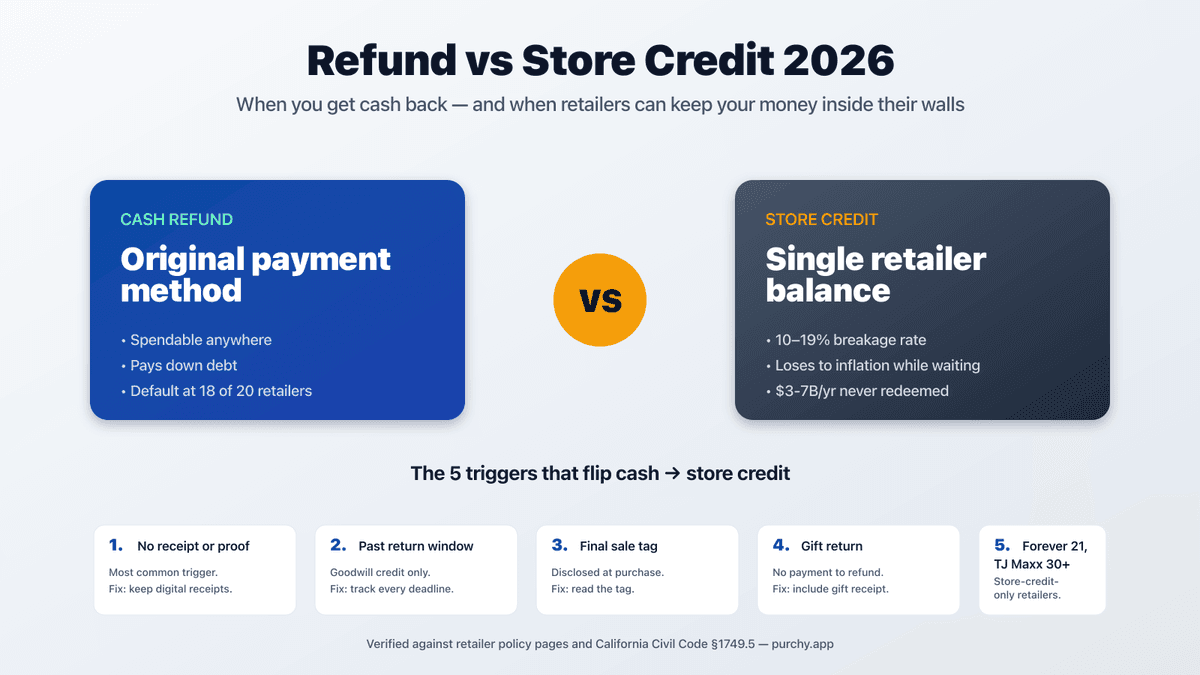
Table of Contents
- Cash vs Store Credit: What's Actually Different
- The Legal Default: Original Payment Wins
- The Five Triggers That Force Store Credit
- Retailer Policy Table: Cash vs Credit at 20 Major Stores
- State Cash-Back Laws You Can Invoke
- The "Breakage" Math: Why Retailers Love Store Credit
- Five Ways to Turn Store Credit Back into Cash
- Gift Returns: The Special Case
- How Purchy Protects Your Cash-Refund Eligibility
- FAQ
Cash vs Store Credit: What's Actually Different in 2026
A refund and store credit are different financial instruments, and the gap matters more than most shoppers think.
A cash refund — almost always issued to the original form of payment in 2026, not literal paper currency — restores fungible money. That money can be spent anywhere, used to pay down a credit-card balance, transferred to savings, or invested. It is not bound to any retailer. If the original payment card is closed or expired, retailers default to mailing a check, posting an ACH credit, or issuing a card-of-record refund through their processor. The crucial property: it leaves the retailer's ecosystem entirely.
Store credit (also called merchandise credit, a store gift card, or in some chains an e-credit) is a private balance redeemable only at the issuing retailer or its affiliated brands. Properties that distinguish it from cash:
- Single-issuer redemption. A Macy's merchandise credit only buys merchandise at Macy's (and Bloomingdale's-affiliated locations within the parent company's redemption network).
- No interest, no growth. The dollar amount stays nominally flat while you wait — losing real value to inflation every month it sits unredeemed.
- Frequently non-transferable. Most major retailers explicitly prohibit reselling store credit, and some can void the balance if they detect resale.
- Subject to retailer terms changes. The retailer can alter what counts as "eligible merchandise," restrict use during sales, or in extreme cases invalidate balances after acquisition or bankruptcy (see our going-out-of-business refund guide).
- Statistically less likely to be fully redeemed. Industry data — discussed in detail in section 6 — consistently shows 10-19% of issued store-credit dollars are never spent.
The functional question is therefore: when does a retailer actually have the right to substitute store credit for cash, and when can a shopper push back? The answer in 2026 is governed by a small number of triggers and a handful of state-law floors. Knowing them is the difference between accepting an unfavorable outcome and getting your money back.
The Legal Default: Original Payment Wins
The starting point is important and often surprising: U.S. federal law does not require any retailer to accept returns at all. There is no FTC "return rule" that mandates cash refunds. Return policies are governed primarily by state consumer-protection law, retailer terms, and — for credit-card purchases — the chargeback rights guaranteed by the Fair Credit Billing Act of 1974.
Within that framework, every major U.S. retailer has standardized on the same default behavior: refunds go back to the original tender. If you paid with Visa, the credit posts to that Visa. If you paid with cash, you get cash. If you paid with a gift card, the credit goes back to that gift card balance. Nordstrom's customer-service page states the rule plainly: "We apply refunds to the tender with which returned items were purchased." Amazon's help center, Walmart's corporate policy, Target's customer-service portal, Costco's return policy, Best Buy, Apple, IKEA, REI, and effectively every other top-25 U.S. retailer follow the same pattern.
This means the legal default in 2026 is: if you have your receipt, you are inside the return window, and the item is eligible to be returned, you are entitled to a refund to your original payment method. A cashier saying "we can only do store credit" in that situation is either misinformed or shading the policy. Asking for a manager and citing the published return policy will almost always reverse the decision.
The exception cases — when retailers legitimately can issue store credit instead — are surprisingly narrow. The next section covers all five.
The Five Triggers That Force Store Credit
In 2026, store credit is the legitimate refund method only when one of these five conditions is met. Anything outside this list is the retailer using its discretion, not its rights — which means the shopper has room to negotiate.
Trigger 1: No receipt and no other proof of purchase. This is the single most common reason shoppers end up with store credit. Without a receipt, the retailer cannot verify the price paid, the payment method, or even that the item was purchased there. Most chains will issue a refund at the current selling price (often lower than what you paid) onto a store gift card. Nordstrom's policy is explicit: "if no record of sale is available, we'll ask for personal identification and a refund will be provided at the current price on a Nordstrom gift card." Macy's, Kohl's, JCPenney, and Bloomingdale's apply parallel rules. The fix is preventative: keep digital receipts, use a single payment card per retailer when possible, or use a tool like Purchy that captures the e-receipt at the moment of purchase. See our how to return without a receipt guide for retailer-by-retailer no-receipt rules and our digital receipt tracking walkthrough.
Trigger 2: Return window has closed. Retailers commonly extend a courtesy refund as store credit when an item is brought back outside the standard return window. This is not a legal entitlement — past the window, the retailer technically owes nothing — so when they offer merchandise credit, they are exercising goodwill. Sephora, Ulta, and several apparel chains routinely do this for returns within 30 days past the window deadline. The mechanic transfers the deadline-tracking burden onto the shopper: miss the window, lose the cash-refund right. This is exactly the use case Purchy was built for; the deadline tracker exists to keep returns inside the window where the cash refund is owed by policy. See our how to get money back after the return window closes guide for additional escalation options.
Trigger 3: "Final sale" or non-returnable merchandise. Items marked final sale, clearance, or marked-down beyond a stated threshold are typically excluded from cash refunds entirely. Some retailers (Lush, Sephora, some department stores) will still grant store credit as a goodwill gesture if the customer escalates and the item is unworn or unused. The label has to be explicit at the point of sale to be enforceable in most states; if the markdown was the retailer's standard price reduction, not a "final sale" tag, the shopper retains normal return rights.
Trigger 4: Gift returns without the gift giver's payment information. When a recipient returns a gift, the retailer cannot post a refund to a card they don't have on file (and shouldn't, even if they did — that exposes the gift giver). The standard outcome is a store gift card or merchandise credit issued to the recipient. This is the legitimate use case for store credit, and the fix is structural: the gift giver provides a gift receipt, which preserves the price proof but anonymizes the payment trail. See our extended holiday return policies 2026 guide for retailer-by-retailer gift-receipt mechanics.
Trigger 5: Retailer-specific store-credit-only policies. A small number of major U.S. chains have moved to store-credit-only as the default refund method, regardless of receipt status. Forever 21 is the most-cited example: returns within 30 days are eligible for store credit only — there are no cash refunds even when the receipt and tag are present. Other apparel resellers and some swimwear and intimates chains apply similar rules. These policies are legal in nearly every state because the policy is disclosed at the point of sale (typically printed on the receipt and posted at registers). The only meaningful escalation path is a credit-card chargeback citing non-disclosure or item-not-as-described — which is a higher bar to clear and not always successful. Our credit card dispute guide walks through the process.
If your situation does not match one of those five triggers, the retailer's default obligation is a cash refund to your original payment method. Cite the policy. Ask for a supervisor. If the retailer refuses without one of these triggers documented, the chargeback path becomes credible.
Retailer Policy Table: Cash vs Credit at 20 Major U.S. Stores in 2026
The table below summarizes the default refund method at 20 high-traffic U.S. retailers in May 2026, sourced from each company's official customer-service or return-policy page. "With receipt" assumes the item is inside the standard return window and not marked final sale.
| Retailer | With Receipt (in window) | No Receipt / Past Window | Notes |
|---|---|---|---|
| Amazon | Cash to original payment | Amazon gift-card balance (case by case) | A-to-z guarantee may add chargeback path |
| Walmart | Cash to original payment | Cash up to $25 / store credit above (limit varies) | In-store ID required without receipt |
| Target | Cash to original payment | Merchandise return card if no receipt found via lookup | Receipt lookup via card or RedCard often resolves |
| Costco | Cash to original payment | Member purchase history reconstructs receipt | Membership lookup almost always finds the order |
| Best Buy | Cash to original payment | Store credit at current selling price | My Best Buy account stores most receipts |
| Apple | Cash to original payment | Limited; depends on serial-number lookup | Apple ID purchase record functions as receipt |
| Macy's | Cash to original payment | Macy's gift card at lowest selling price | 90-day window with receipt |
| Nordstrom | Cash to original payment | Nordstrom gift card at current price | Generous discretion at customer service |
| Kohl's | Cash to original payment | Kohl's merchandise credit at current price | Kohl's Card lookup often retrieves receipt |
| JCPenney | Cash to original payment | Store merchandise credit (lowest price) | Beauty/fragrance often final sale |
| TJ Maxx | Cash to original payment (within 30 days) | Merchandise credit | After 30 days store credit only — even with receipt |
| Marshalls | Cash to original payment (within 30 days) | Merchandise credit | Same group rules as TJ Maxx |
| HomeGoods | Cash to original payment (within 30 days) | Merchandise credit | Same group rules as TJ Maxx |
| Ross | Cash to original payment (within 30 days) | Store credit | Strict ID verification on no-receipt returns |
| Forever 21 | Store credit only | Store credit only / no return | No cash refunds, period |
| Sephora | Cash to original payment (within 30 days, opened OK) | Store credit at current price (30-60 days) | Past 60 days no return |
| Ulta | Cash to original payment (within 60 days) | Merchandise credit at lowest price | Receipt lookup via Ultamate Rewards |
| H&M | Cash to original payment | Store credit / no return without ID | Mail returns charge $3.99 fee unless member |
| Zara | Cash to original payment (30 days) | No return / case-by-case credit | Strict deadline; mail fee $4.95 |
| REI | Cash to original payment (1 year, members) | Store credit at lowest selling price | Member purchase history goes back years |
The pattern is clear: cash to original payment is the default at 18 of 20 major retailers when receipt and window conditions are met. Forever 21 and the TJX off-price family (TJ Maxx, Marshalls, HomeGoods) are the principal exceptions. For the off-price chains, the cash window is 30 days; after that, even a complete receipt only buys merchandise credit. That deadline behavior is precisely the kind of ticking clock Purchy was built to track.
Stop letting deadline lapses turn cash refunds into store credit
Purchy tracks every retailer's cash-refund window and no-receipt cutoff in one dashboard. Join the waitlist for early access at launch.
Join the Purchy waitlist →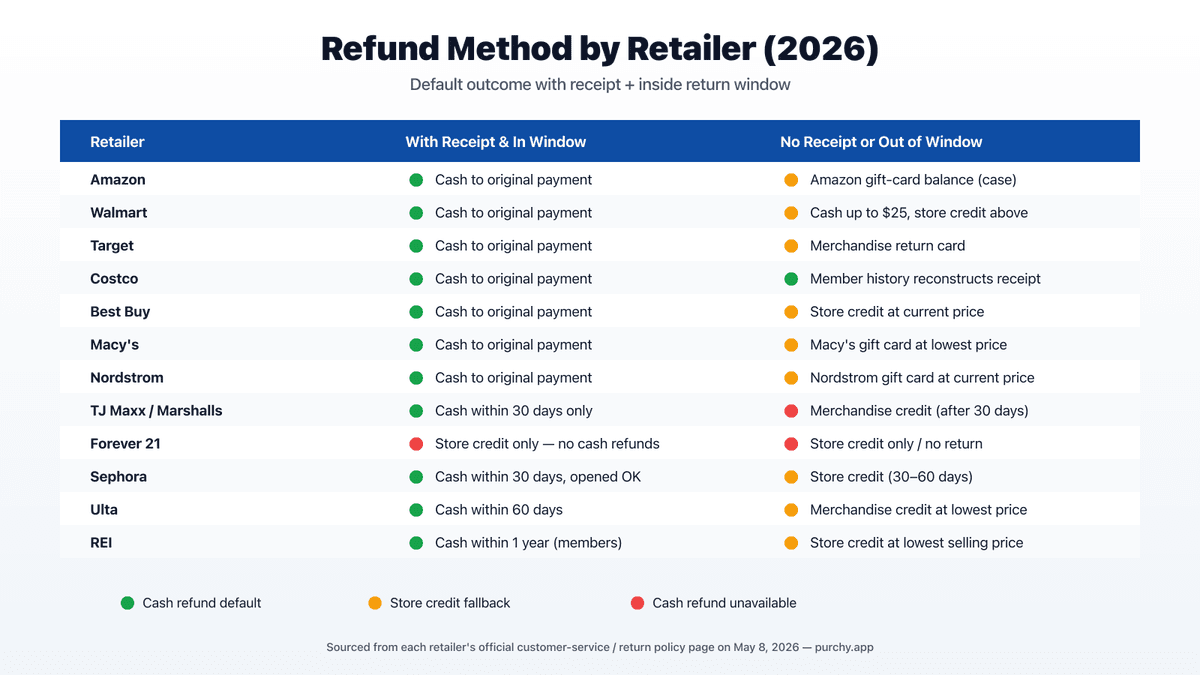
State Cash-Back Laws You Can Invoke in 2026
Once a balance has already been issued as store credit or a store-branded gift card, federal law is silent on cash redemption. State law fills the gap, and a meaningful number of states require retailers to redeem the remaining balance for cash once it falls below a stated threshold. The thresholds and statutes change occasionally; the snapshot below is current as of May 2026.
California — Civil Code §1749.5(b)(2). Any gift certificate or store-credit balance with a value of less than $10 must be redeemable in cash on demand. The statute is explicit and applies to single-merchant gift certificates and merchandise credits issued for returned goods. The full text is available on the California Legislative Information site at leginfo.legislature.ca.gov. This is the most cited and most consumer-favorable threshold in the country.
Massachusetts. Once a gift certificate or store credit has been redeemed for at least 90% of its original face value, the issuer must redeem the remaining balance in cash upon the customer's request. The "10% remaining" rule is the practical phrasing.
Vermont. Cash redemption is required when remaining balance is less than $1.00.
Washington — RCW 19.240. When the balance falls below $5, the issuer must offer cash redemption.
Rhode Island. Balance under approximately $1.00 is redeemable for cash.
Maine. Cash redemption is required for balances under $5.
New Jersey, Colorado, Oregon, Connecticut, and several others have parallel small-balance cash-back rules with thresholds typically in the $1-$10 range. Because state statutes are amended regularly, the most reliable source is the state's official Office of the Attorney General consumer-protection page or the state legislative information site.
How to invoke the law in practice. The pattern that works at customer service is short: cite the statute by name and state, ask for the cash redemption in writing, and escalate to a manager if the front-line associate is unfamiliar. Most state-mandated thresholds are low enough that the retailer is not going to litigate over $7 — they will issue the cash. The harder cases are large balances. Once a Macy's merchandise credit has $400 on it, no state law forces cash redemption, and the gift-card resale market discussed in the next section becomes the practical conversion path.
The Breakage Math: Why Retailers Love Store Credit
Issuing store credit is good business. Three accounting effects explain why, and they are worth understanding because they reveal exactly how aggressively retailers will steer toward credit when they have the discretion.
Effect 1: Breakage. "Breakage" is the accounting term for gift-card and store-credit balances that are never redeemed. Industry estimates from Mercator Advisory Group, the Wall Street Journal, and CEB TowerGroup consistently put the breakage rate for retailer-branded gift cards in the 10-19% range, with smaller-balance store credits (under $25) breaking at the higher end of that range. On the macro picture, NRF estimates total annual U.S. gift-card sales exceed $200 billion, implying breakage in the $3-$7 billion per year range — money paid to retailers and never reclaimed by consumers.
Effect 2: Float. Even on the credit balances that are eventually redeemed, the retailer holds the customer's money interest-free between issuance and redemption. The average redemption window for a store-credit balance is months, not days. Multiplied across a customer base, this is a meaningful working-capital benefit at zero cost of capital.
Effect 3: Retention conversion. A cash refund leaves the retailer's ecosystem. A store credit balance creates a near-guarantee that the customer will spend at least that amount with the retailer in the future. Industry redemption studies consistently show that recipients spend 20-40% more than the credit's face value at the time of redemption, because the credit serves as a discount toward a larger basket. From the retailer's perspective, a $50 store credit converts to roughly $60-70 of incremental gross merchandise volume.
These three effects together explain why retailers without a state-mandated cash refund obligation will almost always prefer to issue store credit when the discretion is theirs. They also explain why returning items with a complete receipt inside the window — preserving the cash-refund default — is so financially valuable to the consumer side. Every dollar that stays on a store credit balance is a dollar that statistically loses 10-19 cents of redemption value and earns the retailer working-capital float on the rest.
Five Ways to Turn Store Credit Back into Cash in 2026
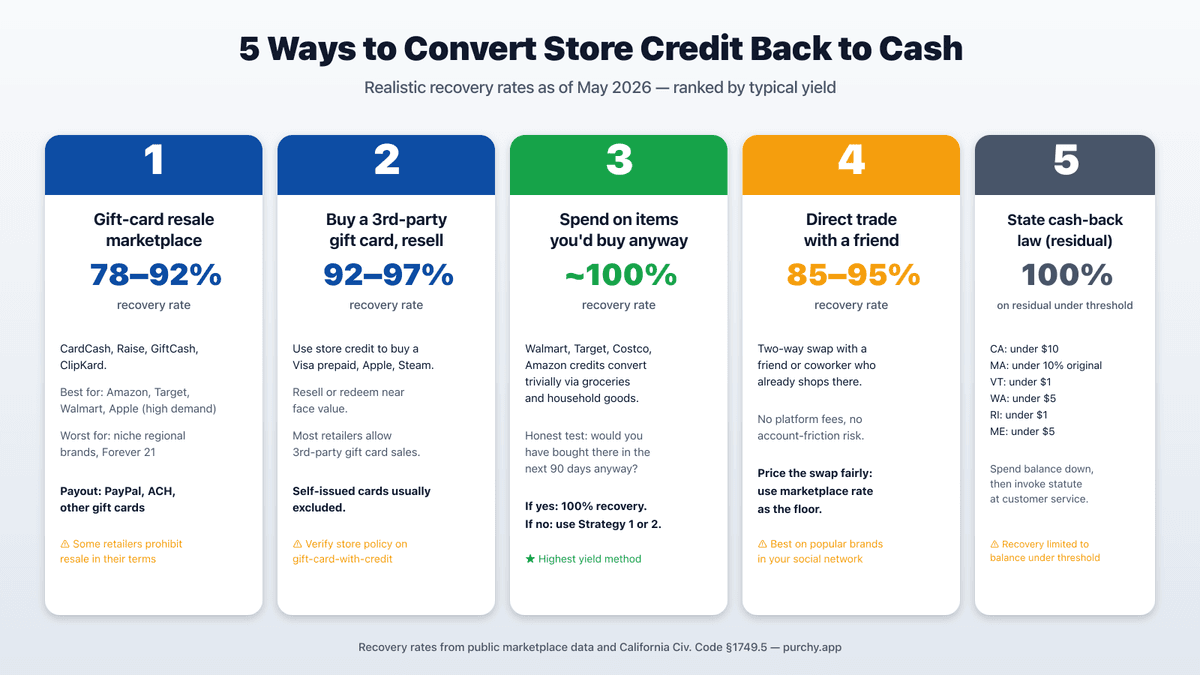
Once a balance is issued as store credit, converting it back to fungible cash takes effort but is almost always achievable. The five most reliable methods, ranked by realistic recovery rate.
Strategy 1: Sell on a regulated gift-card resale marketplace. CardCash, Raise, GiftCash, and ClipKard are the largest reputable players in 2026. The shopper sells the unwanted store credit balance and receives cash via PayPal, ACH, or a different gift card. Recovery rates vary heavily by retailer:
- High-demand brands (Amazon, Target, Walmart, Costco, Apple, Home Depot, Lowe's): typically 85-92% of face value.
- Mid-demand brands (Macy's, Nordstrom, Best Buy, Sephora, Ulta): typically 78-85% of face value.
- Low-demand or restricted brands (Forever 21, niche apparel, regional chains): often 60-75% of face value or rejected outright.
The math is straightforward: if you have a $200 Macy's merchandise credit you would never spend on apparel, selling at 80% nets $160 in cash — a much better outcome than letting the balance break. Note that some retailers explicitly prohibit gift-card resale in their terms; the marketplaces handle that through indemnification agreements with sellers. The risk is small but real, and it is worth checking the specific retailer's terms before listing a balance over $500.
Strategy 2: Spend the credit on a high-resale-value purchase, then resell the item. Buy a popular gift card brand (a Visa or Amex prepaid card where the retailer sells them, an Apple gift card at Target, a steam gift card at Best Buy) using the store credit, then redeem or resell that secondary card. This is sometimes called "credit laundering" and can yield 92-97% recovery on the original face value, depending on what the retailer allows you to buy with credit. Most major retailers do not allow store credit to purchase their own first-party gift cards (Macy's credit cannot buy Macy's gift cards), but they generally do allow store credit to purchase third-party gift cards (Visa prepaid, Apple, Steam, etc.) — those then convert to cash at near face value.
Strategy 3: Use the credit for everyday essentials you'd buy anyway. This is the highest-recovery strategy of all — effectively 100% — but it only works if the retailer sells goods you actually need. A Walmart, Target, Costco, or Amazon credit converts almost trivially via groceries, household goods, or paper products. A Sephora credit only converts at face value if you actually buy beauty products. A Forever 21 credit is meaningfully harder to convert at face value if you are not the target customer. The honest test: would you have spent that money at this retailer in the next 90 days anyway? If yes, use it; if no, the resale path is more efficient.
Strategy 4: Trade with a friend or coworker for cash. A direct two-way swap — your $100 Macy's credit for $90 cash from a friend who shops at Macy's — captures most of the resale-marketplace economics with zero platform fees and zero account-friction risk. The drawback is finding the buyer; this works well for popular retailers where someone in your network already shops, less well for niche brands. Pricing the swap at marketplace rates (80-90% of face value) is fair to both sides.
Strategy 5: Invoke state cash-back law on a depleted balance. This is the smallest-recovery strategy but the most legally clean. After spending the credit down past the state threshold (in California, below $10; in Massachusetts, below 10% of original; etc.), present the balance at customer service and request cash. The recovery is limited by the threshold, but it is 100% on whatever portion is below it, and combined with strategies 1-4 it can clean up the residual after a partial spend.
Gift Returns: The Special Case
Gifts deserve their own treatment because the refund vs store credit decision branches differently. The recipient cannot legitimately demand cash refund to a payment method they don't own. The retailer's options collapse to:
- With a gift receipt: store credit at the price the gift giver paid, issued to the recipient.
- Without a gift receipt but with item lookup possible (item registered in a gift registry, or purchased on a card that can be located in the system): store credit at the lowest recent selling price.
- Without any record of purchase: case-by-case discretion, typically the lowest selling price as store credit, subject to no-receipt return limits.
The win condition for the gift recipient is therefore not "cash refund" but "store credit at the highest defensible price." A gift receipt nearly always preserves the original purchase price for credit purposes. Without one, retailers default to the current selling price — which for items received at a holiday peak and returned post-clearance can be 30-50% below what was paid.
For gift givers who want their recipient to retain maximum flexibility, the playbook is straightforward: include a gift receipt, register big-ticket items where the giver and recipient both have access (wedding, baby, holiday registries), and on dollar-sensitive purchases consider sending the recipient the actual digital receipt outside of the gift moment so they have the price proof if they ever need to return. Our wedding registry returns and extended holiday return policies guides cover the registry and seasonal-window mechanics in more depth.
How Purchy Protects Your Cash-Refund Eligibility
The single most decisive variable in whether a return ends in cash or store credit is timing. Inside the receipt-protected window: cash to original payment is the default at 18 of the 20 retailers in the table above. Past the window or without a receipt: store credit is the legal default in most cases. Tracking the clock is therefore the highest-leverage activity a shopper can do, and it is exactly what Purchy was built for.
Connect a card or scan a receipt and Purchy:
- Captures the digital receipt at the point of purchase, eliminating the no-receipt trigger entirely.
- Surfaces the cash-refund deadline for every order, with retailer-specific window calculations.
- Flags when an item is approaching the cash-refund cutoff, so a 30-day TJ Maxx or 30-day Sephora window doesn't quietly elapse.
- Catches price drops inside the return window so you can request a price adjustment before the deadline closes — see price drop refunds.
- Tracks gift returns with the gift-receipt price preserved, so recipients aren't downgraded to current selling price.
Every cash-refund window protected is a cash-refund window kept. Every store-credit issuance avoided is real money — not breakage-leaking, retailer-locked, redemption-restricted credit.
Keep your refunds in cash, not store credit
Purchy tracks every retailer's cash-refund deadline, no-receipt cutoff, and gift-receipt price in one dashboard. Get on the waitlist for early access at launch.
Join the Purchy waitlist →Frequently Asked Questions
Is store credit considered a refund?
Legally and accounting-wise, yes — store credit is a form of refund. From the consumer's perspective, the practical answer is no, because store credit is restricted to a single retailer and not fungible like cash. When a retailer says "we issued your refund" and it's a merchandise credit, that statement is technically accurate but does not satisfy what most shoppers mean when they ask for a refund. If you want cash to your original payment method, ask explicitly: "I'd like a refund to my original tender, not a merchandise credit."
Can a store legally refuse to give me cash and force store credit?
Yes, in three specific situations: (1) the retailer's published return policy requires store credit (Forever 21 is the cleanest example), (2) you don't have a receipt or other proof of purchase and the retailer's no-receipt policy specifies store credit, or (3) you are outside the return window and the retailer is offering credit as a goodwill gesture they didn't owe you. Outside of those situations, the retailer's published policy almost always promises cash refund to original payment, and the cashier saying "store credit only" is misapplying the policy. Ask for a manager and cite the policy URL.
How long does store credit last in 2026?
The federal CARD Act of 2009 requires gift cards (which most store credits are issued as) to remain valid for at least five years from the date of issuance. Many retailers go further and say the credit never expires. Inactivity fees are limited by federal law to one per month after 12 months of dormancy, with required disclosure. Most major retailers waive inactivity fees entirely. State law in some jurisdictions (California, Maine, Massachusetts among others) extends or eliminates expiration entirely.
Can I dispute a store-credit-only refund through my credit card?
Sometimes. The chargeback succeeds most often when (a) the retailer's published policy promised cash refund and the store gave credit instead, or (b) the item was item-not-as-described or arrived damaged and the retailer is trying to limit you to store credit instead of a full refund. The chargeback fails most often when the store-credit-only policy was disclosed at the point of sale (printed on the receipt, posted at the register) and you are simply unhappy with that disclosed policy. See our credit card chargeback guide for the full process.
What's the highest recovery rate I can realistically get on a $200 store credit I don't want?
Best case 92-97% if you can buy a third-party gift card (Visa prepaid, Apple, etc.) with the credit — those convert to cash at near face value. Typical case 80-90% via gift-card resale marketplaces. Worst case 60-75% on niche-brand store credits where resale demand is thin. Across all paths, expect to recover at least $120-$190 of a $200 credit, depending on retailer brand and method.
Do gift cards that I buy at retail follow the same rules as store credit issued for returns?
In most states, yes — they are governed by the same gift-certificate statutes and benefit from the same cash-back floors (California's $10 threshold applies to both purchased and return-issued credit). Some states (Connecticut for example) treat retailer-issued return credits differently from purchased gift cards, with slightly different expiration and redemption rules. The retailer's terms-of-use page typically clarifies whether the credit is a "merchandise credit" (return-only, often non-transferable) or a "gift card" (fully transferable, broader redemption rules).
If a retailer goes out of business, what happens to my store credit?
You become an unsecured creditor of the bankrupt company, which is almost always a worst-case outcome. In Chapter 11 reorganization, retailers usually honor existing gift-card balances during the proceedings (Bed Bath & Beyond, Tuesday Morning, and others did so before their final liquidations). In Chapter 7 liquidation, the credit typically becomes worthless, and the consumer's only recourse is filing a claim that recovers pennies on the dollar. This is one of the strongest arguments for keeping cash refunds rather than store credit on any retailer with a publicly weakening financial profile. See our store going out of business refund guide for the full playbook.
Are returnless refunds the same as cash refunds?
Not exactly. A "returnless refund" — increasingly common at Amazon and other online retailers — means the retailer issues the refund without requiring the item to be shipped back. The refund itself still goes to the original payment method, so functionally it is a cash refund. The "returnless" part refers to the absence of a return shipment, not the absence of cash. See our coverage of refund without returning mechanics.
Conclusion: Cash Beats Credit by 10-30% — Defend Your Cash-Refund Window
The 2026 picture is clear. The legal default at every major U.S. retailer is cash refund to original payment, gated by a receipt and a return window. Five well-defined triggers — no receipt, missed window, final sale, gift returns, and a small set of store-credit-only retailers — flip the default to merchandise credit. Once credit is issued, the consumer faces a recovery problem: between 10% and 30% of face value is statistically lost to breakage, float, and depleted brand demand at resale. State law sets a small-balance floor (California's $10 threshold is the most consumer-friendly) but does nothing for the bulk of credit balances above that line.
The defense is timing and documentation. A complete digital receipt and a return inside the cash-refund window keeps you in the default — the cash-refund default — at 18 of the 20 major retailers tracked in this guide. Past those windows, the marketplaces, friend trades, third-party gift-card laundering, and state cash-back floors are the recovery toolkit, with realistic combined recovery in the 80-95% range for major-brand credits.
Cash beats credit by 10-30% on the dollar. Tracking the clock and the receipt is what keeps you on the cash side of that equation. Purchy was built for exactly that workflow.
Stop losing 10-30% of your refunds to store credit
Purchy tracks every retailer's cash-refund deadline and receipt in one dashboard. Join the waitlist now for early access at launch.
Get on the waitlist →Related Articles
- Paid Returns 2026: Every Retailer's Mail Return Fee
- How to Get Money Back After the Return Window Closes
- How to Return Without a Receipt: 2026 Retailer Guide
- Store Going Out of Business: How to Get Your Money Back
- How to Dispute a Credit Card Charge in 2026
- How Long Does a Refund Take in 2026?
- How Much Money Americans Waste on Missed Returns
Published May 8, 2026 by the Purchy Team. Verified against the NRF/Happy Returns 2025 returns landscape, California Civil Code §1749.5 (Legislative Information System), and each retailer's official customer-service / return-policy page on the publication date. State gift-card statutes are amended periodically; verify the current threshold with your state's Office of the Attorney General before invoking it at customer service. Retailer policies change frequently; always confirm the current return method at the retailer's policy page before relying on it.
Wake to one edition. Only what matters.
$12.99 a month or $99.99 a year. Cancel any time from your Apple Account.
Download on iOS →