Cell Phone Return Policy 2026: Windows & Restocking Fees
Compare T-Mobile, Verizon, and AT&T phone return windows and restocking fees for 2026 — plus the short deadlines and conditions that can void your refund.
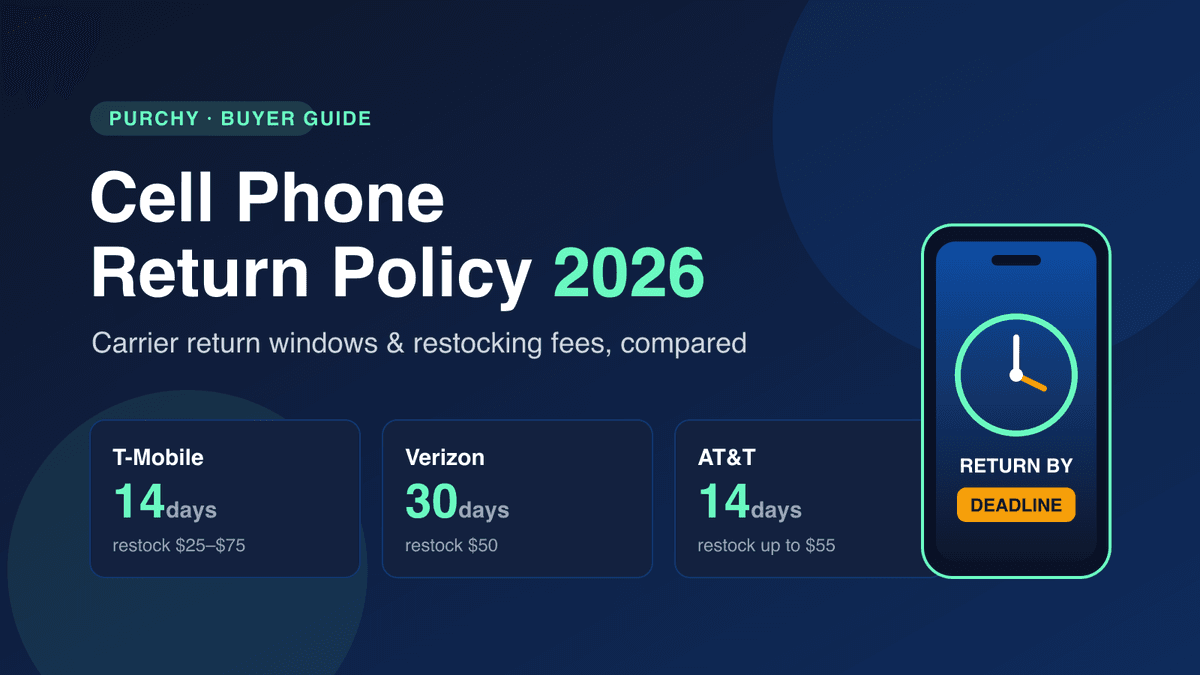
The 30-second version
A new phone is the single most expensive thing most people will ever try to return — and it comes with the shortest return window and the steepest restocking fee of anything in your cart. The major carriers give you somewhere between 14 and 30 days to change your mind, and most of them subtract a restocking fee of $25 to $75 from your refund even when the return is perfectly valid. Miss the window by a day and the usual outcome is brutal: no refund, and you keep the phone (and the installment plan that came with it).
This is the 2026 guide to the cell phone return policy at each of the big three U.S. carriers — T-Mobile, Verizon, and AT&T — plus the rules for buying through Apple, Best Buy, Samsung, or Costco. We'll cover exactly how many days you have, how much the restocking fee is and when it's waived, the condition your device has to be in, the popular "three-day right to cancel" myth (it does not apply to phones), and how to return a device without leaving money on the table.
Start here: the moment you buy or activate a phone, write down two dates — the return-by date (14–30 days out, depending on the carrier) and any trade-in deadline for sending in your old device. These are different clocks, and missing either one costs real money.
Table of contents
- Why phone returns are their own animal
- Carrier return policies at a glance
- T-Mobile return policy
- Verizon return policy
- AT&T return policy
- Buying through Apple, Best Buy, Samsung, or Costco
- Restocking fees: how much, and when they're waived
- The conditions that void your refund
- The three-day "cooling-off" myth
- Three deadlines, not one: return, warranty, trade-in
- How to return a phone without losing money
- What to do if a return or refund is denied
- Frequently asked questions
- How Purchy helps
- Sources and citations
Why phone returns are their own animal
When you return a sweater, the worst case is usually a store credit. When you return a phone, four things make the stakes much higher:
- The window is short. A clothing retailer might give you 30 to 90 days. Two of the three major carriers give you 14.
- There's almost always a restocking fee. Apparel rarely carries one; wireless devices almost always do, and on a flagship phone it can be $75.
- The condition bar is high. "Like-new, in the original box, with every component" is the standard — not "I kept the receipt."
- A phone is bundled with other commitments. An installment plan, a trade-in credit, a promotional discount, and your service activation are all stapled to that one device, and returning it (or failing to) ripples through all of them.
That combination is exactly why a missed deadline on a phone hurts more than a missed deadline on almost anything else — and why it pays to know the rules before you walk out of the store.
Carrier return policies at a glance
Here's how the three national carriers compare on the three numbers that matter most: how long you have, what the restocking fee is, and what condition the device has to be in.
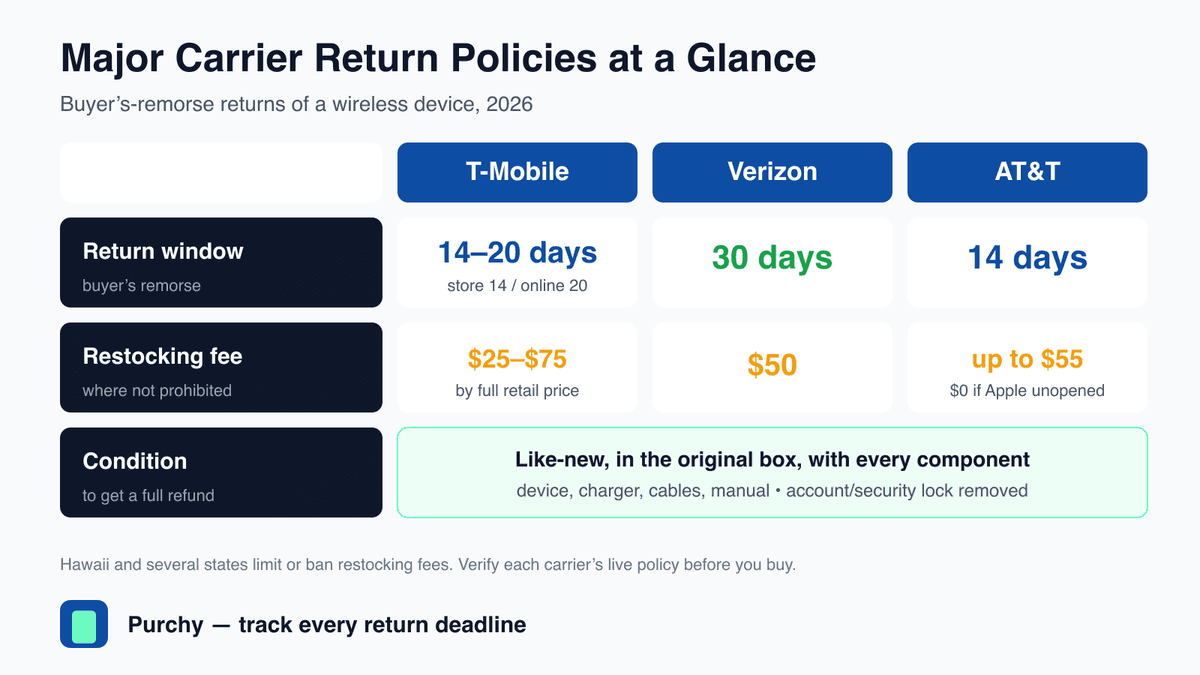
| Carrier | Return window | Restocking fee | Key condition |
|---|---|---|---|
| T-Mobile | 14 days in-store; 20 days for online/phone orders (90 days via Costco) | $25 / $50 / $75 by the device's full retail price | In its package, all contents, undamaged, good working order |
| Verizon | 30 days (devices and accessories) | $50 (plus tax), excluding Hawaii | Like-new, original box, all components, original receipt |
| AT&T | 14 days | Up to $55 ($0 on Apple devices returned unopened); accessories 10% if $100+ | Like-new, manufacturer's original packaging, all components |
The pattern: Verizon gives you the most time (30 days) and a flat fee; T-Mobile and AT&T give you about two weeks. Every carrier waives or limits the restocking fee in states that prohibit it — and AT&T waives it entirely on Apple devices you never opened.
T-Mobile return policy
T-Mobile's return window depends on how you bought the device:
- In-store purchases: return or exchange "within 14 days of the purchase or lease date."
- Online or phone orders: "within 20 days of the date the Device shipped to you."
- Bought at Costco: T-Mobile's partnership extends the window to 90 days of purchase — a rare and generous exception worth knowing about.
The device must come back "in its package, with all contents, undamaged and in good working condition, with no material alterations to the Device's hardware or software." In plain English: original box, everything that came in it, no cracks or water damage, and no jailbreak or unauthorized software changes.
T-Mobile's restocking fee is tiered by the device's full retail price (FRP), not the discounted or installment price:
- $75 for devices with a full retail price of $600 or more
- $50 for devices priced $300–$599
- $25 for devices under $300
A few extra T-Mobile specifics: prepaid services, e-coupons, and gift cards are non-refundable, and your refund comes back "less any rebates received, applicable taxes and fees, and shipping costs." You can return in person at a T-Mobile store, or — for online and phone orders — request a prepaid label and ship it back.
Watch the count. For online orders, T-Mobile's 20 days run from the ship date, not the day the box lands on your porch. If a phone sat in transit for four days, you effectively have 16 to decide.
Verizon return policy
Verizon is the most forgiving of the three on time: "You may return or exchange wireless devices and accessories purchased from Verizon within 30 days of purchase."
The trade-off is a flat restocking fee. Verizon states that "a restocking fee of $50 (plus any applicable taxes) applies to any return or exchange of a wireless device (excluding Hawaii)." That Hawaii carve-out is not a quirk — it reflects state-level limits on restocking fees, and it's a good reminder that where you buy can change what you owe (more on that in the restocking-fee section and our state-by-state return-law guide).
On condition, Verizon is explicit: "return the merchandise (including device, charger, battery, instructions, and any other components) in the ORIGINAL box. All merchandise must be in like-new condition and accompanied by the original receipt." Gift cards "are not eligible for return or exchange, except as required by law," and opened software bought separately can be exchanged only for the exact same item — not refunded.
Verizon also publishes a warning that's easy to overlook and expensive to learn the hard way:
"If you return your merchandise, even by mistake, after the return period, you will not receive a refund and the merchandise you returned will not be returned to you."
In other words: ship a late return and you can lose both the money and the phone. Returns go through My Verizon, Verizon customer service, or a Verizon store (devices bought from Authorized Retailers must go back to that retailer under its own policy).
AT&T return policy
According to AT&T's published Wireless Returns Policy, you have up to 14 days after purchase to return or exchange a device for a "full refund less any applicable fees." Returns are accepted at a corporate-owned AT&T store, over the phone, or online.
AT&T's device restocking fee is up to $55 (charged "except where prohibited" by state law), with two notable wrinkles:
- Apple devices carry no restocking fee if returned unopened — so if you bought an iPhone and changed your mind before breaking the seal, you can avoid the fee entirely.
- Accessories priced $100 or more carry a restocking fee of 10% of the purchase price.
The condition standard mirrors the others: the device must be "in like-new condition with no physical or water damage and in the manufacturer's original packaging," and you must include the original components — device, battery, charger, manual, unopened software, and a copy of the invoice or receipt. "If anything is missing or the device is not in like-new condition," AT&T says, the return may not be accepted.
One thing that is not part of the return window: AT&T's Early Termination Fee for cancelling service on a term agreement, which it lists as $325 minus $10 for each full month you've completed for a smartphone. Returning the device inside the window is a different action from cancelling a service contract — don't confuse the two.
Verify before you rely. Carrier terms change without much fanfare. Before you buy — or before you start a return — open the carrier's own returns page (linked in Sources) and confirm the current window, fee, and conditions. The numbers in this guide reflect each carrier's published policy as of the verification date above.
Buying through Apple, Best Buy, Samsung, or Costco
If you didn't buy directly from the carrier, the seller's policy is what governs the return — and that can work for or against you:
- Apple gives 14 days to return an iPhone for a refund, and Apple itself does not charge a restocking fee on a standard return. See our Apple return policy guide.
- Best Buy runs a standard 14-day window for "activatable" devices like phones, with longer windows for top-tier members — and it sells phones across all carriers. Details in the Best Buy return policy guide.
- Samsung.com sets its own window and conditions for Galaxy devices; see the Samsung return policy guide.
- Costco is the standout: through its wireless kiosks it has historically offered a much longer return window than the carriers' own counters — which is why a phone bought at Costco can carry T-Mobile's 90-day exception.
The rule of thumb: the return policy follows the receipt. A phone bought at Best Buy goes back to Best Buy on Best Buy's terms, even if it runs on Verizon's network.
Restocking fees: how much, and when they're waived
The restocking fee is the part most shoppers don't see coming, because it applies to valid returns — you did everything right and the carrier still keeps $50. Here's how to think about it:
- It's a percentage-killer on cheaper phones. A $55 fee on a $200 phone is 27.5% of the price. On an $1,100 flagship, the same fee is under 5%. The fee stings most on budget devices.
- Unopened can mean free — sometimes. AT&T waives the fee on unopened Apple devices. If you're even slightly unsure about a phone, leaving the seal intact preserves your cleanest exit.
- Your state may ban it. Verizon excludes Hawaii outright. Several states limit or prohibit restocking fees, and others — like California — require any restocking fee or "no full refund" policy to be conspicuously disclosed at the point of sale under Civil Code § 1723. If a fee wasn't disclosed where your state requires it, that's worth raising. Our restocking fees guide and state return-law guide go deeper.
Bottom line on fees: assume a $25–$75 restocking fee will be deducted from any carrier phone return, plan around it, and only count on a waiver if the device is unopened or you're in a state that bans the fee.
The conditions that void your refund
All three carriers describe the same basic bar: like-new, in the original box, with every component. Fail any piece of it and the return can be refused or hit with extra charges.
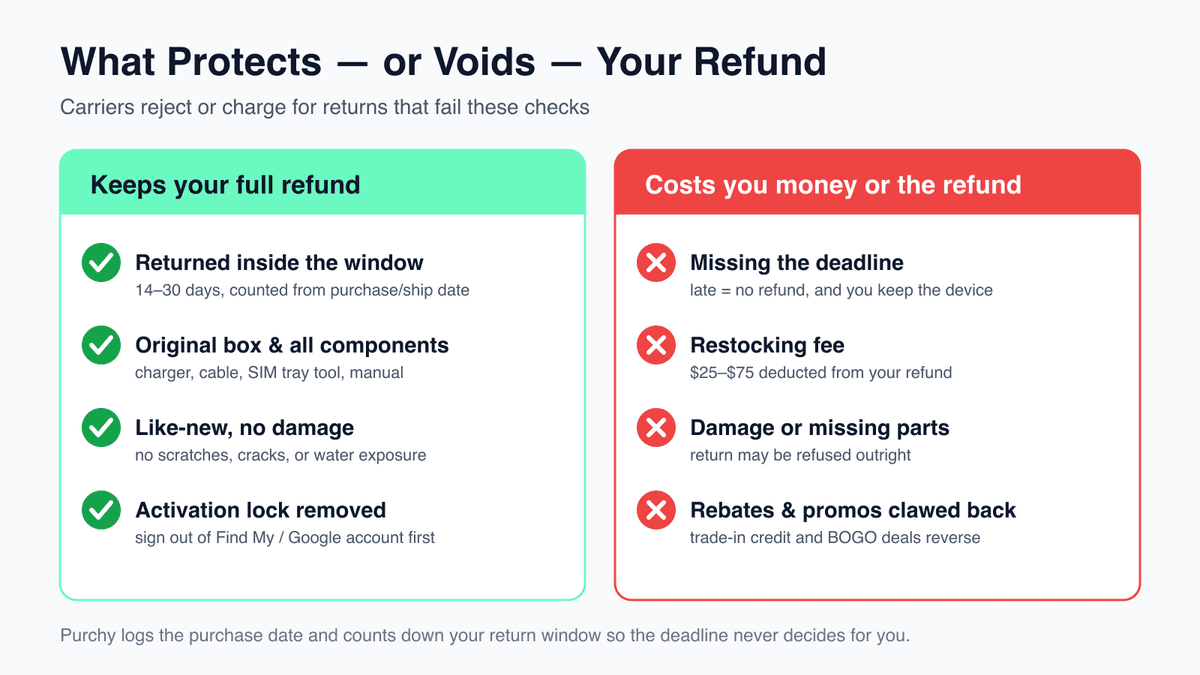
What "keeps your refund" looks like in practice:
- Inside the window. Counted from the purchase, activation, or ship date depending on the carrier.
- Original box and all components. The charger, cable, SIM tool, manual, and any included accessories.
- Like-new, no damage. No scratches, cracks, or any sign of water exposure.
- Activation lock removed. Sign out of Find My (Apple) or your Google account (Android) and remove any screen lock before you hand it back. A device still tied to your account can be rejected because the store can't resell it.
What costs you money or the whole refund:
- Missing the deadline — the most common and least forgivable mistake.
- The restocking fee itself, deducted from the refund.
- Damage or missing parts, which can void the return outright.
- Reversed promotions — if your purchase included a trade-in credit, bill credits, or a "buy one, get one" deal, returning the phone typically claws those back, so your real refund is smaller than the sticker price.
Never let a 14-day clock run out by accident. Purchy logs your purchase date and counts down the return window for every device you buy, so the deadline becomes a reminder instead of a surprise. Get Purchy and stop losing refunds to the calendar.
The three-day "cooling-off" myth
One of the most persistent myths in retail is that you always have three days to cancel any purchase. People apply it to phones constantly. It's wrong.
The federal rule people are thinking of is the FTC Cooling-Off Rule (16 CFR Part 429), and it's narrow. It gives you three days to cancel only a "door-to-door sale" — defined as a sale of consumer goods or services with a purchase price of $25 or more made at the buyer's residence, or $130 or more at temporary locations like "hotel or motel rooms, convention centers, fairgrounds and restaurants," per 16 CFR § 429.0.
A phone you buy in a carrier store is a sale at the seller's permanent place of business — not covered. A phone you buy online isn't a door-to-door sale either. So there is no automatic three-day right to cancel a phone purchase; your only window is the carrier's own 14-to-30-day return policy. We unpack the rule's real scope in the cooling-off rule guide.
Three deadlines, not one: return, warranty, trade-in
The biggest conceptual mistake people make with a new phone is treating it as having one deadline. It has at least three, and they do completely different things:
- The return window (14–30 days). This is your "changed my mind" right. It's short, and once it closes, the phone is yours.
- The warranty (typically one year). This covers defects, not buyer's remorse. A phone that stops working through no fault of yours is a warranty claim — usually a free repair or replacement — and that clock runs for months after the return window has closed. The federal Magnuson-Moss Warranty Act governs how those written warranties work.
- The trade-in deadline. If you got bill credits for trading in an old phone, the carrier requires you to send the old device in by a set date (often a few weeks). Miss it and the promised credit reverses — you get charged for a discount you thought you'd earned.
Confusing a defect for a return — or forgetting a trade-in deadline — is how people lose money on a phone they were happy with. The fix is boring but effective: track each date separately.
How to return a phone without losing money
A clean phone return comes down to six habits:
- Record the purchase date and the return-by date immediately. Don't trust your memory on a 14-day clock.
- Keep the box and everything in it. Don't toss the packaging "until you're sure" — being sure is exactly what the window is for.
- Don't break the seal if you're unsure. Unopened devices return cleanest, and at AT&T an unopened Apple device dodges the restocking fee entirely.
- Back up and sign out before returning. Remove the activation lock and wipe the device so the store can accept it and your data leaves with you.
- Budget for the restocking fee. Expect $25–$75 to come out of the refund unless you're unopened or in a state that bans the fee.
- Return through the original seller, in person if you can. A store associate confirms the device passed inspection on the spot, instead of mailing it and hoping. Get a return receipt.
Then confirm the money actually arrives. Refunds to a card can take a few business days to over a week to post — see how long a refund takes — and a deduction for the restocking fee, taxes, or a reversed promo means the amount won't match the sticker price.
What to do if a return or refund is denied
If you returned a device correctly and inside the window but the refund never shows — or the carrier refuses a return you believe qualifies — escalate in order:
- Go back to the seller with your paperwork. The return receipt, the original invoice, and the date you returned the device usually resolve it.
- Ask for the policy in writing and point to the specific term that supports your return (window, condition, state disclosure requirement).
- Dispute the charge with your card issuer as a last resort. If you paid by credit card, the Fair Credit Billing Act gives you the right to dispute a billing error — see how to dispute a credit card charge. If you paid by debit card, a different set of protections applies; our debit vs. credit disputes guide explains the difference.
The stronger your records, the faster any of these moves works. A timestamped purchase record and a saved return receipt turn a "your word against theirs" argument into a paper trail.
Frequently asked questions
How long do I have to return a cell phone?
It depends on the carrier. T-Mobile gives 14 days for in-store purchases and 20 days for online or phone orders (90 days for phones bought through Costco). Verizon gives 30 days. AT&T gives 14 days. If you bought from Apple or Best Buy, their own windows apply — usually 14 days.
Do carriers charge a restocking fee on returned phones?
Almost always. T-Mobile charges $25, $50, or $75 depending on the device's full retail price. Verizon charges a flat $50 (plus tax), except in Hawaii. AT&T charges up to $55, though it waives the fee on Apple devices returned unopened. The fee is deducted from your refund even when the return is valid.
Can I return an opened phone?
Yes, as long as you're inside the return window and the device is in like-new condition with the original box and all components. Opening the phone does not automatically void the return at the carriers, but damage, missing parts, or a device still locked to your account can cause the return to be refused. Note that AT&T's no-restocking-fee perk for Apple devices only applies if the device is unopened.
Is there a three-day right to cancel a phone purchase?
No. The federal FTC Cooling-Off Rule gives three days to cancel only sales made at your home ($25 or more) or at temporary locations like hotels or fairgrounds ($130 or more). A phone bought in a carrier store or online is not covered, so your only window is the carrier's own return policy.
What happens if I miss the return window?
You generally lose the right to a refund and keep the device, along with any installment plan attached to it. Verizon goes further and warns that a device returned after the window will not be refunded and will not be sent back to you, so do not ship a late return.
Does returning a phone get me out of an early termination fee?
Returning the device within the window is separate from cancelling service. If you cancel a term service agreement, an early termination fee may still apply — AT&T lists $325 minus $10 for each full month completed on a smartphone. Returning the hardware and ending the contract are two different actions with two different sets of rules.
Do I get the restocking fee back if the phone is defective?
A defective phone is usually a warranty matter, not a buyer's-remorse return. Warranty exchanges for a defect typically don't carry a restocking fee, and the warranty clock runs for about a year — long after the return window closes. If a carrier charged a restocking fee on what was actually a defect, raise it and ask for the warranty process instead.
How do I avoid a restocking fee on a phone return?
Three ways: return the device unopened where the carrier waives the fee on unopened items (AT&T does for Apple), buy in a state that prohibits restocking fees, or confirm before purchase whether the fee was properly disclosed where your state requires it. Otherwise, plan for $25–$75 to come out of your refund.
Does buying a phone at Costco, Apple, or Best Buy change the return policy?
Yes. The return policy follows the seller. A phone bought at Costco can carry a much longer window (up to 90 days through T-Mobile's partnership), while Apple and Best Buy each run their own 14-day windows. Always return to the place you bought it, on that seller's terms.
How Purchy helps
A phone return is the textbook case for why deadline tracking matters: the window is short, the fee is real, and there's more than one clock running at once. Purchy is built to keep those clocks from deciding for you:
- Return-window countdowns for every purchase, so the 14-day clock on a phone never expires quietly in the background.
- Trade-in and promo reminders, so you send your old device in before the credit reverses.
- Warranty tracking, so a defect that surfaces months later is still a free repair instead of a missed window.
- Organized receipts and order history — timestamped and centralized — which is exactly the proof you need to win a refund or a dispute.
The whole point is that a return decision should be made on the merits, not lost to a calendar. Get Purchy and let the deadlines work for you instead of against you. It's live on iPhone and Android.
Sources and citations
Carrier return policies
- T-Mobile Return Policy (14-day in-store / 20-day online windows; $25/$50/$75 restocking tiers; condition and non-refundable terms)
- Verizon Returns & Exchanges Policy (30-day window; $50 restocking fee excluding Hawaii; original-box and like-new conditions)
- AT&T Wireless Returns Policy (14-day window; up to $55 restocking fee, waived on unopened Apple devices; 10% accessory fee; early termination fee)
Consumer law
- 16 CFR § 429.0 — FTC Cooling-Off Rule definitions (Cornell LII) — door-to-door sale thresholds ($25 at residence / $130 at temporary locations)
- 16 CFR Part 429 — Cooling-Off Rule (Cornell LII)
- California Civil Code § 1723 — return-policy and restocking-fee disclosure (California Legislative Information)
Internal references
- Apple return policy 2026 complete guide
- Best Buy return policy 2026 complete guide
- Samsung return policy 2026
- Restocking fees 2026 complete guide
- Return policy laws by state 2026
- The cooling-off rule and your 3-day right to cancel
- How long does a refund take? 2026
- Magnuson-Moss Warranty Act 2026
- How to dispute a credit card charge 2026
- Debit vs. credit card disputes 2026
- How to track receipts digitally 2026
Last verified May 26, 2026 against the published return policies of T-Mobile, Verizon, and AT&T, the FTC Cooling-Off Rule (16 CFR Part 429, Cornell Legal Information Institute), and California Civil Code § 1723 (California Legislative Information). Carrier return windows, restocking fees, and conditions change and vary by state — always confirm the current terms on your carrier's official returns page before you buy or return a device. Educational content only; not legal advice.
Wake to one edition. Only what matters.
$12.99 a month or $99.99 a year. Cancel any time from the App Store or Google Play.