Why a Daily Budget Works: The Purchy Paradigm
A daily budget answers the question a bank balance can't. Here is the arithmetic behind the Purchy Paradigm, why it needs no memory, and where it falls down.
Standing at the till with your phone in your hand, you do not actually want to know your balance. You want to know whether this is fine. A daily budget answers that question; a balance never has. What follows is the case for one number a day — the method we call the Purchy Paradigm — the arithmetic underneath it, the seven reasons it survives contact with a real week, and the three places it lets you down.
The Purchy Paradigm, in one sentence
The Purchy Paradigm is this: take what is actually left, subtract what is already promised to somebody else, divide the rest by the days until payday, show that and only that — then throw it away and work it out again from scratch tomorrow morning.
Everything else on this page is an argument for why each clause of that sentence is load-bearing.
The question a balance cannot answer
A bank balance is a stock. It is a single large number with no reference point attached, and it is the same number whether payday is tomorrow or eleven days away. Ask it whether you can spend forty dollars on dinner and it says nothing at all, because forty dollars is small next to almost any balance a person is willing to look at. That is precisely the problem. Judged against a big number, every individual purchase looks trivial, which is how a month of individually trivial purchases arrives at the end of the month as a surprise.
The trouble is not that people are bad at arithmetic. It is that a stock and a decision are different shapes. The decision at the till is about a flow — money per unit of time — and the balance is the wrong unit to answer it in. This is the same reason people will happily drive across town to save ten dollars on a twenty-dollar item and would not consider the same drive to save the identical ten dollars on a five-hundred-dollar one. We judge amounts against whatever reference we have to hand, and a daily budget hands you a reference small enough that a forty-dollar dinner is visibly forty dollars.
A balance is a stock. A spending decision is a flow. Dividing one into the other is not a simplification — it is a unit conversion into the terms the decision is actually made in.
What the number actually is
Three details separate this from a number you could guess at.
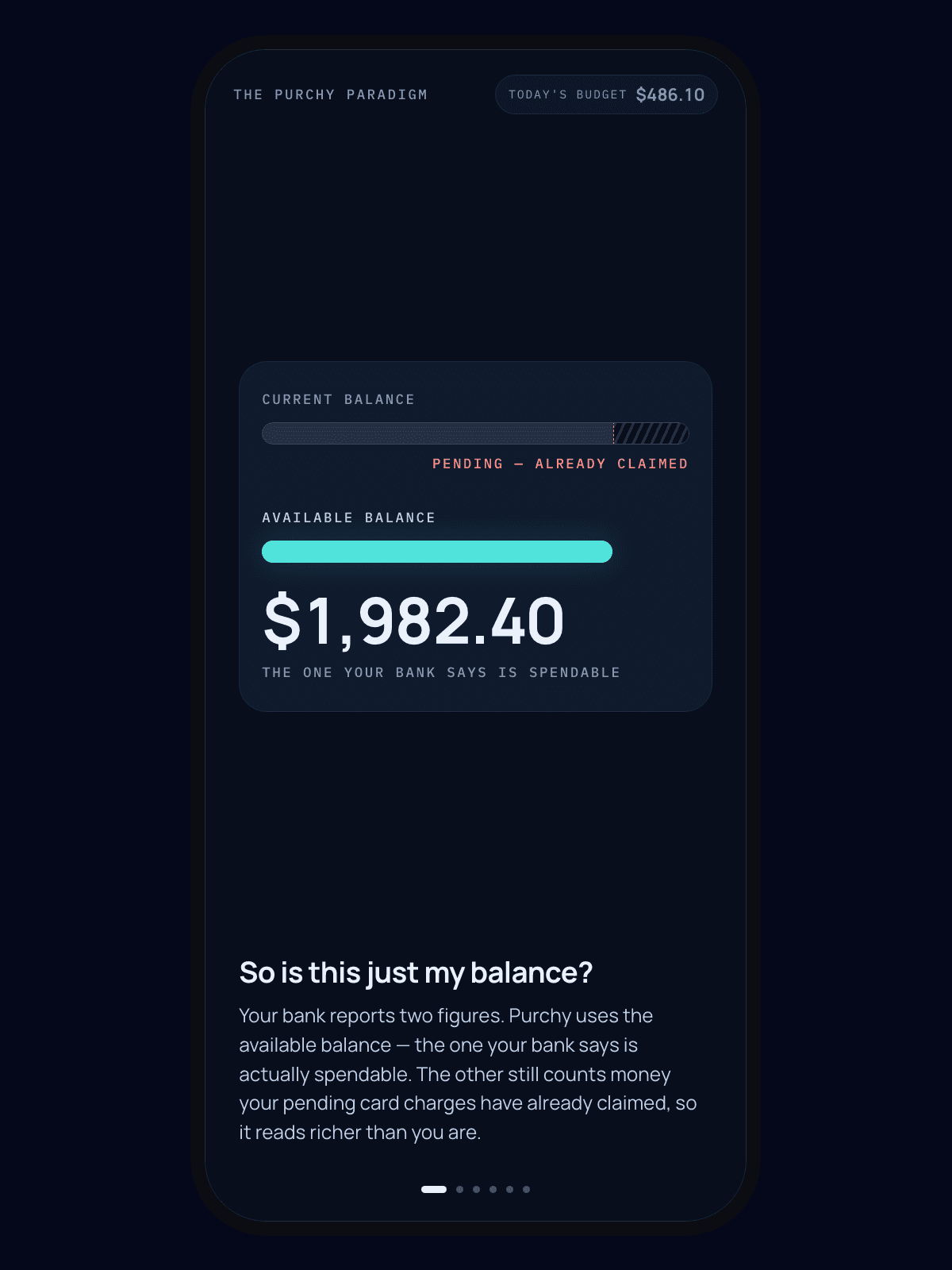
It divides the available balance, not the current balance. These differ more often than people expect, and the distinction is the bank's own, not ours. The current figure still counts money that pending debits have already claimed — the card you tapped this morning, the deposit that has not fully settled. Available is what the bank will actually let you draw today. Budget from the current figure and you are dividing up money that is, in the most literal sense, already gone.
It subtracts what is already spoken for first. Before anything is divided, the app reserves every charge it expects between today and your next payday. Internally that reserve has a name — the committed reserve — and it is the difference between a daily number you can trust and one that quietly borrows from your rent. It is also why a forgotten subscription costs you twice: once when it charges, and every day before that, in a budget that was quietly too generous.
Then it divides by the days you have left, not by thirty. The full formula is short enough to write down:
available    = what the bank says you can draw today
committed    = charges due between today and payday
leftToSpend  = available + unseen income − committed
budget       = leftToSpend ÷ days until payday
"Unseen income" is the term for money that is genuinely coming but has left no trace in the account yet. It is usually zero.
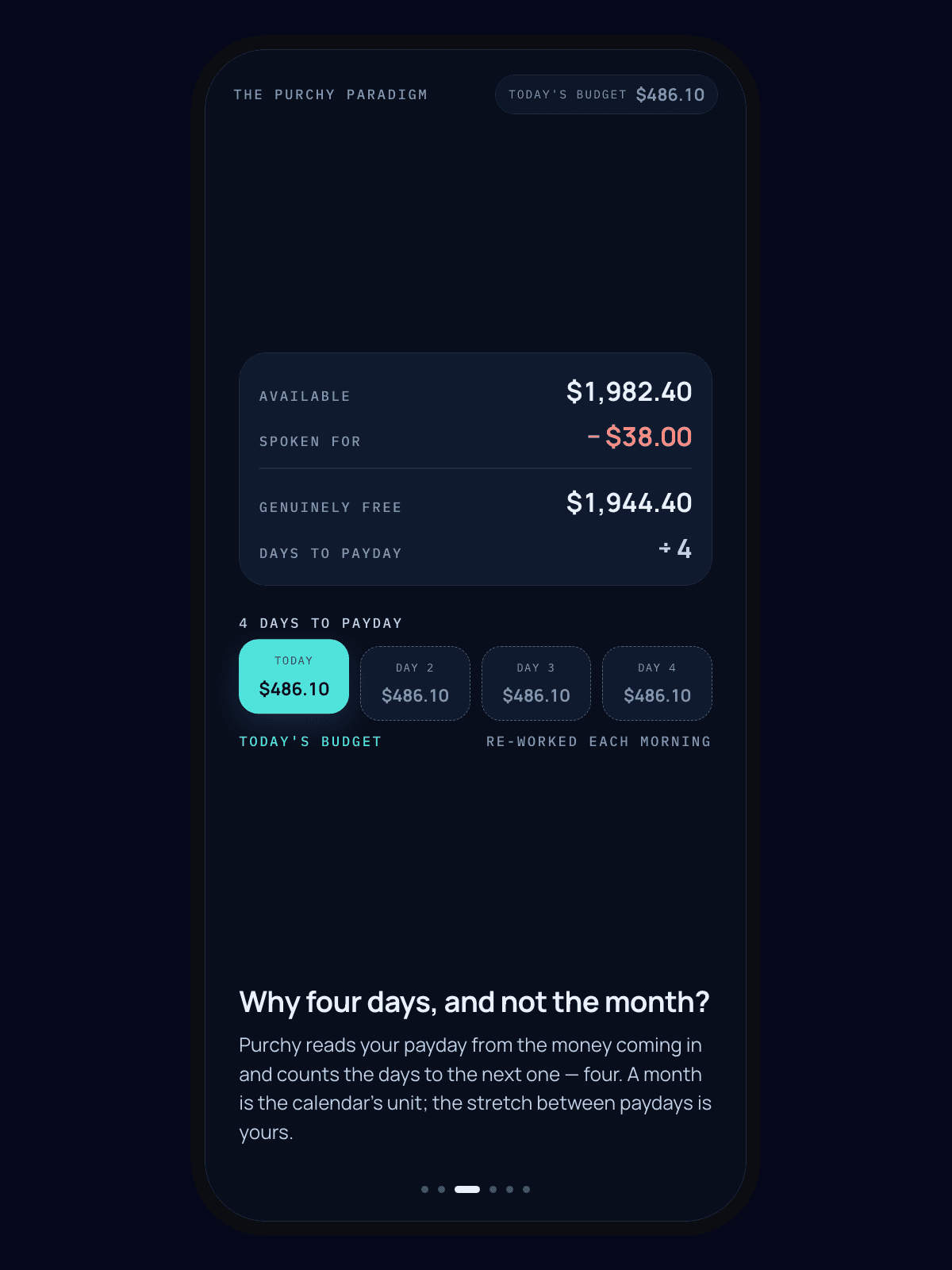
With real figures in, the whole thing fits on one card:
And here are the same figures on the Perch itself:
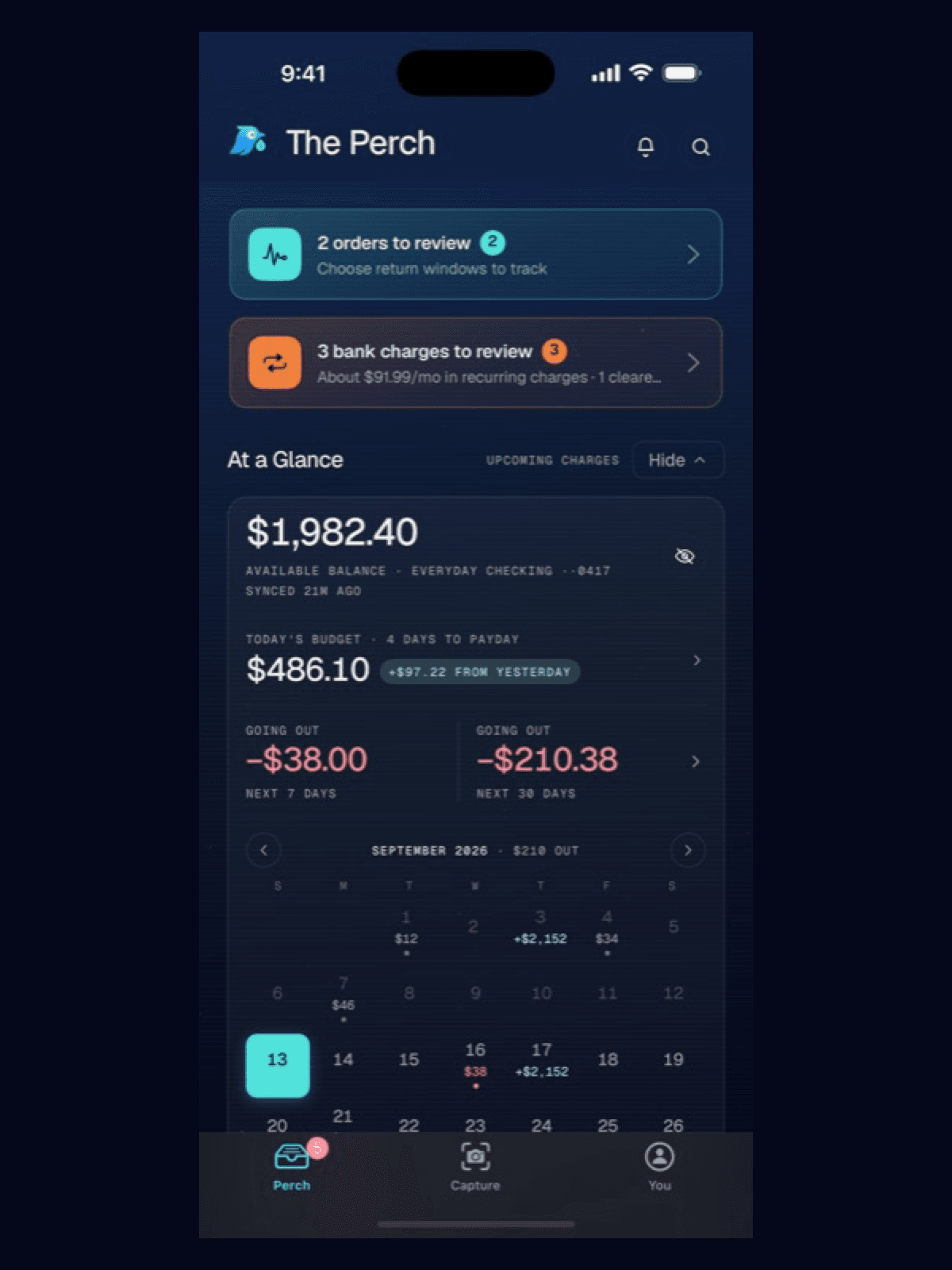
The screen above is the whole formula, if you read it in the right order. Available balance, $1,982.40. Going out before payday, $38.00 — a single gym renewal due on the sixteenth. Days to payday, four, with the deposit landing on the seventeenth. Which gives $1,982.40 minus $38.00, divided by four: $486.10, which is exactly the number on the screen. There is no fudge factor and nothing held back, and no unseen income to add.
What "already spoken for" means
The reserve is where a daily budget is usually quietly wrong, so it is worth being exact about what goes into it. The rule is deliberately pessimistic: a charge counts against you until you have proof it will not happen.
| What you have told Purchy about a charge | Does it come out of today's budget? |
|---|---|
| You are keeping it | Yes |
| You need to investigate it | Yes |
| You intend to cancel it, but haven't yet | Yes |
| You haven't reviewed it yet | Yes |
| You have confirmed it is cancelled | No |
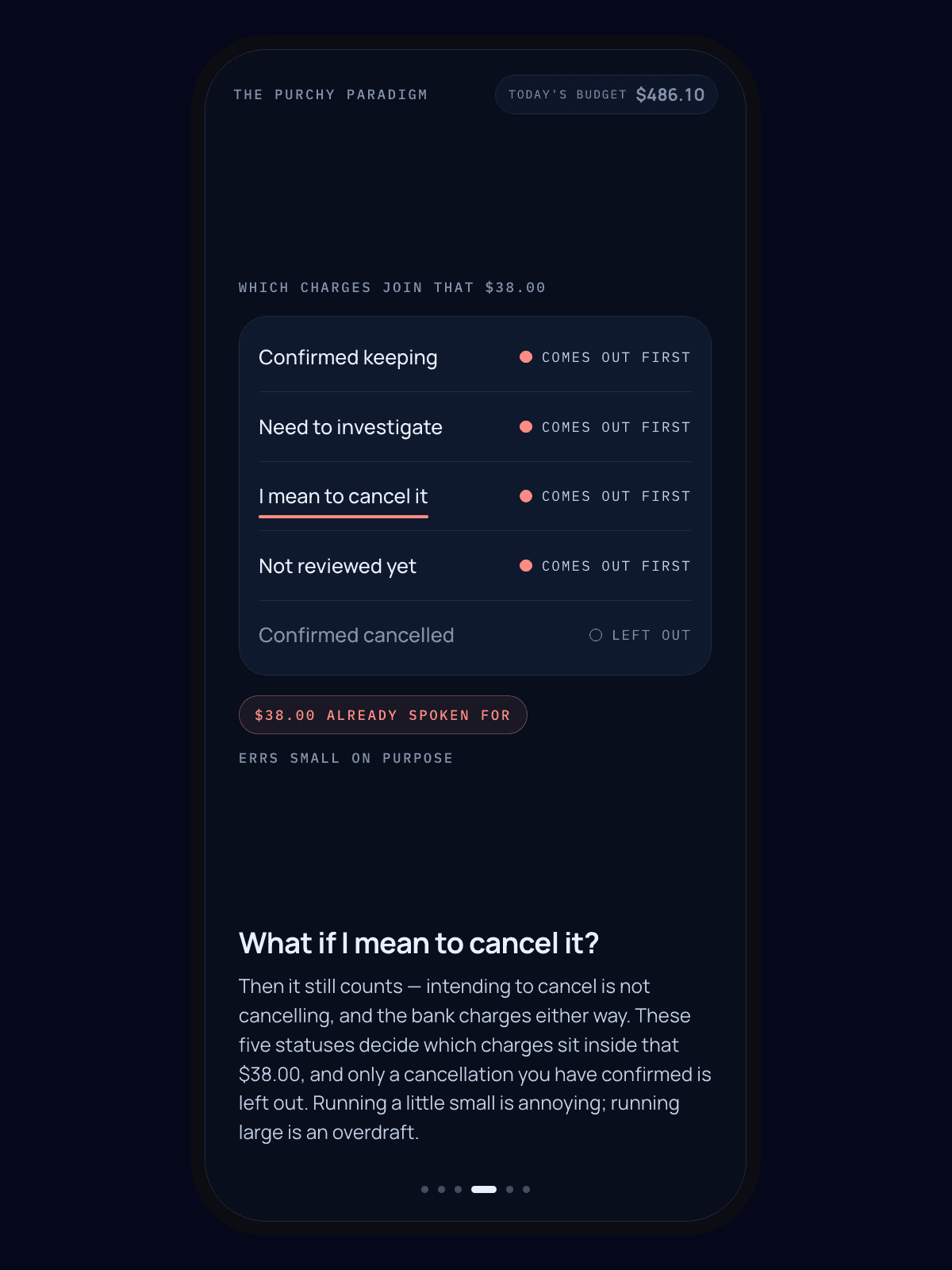
The third row is the one that matters and the one most tools get wrong. An intention to cancel is not a cancellation. The bank does not know what you meant; it knows what mandate it holds, and it will charge you again on schedule. Reserving that money until the cancellation is real is not pessimism, it is accuracy — and it means the day you actually go and cancel the thing, tomorrow's number goes up, which is far better feedback than a number that flattered you in advance.
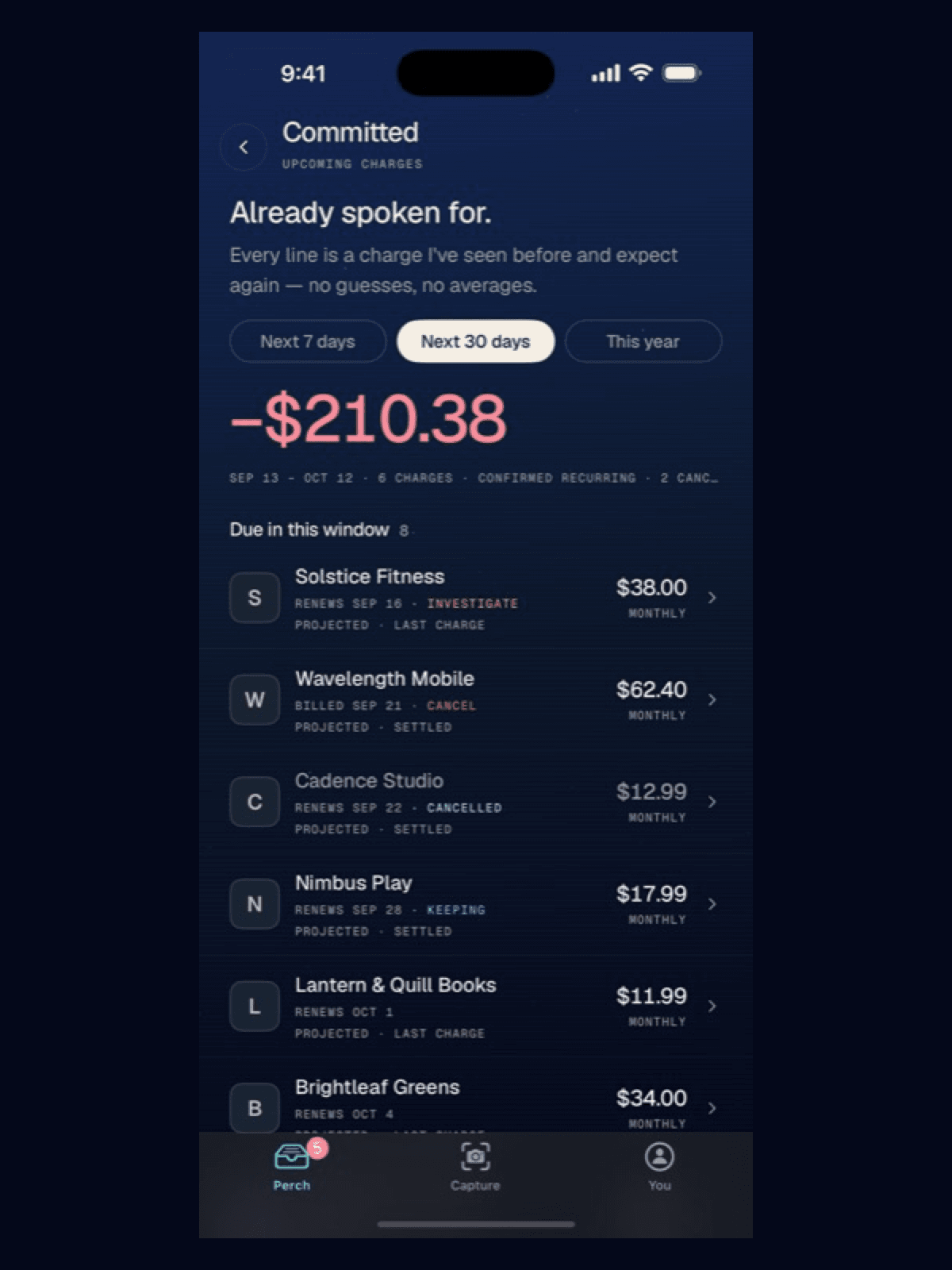
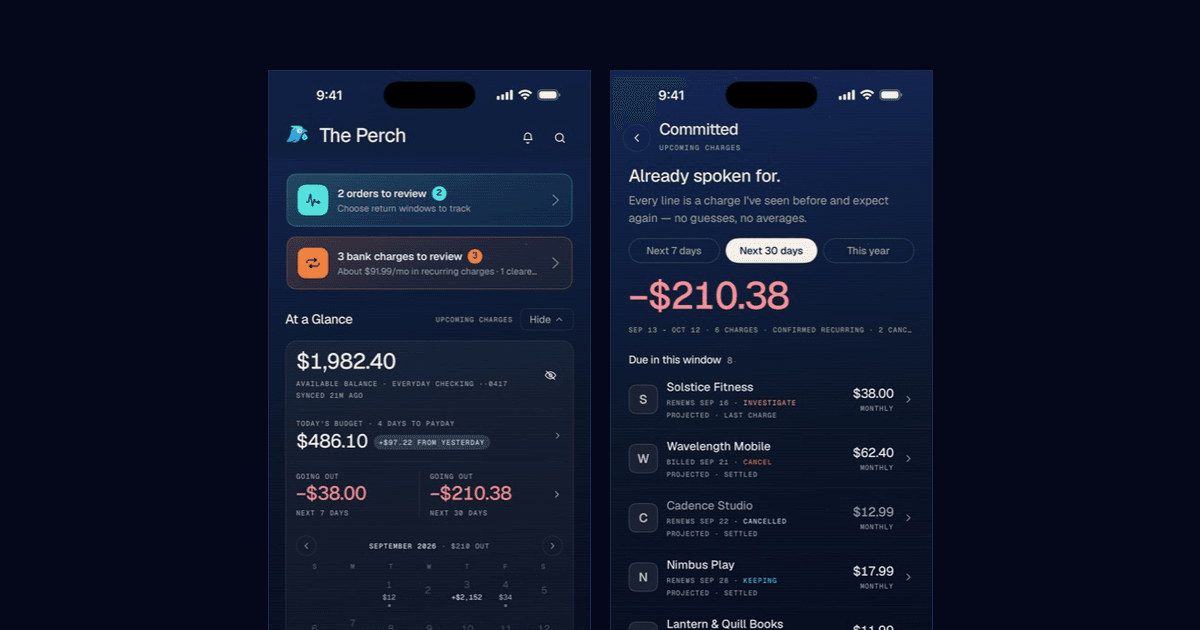
That screen is the rule made visible. The gym charge is flagged investigate and counts. The phone bill is flagged cancel and still counts, because it has not been cancelled. The streaming subscription is flagged keeping and counts. Two more charges nobody has looked at yet count. And Cadence Studio, at $12.99, is greyed out and excluded, because that one is confirmed cancelled. Six charges remain, and they add to $210.38 — the figure at the top of the screen, and the same figure carried back to the Perch as the thirty-day outflow.
Why it needs no memory
The original specification for this feature was recursive, and sounded much more complicated than what shipped: each morning, take whatever you didn't spend yesterday, and spread it across the days you still have left. Under-spend today and tomorrow is richer. Over-spend today and tomorrow is leaner. It is an appealing description because it is how the experience actually feels.
It is also, when you work it through, identical to the single division above. The leftover from yesterday is just the balance today, and the days still left are just today's denominator. The recursion collapses. That is not a curiosity — it is the reason the feature has no state to corrupt. There is no running total kept anywhere, no ledger of the month so far that can drift a few cents out of true and stay wrong until someone notices. The number is re-derived from the bank every morning, which means a stale or broken figure can survive at most one day.
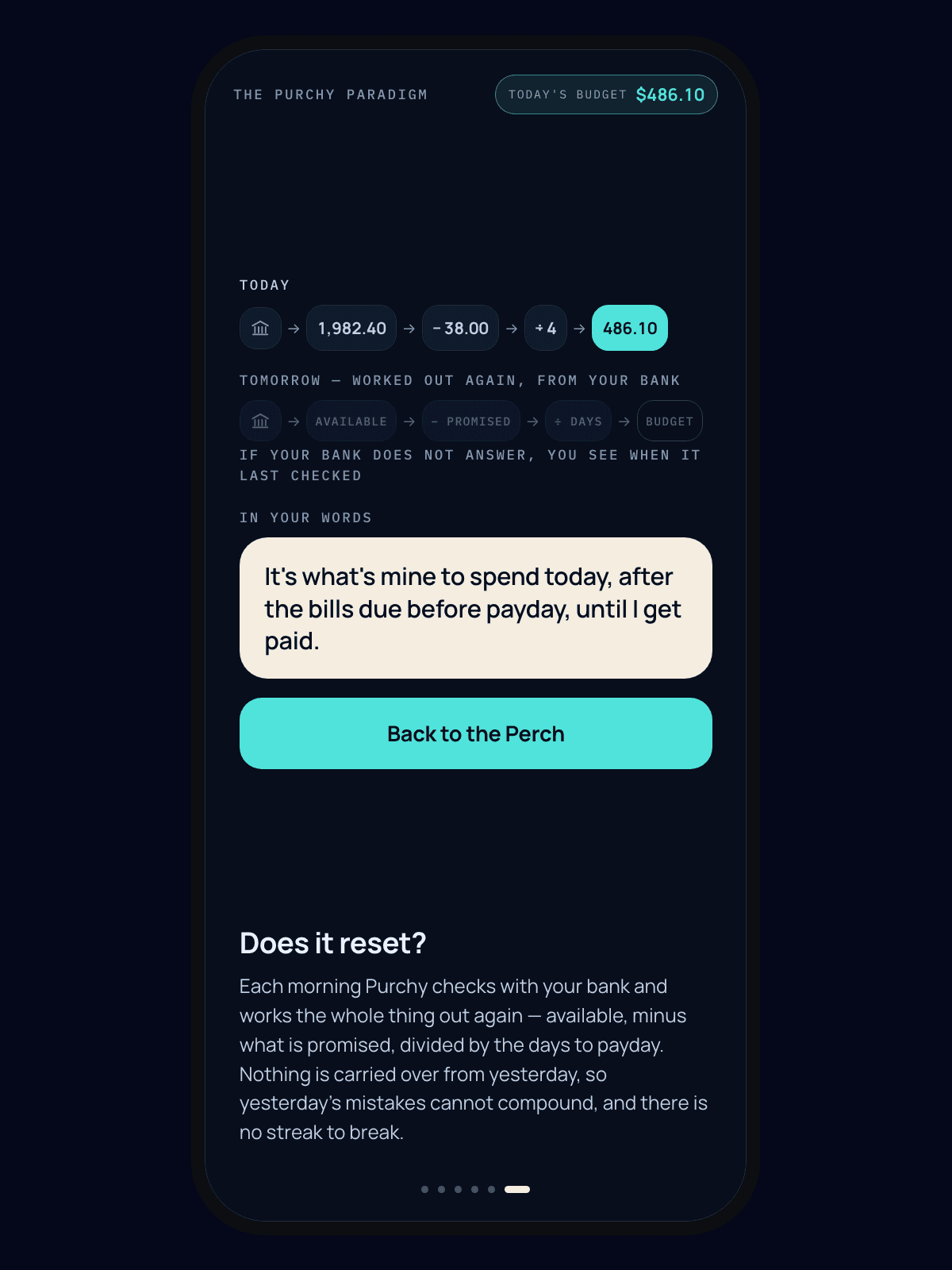
The general name for that closed form is amortization — specifically re-amortization, or recasting: re-dividing a remaining balance over a remaining term, every period. In a spreadsheet it is the PMT function with the interest rate set to zero. The most widely used real-world instance of exactly this formula is the required minimum distribution rule for retirement accounts, which each year divides the account balance by remaining life expectancy. And the consumer-facing name for the idea is "safe to spend", a framing the banking app Simple popularized around 2012.
None of this is new mathematics. The Purchy Paradigm's contribution is not the formula — it is that the reserve is assembled from charges the bank has actually seen before, rather than from categories you were asked to estimate in advance.
Seven reasons the number sticks
It converts a stock into a flow
This is the load-bearing one. A balance cannot answer the question you are actually asking, because it has no time dimension and no reference point. A daily number has both. It answers "is this fine?" directly, in the unit the question was asked in, and it puts a small purchase next to a small budget where the comparison is one a person can actually make.
It replaces self-control with arithmetic
Consider what you would have to do, unaided, to know whether a purchase is affordable: recall your available balance, recall every charge due before payday, subtract, count the days, divide. Nobody does this standing in a shop. Nobody can. When people fail at this they conclude they lack discipline, but the failure is informational, not moral — they were never given the number that the decision required. Handing it over does not demand more willpower; it removes the need for most of it.
Reserving the rent removes the recurring surprise
Everybody knows, in the abstract, that rent is coming. Almost nobody feels it in the week before it lands, which is why the same bill produces the same jolt month after month. Pulling committed money out before the division converts that abstract knowledge into a smaller number today, and the jolt stops arriving. This matters more than it sounds, because financial stress is driven at least as much by uncertainty as by scarcity: not knowing whether you are fine is its own cost, separate from whether you are.
Daily re-amortization removes the abandonment cliff
A monthly budget has exactly one failure point, and it is early. Go over in week two and the budget is broken, and a broken budget is one you stop opening — which is when the real damage starts, because now you are spending without any reference at all. The collapse that follows a first lapse is well documented in dieting research, where it is called the what-the-hell effect: having broken the rule, the rule no longer constrains, and the rest of the day is written off. A number recomputed each morning from what is actually in the account has no broken state to abandon. Overspend today and tomorrow's number is smaller. That is the entire consequence. There is nothing to have failed at and therefore nothing to walk away from.
Restraint pays back tomorrow morning
Skip the thing today and you see the result at breakfast, as a bigger number with a small note beside it saying where it came from. That gap — between the effort and the evidence it worked — is doing most of the work in building the habit. Rewards that arrive at the end of the month, or at the end of the year, are too far away to reinforce the behaviour that earned them. A budget that pays out overnight is a budget you learn from.
One number fits in working memory
Envelope budgeting asks you to hold a dozen category balances in your head and route each purchase to the right one, which is why adherence to it is famously poor — not because the idea is wrong, but because the ongoing cost of running it exceeds what most people will pay for years on end. One number has no routing step and no categories to maintain. It is worse at diagnosis and far better at survival, and a method you are still using in three years beats a better method you abandoned in March.
It puts the constraint in the present
We discount the future steeply. A target that binds at the end of the month is, from where you are standing, a fact about a stranger, and it carries about as much weight as one. A number for today is not in the future at all. It is a constraint on the decision in front of you, made by you, this morning — which is the only place a constraint has any real force.
What today's spending does
One consequence catches people out, so it is worth stating plainly: what you spend today does not change today's number. The budget is derived once, in the morning, from the balance the bank reported. Spend forty dollars at lunch and the figure on the screen does not tick down.
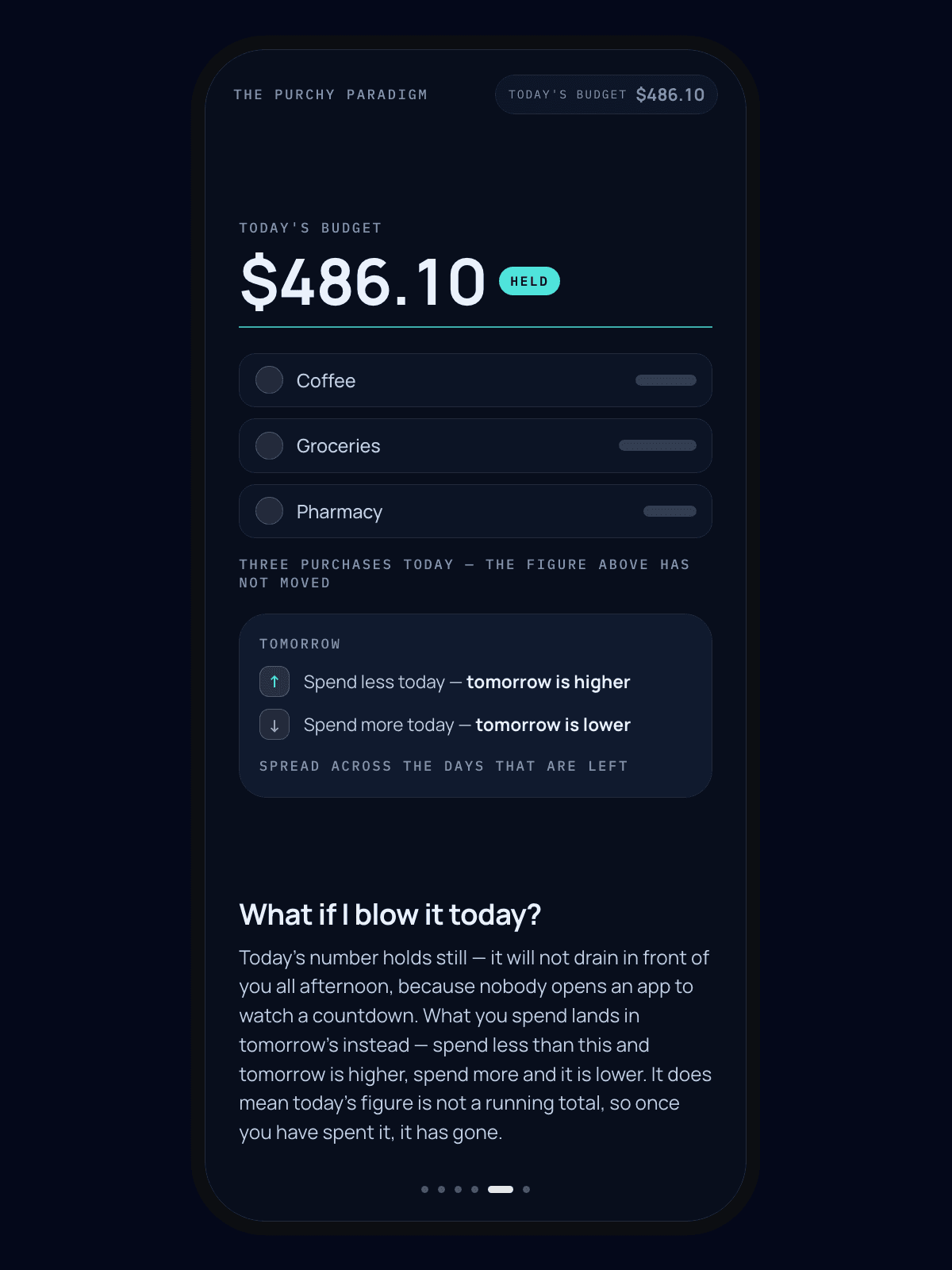
That is a design decision rather than an oversight. Today's spending shows up tomorrow, in tomorrow's number, because tomorrow's number is derived from tomorrow's balance. The alternative — a live countdown that shrinks as you spend — reintroduces exactly the thing the daily frame was built to remove: a running total that can be broken, and that you can then stop looking at.
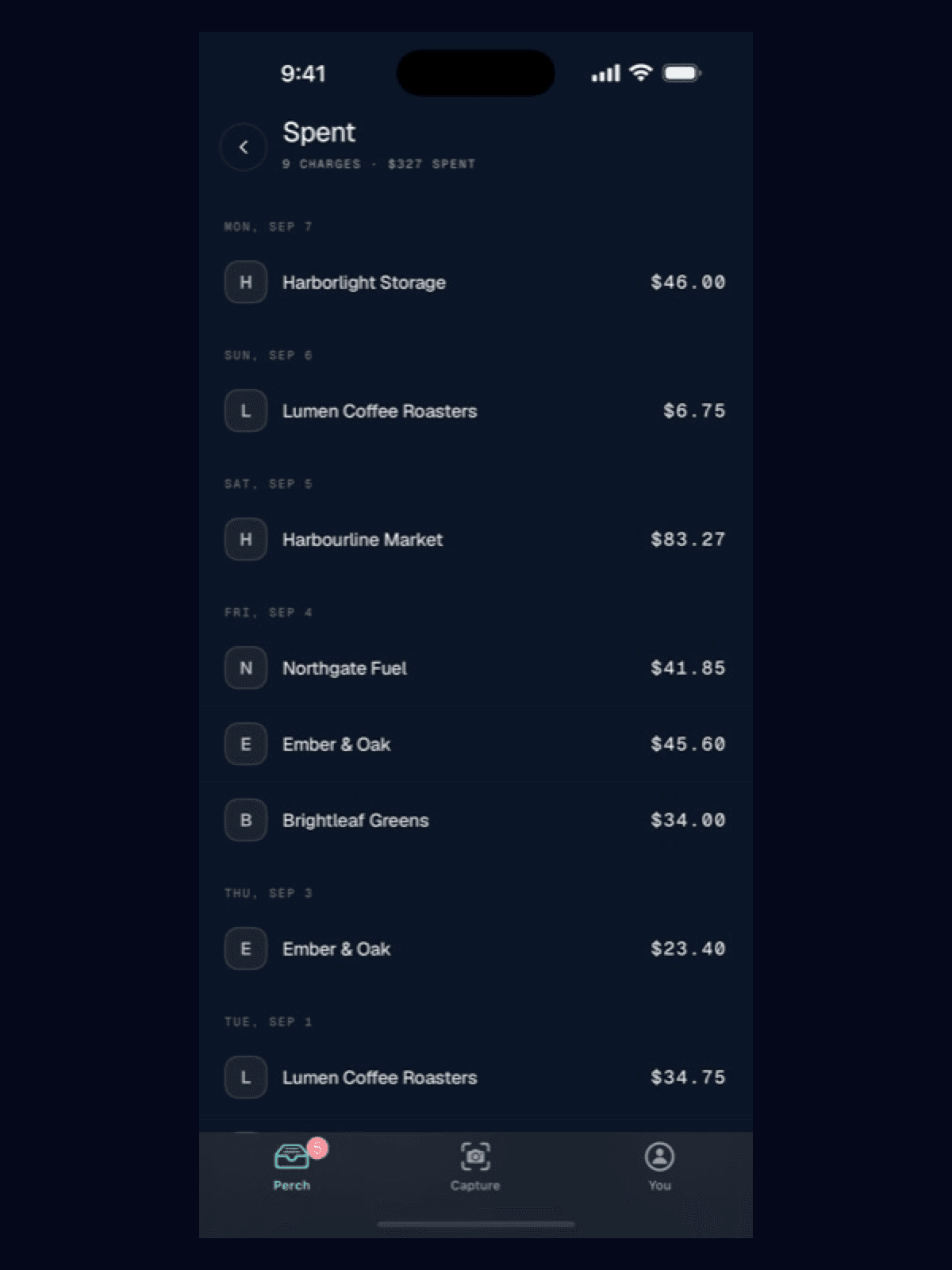
The drill-in above is where today goes to be read: not as a score, just as a record of what the number was spent on.
Where the Purchy Paradigm falls down
Three honest objections, none of which have good answers.
A daily allowance can license spending. A number that says $486 is available today is also a number that says $486 is available today. For some people, on some days, that reads as permission for a purchase they had no intention of making before they looked. A budget that tells you a ceiling has told you where the ceiling is, and ceilings are load-bearing in both directions.
The smoothing is symmetric, and it flattens saving too. The mechanism that stops a bad Tuesday from wrecking the month also stops a frugal Tuesday from compounding into anything. Money you don't spend is not moved anywhere or marked as saved; it is simply re-divided across the remaining days and handed back to you as a slightly larger allowance. Under-spending, in this frame, buys you a better tomorrow rather than a balance that grows.
There is no room in the frame for a goal past the next payday. The horizon is, by construction, the next deposit. A deposit for a flat, a trip eight months out, a fund you are trying to build — none of these have any representation in a number that resets every fortnight. The Purchy Paradigm answers "can I spend this today", and that is genuinely all it answers. It is not a plan, and anyone using it as one will find it silent on the thing that mattered most.
And underneath all three, one structural risk: the entire benefit rests on the number being correct, and the error is asymmetric. A number that is too low is annoying, and you will stop trusting it. A number that is too high is an overdraft. That asymmetry is why the reserve counts a charge you meant to cancel, and why it divides the available balance rather than the flattering one. Being slightly too careful costs you a mild irritation. Being slightly too generous costs you a fee and the credibility of every number that comes after it.
What it is actually for
The Purchy Paradigm is not a budgeting philosophy and it does not ask you to be a different kind of person. It does one narrow thing: it converts a balance you cannot reason about into a number you can, subtracts the money that was never really yours to spend, and shows you the result at the only moment the answer is useful. Then it forgets, and does it again tomorrow.
That is a smaller promise than most budgeting tools make. It is also one that can be kept every single morning, which is the only reason it works. If you want the longer argument for why we think money is a visibility problem rather than a discipline problem, it is over here.
Wake to one edition. Only what matters.
$12.99 a month or $99.99 a year. Cancel any time from your Apple Account.
Download on iOS →