Forgotten Subscription Charge? How to Get a Refund
Need a refund for a forgotten subscription charge? Apple, Google Play, Microsoft and Amazon publish four different rules. Here is which one applies to you.
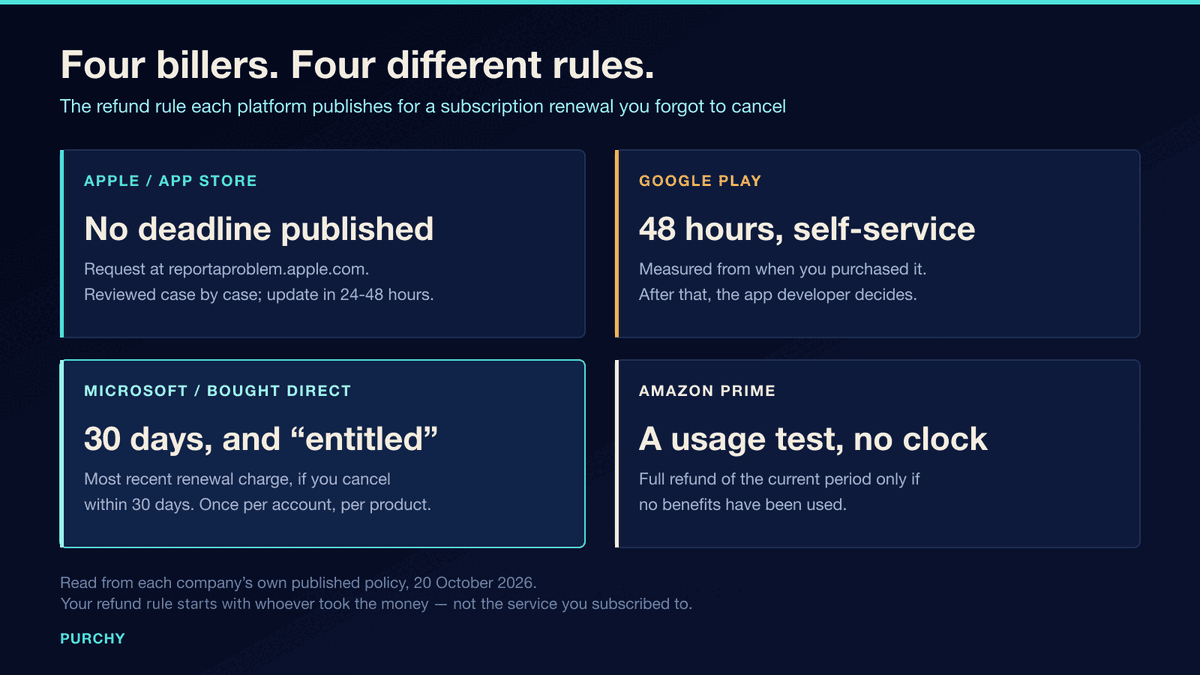
Whether you can get a refund for a forgotten subscription charge depends on who took the money. Microsoft says you are "entitled" to your latest renewal back if you cancel within 30 days of paying, Google Play may refund within 48 hours of purchase, Amazon asks only whether you used your Prime benefits, and Apple publishes no deadline. Each of those rules comes from the biller's own policy page, and the spread is wide: the same forgotten $14.99 renewal is an explicit entitlement at Microsoft and expressly nonrefundable at Netflix.
The 30-second answer. Your refund does not depend on how quickly you noticed or how politely you ask. Find the biller named on your card statement, cancel the subscription, then ask through that biller's own channel and name the published condition you meet — Microsoft's 30 days, Google Play's 48 hours, Amazon's unused benefits. If you subscribed directly to a service such as Netflix or Spotify, there is usually no published refund at all, so you are asking a favor rather than invoking a rule.
Who refunds a forgotten subscription charge? Start with who took the money
The company whose service you subscribed to is often not the company that charged you. If you subscribed through an in-app purchase on an iPhone, Apple took the money. Through an Android in-app purchase, Google took it. Through a Microsoft account, Microsoft took it. And whoever took the money determines which published policy your request runs through first — though not always their own, as the Google Play case below shows.
This matters because those policies are not similar. One sets a 48-hour clock. One sets 30 days and calls the result a right. One sets no clock and no promise. One ignores time completely and asks a different question entirely.
A note on what this guide covers. This page is about a charge you did not cancel in time — the renewal you meant to stop and forgot. If you already cancelled and the charges kept coming anyway, that is a different problem with different remedies, and it is covered in depth in canceled subscription still being charged, including the card-network dispute rules and the Regulation E stop-payment route. Here, the money was taken under a subscription that was genuinely still active. You are asking for it back.
The published refund rules, side by side
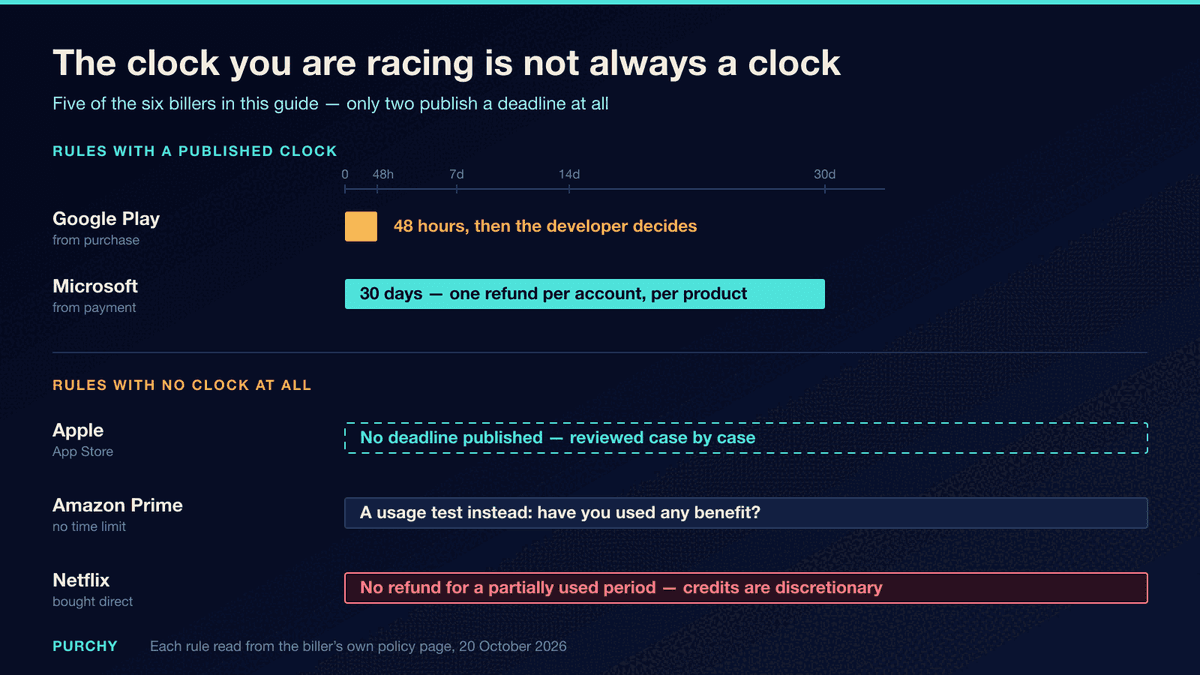
Six billers cover most forgotten charges: the four big platforms that take the payment — Apple, Google Play, Microsoft and Amazon — and the direct merchants you pay yourself, represented here by Netflix and Spotify. (Apple and Google bill on a developer's behalf; Microsoft and Amazon bill for their own services. Either way, they own the refund rule.) Here is what each one actually publishes, read from its own policy pages on 20 October 2026. The "who decides" column is the one that matters most.
| Biller | Published window for a renewal charge | Who decides | Where you ask |
|---|---|---|---|
| Apple (App Store) | No deadline published | Apple, case by case | reportaproblem.apple.com |
| Google Play | Self-service within 48 hours of purchase; after that, the developer | Google for 48 hours, then the app developer | Google Play refund form, then the developer |
| Microsoft (direct) | Most recent renewal, if you cancel within 30 days of payment — once per account, per product | Microsoft, applied automatically at cancellation | Services and subscriptions, then Manage, then Cancel |
| Amazon Prime | No time limit stated; turns on whether benefits were used | Amazon, on the usage test | Cancel Your Prime Membership |
| Netflix (direct) | None — payments are nonrefundable | Netflix, "at our sole and absolute discretion" | Account page, then support |
| Spotify Premium (direct) | None published | Spotify | Spotify support |
Read that table again and notice what is missing: there is no column for how nicely you ask. For most of them the outcome turns on a published condition you either meet or do not.
Apple: no published deadline, and "all transactions are final"
Apple publishes no time limit on refund requests for App Store purchases. Its support page says only that purchases "might be eligible for a refund" and that "refund eligibility might vary by country or region." You request one at reportaproblem.apple.com, and Apple says to expect "24 to 48 hours for an update on your request."
That absence of a deadline is genuinely useful, and it is also widely misreported. You will see claims that Apple allows 90 days. Apple's own page states no window at all — neither 90 days nor any other figure. The honest reading is that there is no published cutoff, not that there is a generous one.
What Apple does publish is a strong reservation of discretion. The Apple Media Services Terms and Conditions put it in four words in section B, "Payments, Taxes, and Refunds": "All Transactions are final." For subscriptions with a fixed commitment, the terms add that "any such refund will relate only to the period of access already paid for but not yet provided."
Two practical traps on Apple's side:
- A pending charge cannot be refunded yet. Apple's page is explicit: "If the charge is pending, you can't request a refund yet." If the line item on your statement is still an authorization hold rather than a settled charge, you have to wait. (How long pending charges take to clear explains that timing.)
- An unpaid order blocks the request. "If you have an unpaid order, you need to pay for that order before you request a refund."
Apple also notes that "in countries and regions with consumer law protections, users retain their rights under these protections" — so the terms above are Apple's floor, not a ceiling on local statutory rights.
For an Apple hardware-plan charge rather than an App Store subscription, the rules are different again; see AppleCare+ refund policy.
Google Play: 48 hours, then it is the developer's call
Google Play publishes the tightest self-service window of any major biller, and it is 48 hours. Google Play Help states the position without hedging: "Google doesn't give refunds for most Google Play purchases. However, there are exceptions detailed below."
The exception is a time split, quoted verbatim from Google Play Help 15574908:
"Within 48 hours: You may be able to get a refund depending on the details of the purchase."
"After 48 hours: Contact the developer to troubleshoot and find out if you can get a refund. The developer can help with purchase issues and can process refunds according to their policies and applicable laws."
There is an important scope detail here that is easy to overstate, so read it precisely. Google frames the 48 hours as depending on "how long it has been since you purchased it" — not since the renewal charge posted. Google does not publish a separate clock for a subscription renewal. What its cancellation page does say is that after you cancel "you'll still be able to use your subscription for the time you've already paid," and that "in some instances, you may be eligible for a refund."
So the practical position on Android is: try the self-service form immediately, and if it declines, your counterparty is the app developer, not Google. Google says so itself — "most apps on the Play Store are made by third-party developers, not by Google," and the developer "can process refunds pursuant to its policies and applicable laws."
Three further published limits worth knowing:
- One refund per app, ever. "You can only return an app or game for a refund once. If you buy it again, you can't get a refund."
- All or nothing on a bundle. "If you buy multiple items in one purchase, you can only refund the entire purchase. You can't refund individual items of that purchase."
- Partial subscription refunds are region-locked. Google's refund-policy hub lists "partial refunds for subscriptions" as available in Israel, France or Germany only.
One genuinely different case: an unused prepaid plan. Google says "if your prepaid plan hasn't been used, you can request a refund for it" — a usage test rather than a clock, closer to Amazon's model than to Google's own.
If the charge was not authorized by you at all, that is a separate track with a far longer window: Google takes reports of unauthorized charges "within 120 days of the transaction."
Microsoft: the one biller that uses the word "entitled"
This is the finding that should change how you think about forgotten renewals. Across all six billers in this guide, exactly one writes its forgotten-renewal policy in the language of rights rather than goodwill.
The Microsoft subscription refund policy states:
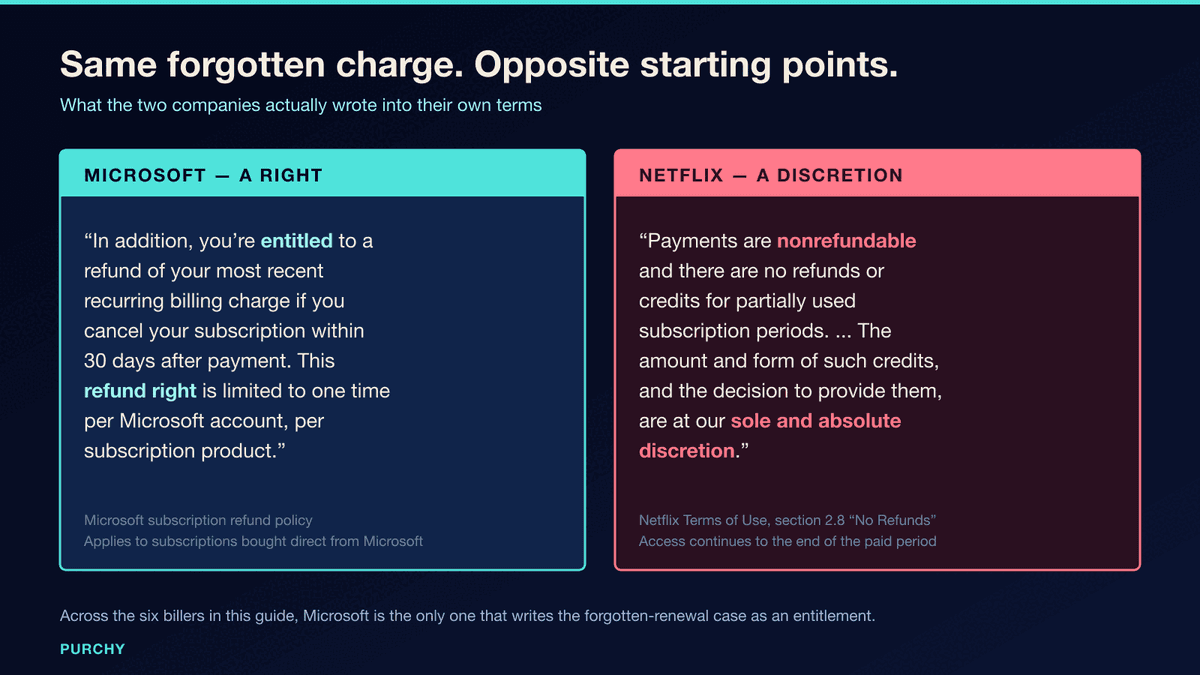
"In addition, you're entitled to a refund of your most recent recurring billing charge if you cancel your subscription within 30 days after payment. This refund right is limited to one time per Microsoft account, per subscription product."
That is the forgotten-renewal scenario described exactly, with a 30-day window and an explicit entitlement. It sits alongside a separate first-purchase rule: "in most cases, you may receive a refund within 30 days of your initial purchase or before your first recurring billing date (whichever is sooner)."
Five qualifications you need to apply honestly:
- It is a one-shot right. One time per Microsoft account, per subscription product. Use it on a $9.99 month and it is gone for that product.
- Not every cancellation triggers it. Microsoft warns on the same page: "Not all cancellations result in a refund." Eligibility "is determined automatically during the cancellation process," so the cancel flow itself tells you the answer.
- It only covers subscriptions bought direct. If you bought Microsoft 365 through the App Store or Google Play, Microsoft tells you to "contact their customer support for cancellation or refund" — the platform rules above apply instead, not this one.
- Prorated refunds are a different, regional thing. Microsoft publishes separate tables for prorated refunds covering 19 named countries and territories (Canada, Denmark, France, Israel, Korea, Türkiye and a list of French and Danish overseas territories), which may "cancel at any time." For Microsoft 365 Basic, Personal, Family, OneDrive and ClipChamp in all other countries, including the United States, "prorated refunds are not available." Microsoft 365 Premium and Pro subscribers elsewhere, including the United States, can get a prorated refund only if they "cancel within 14 days of initial purchase" — which does not help with a renewal. Do not confuse the prorated tables with the 30-day refund right — they are independent, and the 30-day right is the one that matters for a forgotten renewal.
- It does not cover retail key cards. Microsoft says the policy "doesn't apply to prepaid retail subscription codes," which are "subject to the return policies of the retailer from which you purchased the code" — a Microsoft 365 card bought in a store goes back through that store.
If no refund is issued, Microsoft confirms the usual consolation: "access to Microsoft 365 typically continues until the end of the current billing period."
Amazon Prime: a usage test, not a clock
Amazon does not ask when you noticed. It asks whether you used anything. Its Prime cancellation page states the rule in one sentence: "Paid members who haven't used their benefits are eligible for a full refund of the current membership period. Amazon will process the refund in three to five business days."
No deadline appears in that rule. A renewal you spotted three weeks late is still a candidate, provided you have not taken a Prime delivery, streamed from Prime Video, or otherwise used a benefit in the current period. Conversely, a renewal you spotted the next morning is unlikely to qualify if you have already had something shipped on Prime shipping.
Two routing notes Amazon publishes on the same page:
- If you signed up for Prime through Google Play on Android, "cancel your subscription through Google Subscription services" — Google's 48-hour rule governs, not Amazon's usage test.
- If your membership "is associated with another company's service," you have to contact that company.
Netflix and Spotify refunds: when you subscribed directly
For a subscription you bought straight from the company, with no app store in the middle, there is usually no published window — because there is usually no published refund. This is where the polite email finally becomes the right tool, and it is also where your expectations should drop.
Netflix is the clearest written example. Section 2.8 of the Netflix Terms of Use is titled "No Refunds" and reads:
"Payments are nonrefundable and there are no refunds or credits for partially used subscription periods. Following any cancellation, however, you will continue to have access to the service through the end of your current billing period. At any time, and for any reason, we may provide a refund, discount, or other consideration to some or all of our members ("credits"). The amount and form of such credits, and the decision to provide them, are at our sole and absolute discretion."
Put Microsoft's sentence next to that one and the whole landscape becomes legible. Microsoft: "you're entitled." Netflix: "at our sole and absolute discretion." Same forgotten charge, opposite starting positions.
Netflix's terms add the mechanics — section 2.6: "the cancellation will take effect at the end of the billing period," and section 2.1: "you must cancel your subscription before it renews in order to avoid billing of the subscription fees for the next billing cycle."
Spotify publishes no refund window for Premium at all. Its refund policy frames cancellation as the remedy instead: "you can cancel any time and keep what you paid for," with the plan running to the end of the billing period. Where Spotify does publish refund conditions — for audiobooks — they combine a clock with a usage test. Its audiobook refund policy allows a request if "the payment was made within the last 7 days" and you've "listened to less than 50% of the audiobook content," and its top-up refund policy pairs the same 7 days with "no part of the listening time was consumed." Spotify says each request is "reviewed on a case-by-case basis." Spotify also says it can't refund store-bought gift cards (return them to the store) or Premium paid through a partner (ask that partner instead).
A useful related case is Steam, which publishes an unusually specific two-part test of its own; see Steam refund policy.
Charged after a free trial? The Apple and Amazon rules
A large share of forgotten charges are not really forgotten renewals — they are free trials that converted. For Apple-billed subscriptions the relevant number is published in the Media Services Terms, and it is 24 hours:
"You will be charged no more than twenty-four (24) hours prior to the start of the latest Subscription period."
And for trials specifically, the terms instruct you to "cancel the Subscription at least twenty-four (24) hours before the free trial ends."
That 24-hour lead time is why a trial conversion can appear on your statement before the date you had in your head. The charge is not early by mistake; it is early by contract. Apple's terms tell you to cancel at least 24 hours before the trial ends, so the deadline you actually need is a day earlier than the one the signup screen showed you.
Amazon has a separate rule for this case: its Prime Terms promise a full refund if you cancel "within 3 business days of signing up for or converting from a free trial to a paid membership," though Amazon "may charge you (or withhold from your refund) the value of Prime benefits used" in that window. Free trial cancellation tracking covers how to stay ahead of both deadlines.
Is a refund for a forgotten subscription a legal right?
This is the part that decides how much leverage you have, so it is worth stating plainly.
No federal U.S. law entitles you to a refund for a subscription renewal you forgot to cancel. The main federal statute in this area is the Restore Online Shoppers' Confidence Act, 15 U.S.C. § 8403. It governs how a company may sign you up and how easily it must let you leave. It says nothing about giving money back. Here is the operative text, verbatim from Cornell's U.S. Code:
"It shall be unlawful for any person to charge or attempt to charge any consumer for any goods or services sold in a transaction effected on the Internet through a negative option feature ... unless the person— (1) provides text that clearly and conspicuously discloses all material terms of the transaction before obtaining the consumer's billing information; (2) obtains a consumer's express informed consent before charging the consumer's credit card, debit card, bank account, or other financial account ...; and (3) provides simple mechanisms for a consumer to stop recurring charges from being placed on the consumer's credit card, debit card, bank account, or other financial account."
Three duties: disclose, get consent, let people cancel easily. No refund duty. So when a company refuses, it is usually not breaking federal law — which is exactly why the biller's own published policy is the document that decides your case.
The FTC's "click to cancel" amendments are not in force. This is current as of October 2026 and it changed this year. After the Eighth Circuit vacated the FTC's 2024 amendments to the Negative Option Rule, the Commission took formal action to conform the rule book to that decision. The final rule at 91 FR 6507, effective 12 February 2026, states that the FTC "is revising its recently amended 'Rule Concerning Recurring Subscriptions and Other Negative Option Programs' ... to recodify the text of the Negative Option Rule as it existed before the effective date of the Commission's 2024 final rule amending it."
In plain terms: 16 CFR Part 425 is back to its pre-2024 wording. The FTC has since restarted rulemaking in this area — an advance notice of proposed rulemaking on the Negative Option Rule was published at 91 FR 12318 on 13 March 2026 — but no federal click-to-cancel mandate is in effect today. ROSCA and Section 5 of the FTC Act remain the enforcement hooks. Our guide to a canceled subscription still being charged sets out that history in more detail.
State law is where the real leverage sits. Several states impose stricter auto-renewal duties than federal law does, and a violation there can give you a much stronger argument than "I forgot." State automatic renewal laws sets out which states require renewal reminders and online cancellation. Separately, the three-day cooling-off right that people often invoke here does not apply to online subscriptions at all — see the cooling-off rule for what it actually covers.
How to ask, step by step
- Read the statement descriptor to identify the biller. "APPLE.COM/BILL" means Apple is the merchant of record. "GOOGLE" followed by an app name means Google Play. A descriptor naming the service itself means you subscribed directly. This single line determines which rule from the table above applies to you.
- Confirm the charge has settled. Apple is explicit that "if the charge is pending, you can't request a refund yet." Wait for it to post.
- Cancel the subscription first, before asking for money back. On Microsoft this is not optional — the refund is assessed inside the cancellation flow, and "eligibility is determined automatically during the cancellation process." On Amazon, cancelling is what triggers the unused-benefits assessment.
- Apply the biller's own rule, in its own words. If you are inside Microsoft's 30 days, say so and use the phrase "most recent recurring billing charge." If you are an Amazon Prime member who has used nothing, say that you have not used any benefits in the current period. Quoting the published condition you meet is far more effective than describing how you feel.
- Use the biller's named channel, not a generic contact form. Apple: reportaproblem.apple.com. Google Play: the refund form, then the developer. Microsoft: Services and subscriptions, then Manage, then Cancel. Amazon: Cancel Your Prime Membership.
- If the biller is the service itself, send one short, specific email. This is the discretionary case, and brevity plus a clear ask works better than argument. Templates are below.
- If refused once, reply once asking for a review. Then stop and consider whether a card dispute is appropriate — a different process with its own rules and its own risks.
What to say, by biller
Each biller decides on a condition it has already published. Naming that exact condition is the whole job — it is what turns a request into something the agent can approve under their own policy rather than as an exception.
| If the biller is | The condition to name | Where to say it |
|---|---|---|
| Apple | That you want a refund for that specific item. There is no deadline to beat, so say what happened plainly | reportaproblem.apple.com |
| Google Play, within 48 hours | That the purchase falls inside the 48-hour window | The Google Play refund form |
| Google Play, after 48 hours | Whatever the developer's own published policy turns on | The app developer, not Google |
| Microsoft | Your "most recent recurring billing charge", cancelled within 30 days of payment | Inside the cancellation flow |
| Amazon Prime | That you have used no Prime benefits in the current membership period | Cancel Your Prime Membership |
| Netflix, Spotify or another direct merchant | That you have cancelled and have not used the period. This is a request, not a claim | Support email or chat |
Email templates that match the rule you are invoking
Templates only matter for the discretionary case — a subscription you bought directly from the company. For Google, Microsoft and Amazon, use the structured channel instead, because the decision is applied against a published condition. Apple's form asks you to pick a reason and then reviews the request, so there say plainly what happened rather than arguing a case.
Keep it short. Name the charge, name the condition, make one ask, stop.
Template: a renewal you did not intend
Subject: Refund request — renewal charged [date]
Hi [Service] Support,
I was charged $[amount] on [date] for the renewal of my [plan name] subscription on the account [your email]. I intended to cancel before the renewal and did not.
I have now cancelled. Could you refund this most recent charge? I have not used the service in this billing period.
Thank you — [Your name]
That last sentence is the one doing the work, and only include it if it is true. It mirrors the usage test that Amazon, Google (on prepaid plans) and Spotify (on top-ups) all apply, and it gives a support agent a reason that fits their own policy language.
Template: a free trial that converted
Subject: Refund request — trial conversion on [date]
Hi [Service] Support,
My free trial of [service] converted to a paid plan on [date] and I was charged $[amount] on the account [your email]. I did not intend to continue to a paid subscription.
I have cancelled the plan. Could you refund that conversion charge?
Thank you — [Your name]
Template: an annual renewal
Subject: Refund request — annual renewal on [date]
Hi [Service] Support,
My annual [service] subscription renewed on [date] for $[amount] on the account [your email]. I was not expecting the renewal and have not used the service since it renewed.
I have cancelled. Could you refund the renewal, or refund the unused portion if a full refund is not possible?
Thank you — [Your name]
Offering the partial as a fallback is deliberate. It gives the agent an option they can approve without an exception, and a part refund banked today beats a full refund argued for over three weeks.
What to do if your refund request is denied
One polite follow-up is worth sending; a second is not. Ask explicitly for the request to be reviewed, and add any fact that maps onto a published condition — you cancelled before the renewal date, you never used the current period, the renewal notice never arrived.
If that fails, you have two remaining routes and they are not equivalent:
- Check your state's auto-renewal law. If the company failed a duty that your state actually imposes — a renewal reminder, a working online cancellation path — you are no longer asking for a favor. State automatic renewal laws is the place to check before you escalate.
- Consider a card dispute, carefully. This is a formal process with deadlines, evidence requirements and consequences, including the real possibility of losing your account with that service. Do not treat it as a stronger version of an email. How to dispute a credit card charge covers the mechanics, and debit vs credit card disputes explains why the protections differ sharply depending on which card you used. If the subscription was paid through a payment app, payment app buyer protection sets out what is and is not covered.
One thing not to do: never describe a charge you genuinely authorized as fraud or as unauthorized. Google, for instance, runs unauthorized-charge reports as a separate 120-day track, and it explicitly tells you to "request a refund instead" when the purchase was made by a friend or family member on your account. Filing in the wrong category gets the request closed rather than approved.
Once a refund is approved, the money still has to travel. How long a refund takes sets out the typical timings — Amazon, for instance, publishes three to five business days for a Prime refund.
How to avoid forgotten subscription charges
Speed is not the rule, but it is still your best lever — because every condition these billers do set is easier to meet before you have used the service. Google's only self-service window is 48 hours wide. Amazon's usage test is lost once you use a benefit. Apple's terms allow a trial to bill up to 24 hours before the period starts.
So the practical fix is not a better refund email. It is seeing the renewal before it happens.
- Review your recurring charges on a fixed schedule, not when something looks wrong. The subscription audit checklist is a workable monthly pass, and the hidden cost of forgotten subscriptions covers why the small ones are the ones that survive unnoticed.
- Record the trial end date a day early. Apple's own terms tell you to cancel at least 24 hours before a trial ends.
- Keep the receipts findable. Every request above goes faster with a date and an amount to hand. How to track receipts digitally covers the setup.
- Cancel at the layer that bills you, which is the single most common reason a cancellation does not stick. How to cancel subscriptions you forgot about walks through each one.
Purchy is built for the noticing part. It reads the receipts and charges you already receive and groups your recurring charges, so a renewal review is one screen rather than a hunt through old statements. Purchy is free to download; Purchy Pro is $12.99 a month or $99.99 a year, and you can cancel it from the App Store or Google Play like any other subscription on this page.
Frequently asked questions
Can I get a refund for a subscription I forgot to cancel?
Often yes, but it depends entirely on who billed you. Microsoft publishes an entitlement to a refund of your most recent renewal if you cancel within 30 days of payment. Amazon refunds the current Prime period if you have not used any benefits. Google Play offers self-service refunds only within 48 hours of purchase. Apple accepts requests with no published deadline and decides case by case.
How long do I have to request a refund for a forgotten charge?
There is no single deadline. Google Play's published self-service window is 48 hours. Microsoft's is 30 days after payment for the most recent recurring charge. Apple publishes no deadline at all. Amazon publishes no time limit for Prime and applies a usage test instead. Check the rule for the biller named on your statement.
Does Apple give 90 days to request a refund?
Apple's support page does not state a 90-day window, or any window. It says only that purchases "might be eligible for a refund" and that eligibility "might vary by country or region." Treat the absence of a deadline as an absence, not as a published 90-day allowance.
Is a forgotten subscription refund a legal right in the United States?
No federal law requires it. The Restore Online Shoppers' Confidence Act, 15 U.S.C. § 8403, requires clear disclosure, express informed consent and simple cancellation mechanisms, but it creates no refund right. Some state auto-renewal laws impose stricter duties on the company, which can strengthen your position.
Is the FTC click-to-cancel rule in effect in 2026?
No. After the Eighth Circuit vacated the FTC's 2024 amendments, the Commission issued a final rule at 91 FR 6507, effective 12 February 2026, recodifying the Negative Option Rule as it read before those amendments. The FTC published an advance notice of proposed rulemaking (an early request for comment) at 91 FR 12318 on 13 March 2026, but no federal click-to-cancel mandate applies today.
Why was I charged before my free trial ended?
If Apple billed you, the Media Services Terms allow a charge up to 24 hours before the new subscription period starts, and tell you to cancel "at least twenty-four (24) hours before the free trial ends." The charge is early by contract, not by error.
What does Netflix's policy say about refunds?
Section 2.8 of the Netflix Terms of Use states that "payments are nonrefundable and there are no refunds or credits for partially used subscription periods." Netflix may provide a credit "at any time, and for any reason," but describes that decision as being "at our sole and absolute discretion." You keep access until the end of the billing period you paid for.
Can I get a partial refund for the unused part of a subscription?
Rarely, and it is region-dependent. Google lists partial subscription refunds for Israel, France and Germany only. Microsoft publishes prorated refunds for 19 named countries and territories, and states that prorated refunds "are not available" in all other regions, including the United States, for Microsoft 365 Basic, Personal, Family, OneDrive and ClipChamp; Microsoft 365 Premium and Pro get a prorated refund there only within 14 days of initial purchase. Netflix rules out credits for partially used periods outright.
Why does Google Play tell me to contact the app developer?
Because after 48 hours the developer is the decision-maker. Google states that "most apps on the Play Store are made by third-party developers, not by Google," and that the developer "can help with purchase issues and can process refunds according to their policies and applicable laws."
Does cancelling a subscription automatically refund the charge?
No, and on some platforms it is a precondition rather than a remedy. Microsoft assesses refund eligibility inside the cancellation flow and warns that "not all cancellations result in a refund." Google and Netflix both say you keep access for the period you already paid for; cancelling does not by itself return that money.
My Prime renewed and I forgot to cancel. Can I still get it back?
Amazon's published rule is that "paid members who haven't used their benefits are eligible for a full refund of the current membership period," processed in three to five business days. There is no stated deadline, but using any benefit in the current period — a Prime delivery, a Prime Video stream — ends your eligibility.
Should I just dispute the charge with my bank instead?
Not as a first step. A dispute is a formal process with deadlines and evidence requirements, and it can put your standing with that service at risk. Ask the biller first using its published rule. If you did cancel and the charges continued anyway, that is a stronger dispute case and is covered in our guide to a canceled subscription still being charged.
Can I use a platform refund more than once?
Usually not for the same product. Microsoft limits its renewal refund right to "one time per Microsoft account, per subscription product." Google states that an app or game can be returned for a refund only once, and that repurchasing it removes your eligibility.
Related reading: canceled subscription still being charged, how to cancel subscriptions you forgot about, state automatic renewal laws, how long a refund takes, and getting money back after the return window.
Get a heads-up on upcoming renewals.
Purchy watches your bank for recurring charges and flags the upcoming renewals it finds — so a subscription you forgot about is easier to spot.
Scan to get Purchy on your phone
Purchy is free to download. Purchy Pro is $12.99 a month or $99.99 a year. There is no free trial. Cancel any time from the App Store or Google Play. Read-only access to your email and bank.