AT&T Return Policy 2026: 14 Days, $55 Restock, Apple Waived
AT&T gives you 14 days, charges up to $55 to restock — except on an unopened Apple device, where the fee is zero. Every clause, verbatim, for 2026.
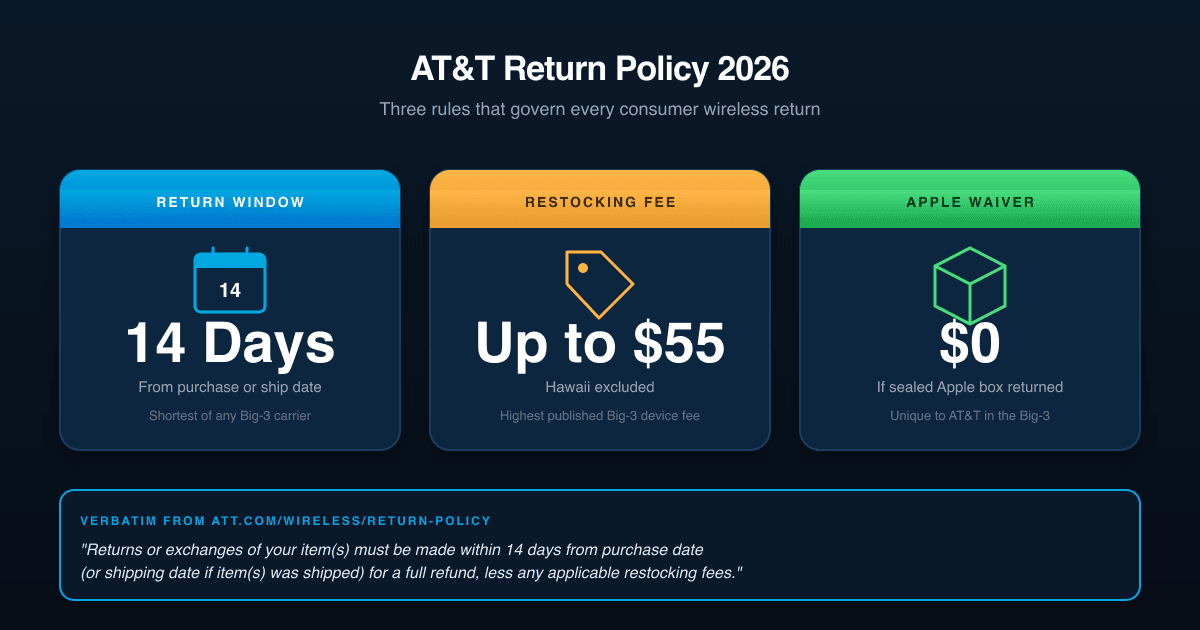
The AT&T return policy in 2026 is the shortest of any major U.S. wireless carrier, the most expensive to walk away from at retail, and contains one quietly enormous loophole that wipes the restocking fee to zero if you bought the right device and kept the box sealed. AT&T — the third-largest U.S. wireless carrier with 109.3 million subscribers as of March 31, 2026 — gives you exactly 14 days to start a return or exchange on a consumer wireless device, charges a restocking fee of up to $55 at AT&T-branded retail (Hawaii excluded), allows one exchange within that 14-day window, and waives the entire restocking fee on an Apple device returned in unopened packaging. This guide pulls every clause from AT&T's live Wireless Return & Exchange Policy at att.com/wireless/return-policy/ — the 14-day consumer window, the 30-day Corporate Responsibility User (CRU) window, the up-to-$55 restocking fee, the Apple unopened-package waiver, the 10% accessory restocking on items $100 and up, the one-exchange cap, the like-new condition rule, the AT&T Certified Pre-Owned and Certified Restored exchange clause, the 3-day activation-fee refund, the up-to-two-bill-period refund timing, the 7-day activation requirement, the AT&T Installment Plan acceleration trigger, the prepaid-refill-card refund ban, the gift-card and protection-program exclusion, the December gift-buying holiday extension, and the new February 14, 2024 business Cancellation Fee schedule — and compares AT&T head-to-head with Verizon and T-Mobile so you can see, at a glance, which carrier's 2026 policy actually treats a careful shopper best.
The AT&T Return Policy in 60 Seconds
If you stopped reading right now and absorbed only one paragraph of this article, AT&T's policy reduces to this: you have 14 days from the purchase date (or the shipping date if the device was shipped to you) to start a return or exchange at an AT&T-branded store or by calling 800.331.0500, you can be charged a restocking fee of up to $55 at retail (Hawaii excluded), you get to exchange the device exactly once within that window, and the device has to come back in like-new condition with all original components in the original packaging plus the receipt. There are two big carve-outs to memorize: Apple devices returned in unopened packaging carry no restocking fee, and Corporate Responsibility Users — employees billed through a company account — get 30 days instead of 14. Promotions tied to the original purchase are voided on return, your refund posts back to the original payment method within roughly two AT&T bill periods, and the prepaid refill cards you may have layered onto the account are not refundable for cash or credit under any circumstance.
That's the policy in one breath. The rest of this guide walks through every clause line by line, with the verbatim quotes from att.com/wireless/return-policy/ so you can verify each rule against the source.
The 14-Day Consumer Return Window
AT&T's headline rule is the 14-day return and exchange period for consumer purchases, and the legal modal on att.com/wireless/return-policy/ states it unambiguously: "If you purchased your item(s) from an AT&T branded store, online (att.com) or over the phone with AT&T, you may return or exchange your item(s) once at an AT&T branded store or by mail by calling 800.331.0500. Returns or exchanges of your item(s) must be made within 14 days from purchase date (or shipping date if item(s) was shipped) for a full refund, less any applicable restocking fees." The page restates the same window in its consumer-facing FAQ: "If you bought your device online (att.com), over the phone with AT&T, or at an AT&T branded store, you have 14 days to start your return or exchange."
Two practical points hide inside that one sentence. First, the clock starts on the purchase date for in-store buys and the shipping date for online orders — not the delivery date. If you bought a phone online and the package took six days to arrive, you have eight days left, not fourteen. Second, the policy treats initiation of the return as the deadline event, not completion: as long as you've called 800.331.0500 to request a shipping label or walked into a store and started the process within 14 days, you've met the deadline even if the device physically moves later. That distinction matters most when day 14 lands on a holiday — call AT&T or stop into a store before the clock expires and the return is still in time, even if AT&T's warehouse doesn't scan the device for another week.
A 14-day window puts AT&T in the most restrictive tier of any major U.S. wireless carrier. T-Mobile gives 14 days at retail but extends to 20 days online from ship date and 90 days through its Costco partnership for the same exact phones. Verizon gives all consumers 30 days, period. AT&T's flat 14 days everywhere is the shortest cap on the market — which is why getting the device into your hands quickly and starting the deliberation clock the moment you sign for delivery matters far more on AT&T than on either competitor.
The 30-Day Window for Corporate Responsibility Users (CRU)
There is exactly one consumer-flavored loophole in AT&T's 14-day cap, and it isn't really for consumers: Corporate Responsibility Users (CRU) — employees with wireless service billed through a company account — get 30 days instead of 14. AT&T's policy spells out the carve-out: "Corporate Responsibility Users can initiate returns up to 30 days after purchase date (or shipping date if item(s) was shipped)." The company's CRU-equipment-ETF terms page restates the same window: "30 Days for Corporate Responsibility Users: You may return or exchange your equipment within 30 days from purchase date (or shipping date if equipment is shipped) (30-day Return Period) for a full refund, less any applicable restocking fees."
A CRU is defined narrowly: "A Corporate Responsibility User (CRU) is an employee receiving service under a corporate account for which their employer has financial responsibility." Translation: if your employer pays the AT&T bill (or part of it), you may qualify. If you're a personal-account holder who happens to work for a company, you don't qualify just by association — the line itself must be billed through the corporate account.
The 30-day CRU window is structurally identical to Verizon's 30-day consumer window: same length, same restocking-fee schedule, same like-new condition rule. The only difference is who gets it. If you have any choice about whether a new device flows through your work account or your personal account, the 30-day CRU window is materially friendlier than the 14-day consumer window — you double the deliberation period for free.
The Up-to-$55 Restocking Fee — and the Hawaii Carve-Out
AT&T's restocking fee is one of the most-misreported numbers in mobile reporting. The policy says, plainly: "When returning an item(s) to an AT&T-branded retail store you may be charged a restocking fee of up to $55. You will not be charged a restocking fee for an Apple device returned in unopened packaging." Three things in that sentence often get garbled in third-party retellings:
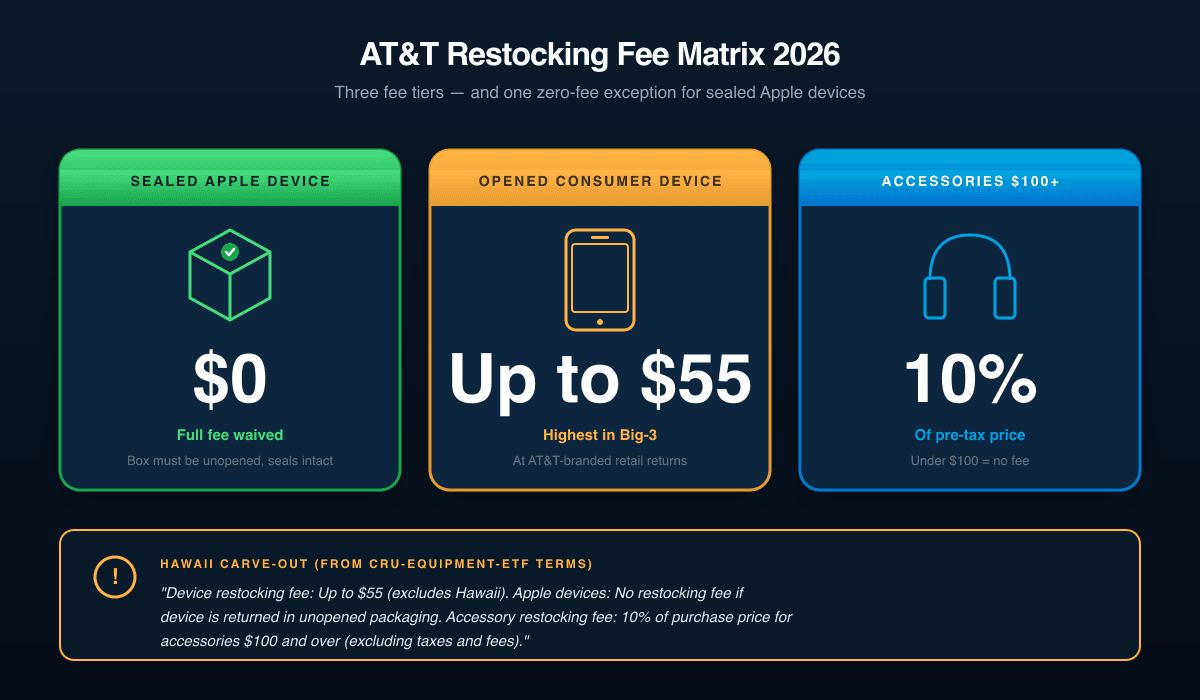
- The fee is up to $55, not a flat $55. AT&T's CRU terms page reinforces the cap: "Device restocking fee: Up to $55 (excludes Hawaii)." Some category-tier devices come back at less than the ceiling.
- The fee applies to AT&T-branded retail returns specifically — not to manufacturer returns, not to AT&T device-protection-program returns, not to non-AT&T branded resellers. If you bought from a non-AT&T store, the device goes back to that store under that store's policy.
- Hawaii is fully exempt from the restocking fee. Hawaii Revised Statutes §481B-3 and related state consumer-protection rules limit restocking fees on a class of consumer transactions, and AT&T mirrors Verizon and T-Mobile in calling that carve-out out on the policy page itself.
A "up to $55" cap is the highest device restocking fee published by any of the U.S. Big Three carriers in 2026. Verizon charges a flat $50 (also Hawaii-waived). T-Mobile charges a tiered $25 / $50 / $75 based on full retail price (FRP under $300 = $25; $300–$599 = $50; $600 and above = $75). AT&T's flat-ceiling structure means a $300 mid-range Android phone walks back with the same $55 fee a $1,400 iPhone Pro Max would carry — unless that iPhone Pro Max happens to be returned in its sealed box, in which case the fee disappears entirely.
The Apple Unopened-Package Waiver
The single most valuable line in AT&T's policy, for any iPhone or iPad buyer, is the eight-word exception buried inside the restocking-fee clause: "You will not be charged a restocking fee for an Apple device returned in unopened packaging." No other major U.S. carrier publishes this exemption on the same terms. Verizon's policy carves out a similar narrow waiver only when the seal sticker is verifiably intact (a stricter standard than "unopened packaging"); T-Mobile applies its tiered $25–$75 fee regardless of whether the box was opened.
The Apple-unopened waiver is most useful in two real-world buying patterns. First, trial-and-decide buyers: if you're between an iPhone and a Samsung Galaxy and want to physically compare them, buying the Apple side from AT&T and keeping the box sealed for the deliberation period lets you walk it back with no penalty if you choose the Samsung. Second, gift mis-targeting: if you bought an iPhone as a gift and the recipient already has one or wants a different model, the sealed box is essentially a free re-do — return it unopened within 14 days and you owe nothing beyond the original purchase amount being refunded.
Read the waiver narrowly. "Unopened packaging" means the original retail Apple seals are intact, the shrink wrap is unbroken, and no plastic tab has been pulled. The moment you slide a thumbnail under the seal tape to "just check it out," the device is opened and the up-to-$55 fee snaps back into place. If you're not sure you want the device, treat the box like it has gold leaf on it until the deliberation period closes.
The 10% Accessory Restocking Fee Threshold
Most coverage of AT&T's policy stops at devices and never gets to accessories, but the CRU-equipment-ETF terms page publishes the accessory rule alongside the device rule: "Accessory restocking fee: 10% of purchase price for accessories $100 and over (excluding taxes and fees)." The threshold matters: accessories under $100 carry no restocking fee, while accessories at or above $100 carry a flat 10% of the pre-tax purchase price.
A $129 pair of AirPods Pro 2 returns with a $12.90 restocking fee. A $349 Apple Watch Series 10 cellular returns with a $34.90 restocking fee. A $99 wireless charger returns with no restocking fee at all. The same 14-day window applies — accessories aren't on a separate clock. The accessory rule is the strongest argument for buying accessories from Apple, Amazon, Best Buy, or Target rather than from AT&T at point-of-sale: those competitors generally charge no accessory restocking fee on equivalent items, and the 10% AT&T cost can easily exceed the modest savings of bundling at signup.
The One-Exchange Limit
AT&T limits in-window exchanges to one and only one: "You may exchange item(s) for another device once within the applicable return period." That mirrors Verizon's one-exchange cap exactly. T-Mobile's policy doesn't publish a hard one-exchange limit on the consumer page, leaving slightly more flexibility for buyers who change their mind twice.
Three exchange-handling quirks are worth understanding before you commit:
AT&T Certified Restored or Pre-Owned upgrade-to-new path. The policy specifies: "If you bought an AT&T Certified Restored or AT&T Certified Pre-Owned device and want to exchange it for a brand-new version of the same device (if available), or a different device, within the applicable return period, you will have to pay the price difference between the AT&T Certified Restored or AT&T Certified Pre-Owned device and the new device." So an exchange is allowed; you just owe the gap.
Term-commitment restart on CRU exchanges. For CRU customers on legacy term-commitment plans, AT&T notes: "Your CRU line will be subject to a new service commitment. The price you paid for the original item(s) was a term commitment price… The new service commitment term will restart from the date the new item(s) is activated." Your warranty clock keeps running from the original activation date, but your cancellation-fee clock resets to the new device's activation date.
Single shot, period. Use your one exchange wisely. If you exchange a new device for a different new device on day 7 and then realize on day 12 you want the original after all, the policy treats that as a second exchange — which it doesn't allow.
The Like-New Condition Requirement
AT&T's policy uses a notably tight standard for what counts as a valid return: "Your item(s) must be in like-new physical and working condition (e.g., no physical blemishes, internal damage, screen, or other external damage). It must include all original components in the original packaging and the receipt/proof of purchase. If anything is missing or the device is not in like-new condition, your return may not be accepted."
Three phrases inside that sentence are doing a lot of work:
"Like-new physical and working condition." Not "good condition." Not "no major damage." Like-new — meaning the device should look indistinguishable from a sealed-box unit when an AT&T retail associate inspects it. A scratch on the bezel, a hairline crack on the camera lens, a dust speck inside the speaker grille — any of these can flip the return from accepted to rejected at the associate's discretion.
"All original components in the original packaging." The cables, the SIM tray ejection pin, the documentation, the box itself — all of it. Throw out the manufacturer-shipped USB-C cable, hand the device back without it, and AT&T can refuse the return outright because a "component is missing."
"Receipt/proof of purchase." AT&T can pull your purchase history from your account, but the legal language requires the receipt; bringing the paper or digital receipt to a store return is a five-minute step that prevents a return getting paused while a manager looks up the transaction.
The CRU page adds two operational requirements that apply equally to consumer returns: you must disable all security features ("All security features must be disabled or removed, such as Find My (Apple), Find My Mobile (Samsung), or the equivalent equipment locator service") and you must factory reset the device ("perform a factory reset before returning your equipment"). A device that comes back with Find My Activation Lock still engaged is essentially a paperweight to AT&T — they cannot resell or refurbish it — and the return will be rejected on the spot.
AT&T Certified Pre-Owned and Certified Restored Exchange Rules
AT&T sells two refurbished tiers — Certified Pre-Owned and Certified Restored — alongside its new-device lineup, and the policy carves out specific exchange rules for both. The exchange-to-new path requires paying the price difference, as noted above. The warranty coverage is also explicitly time-bounded: "AT&T backs its AT&T Certified Pre-Owned and AT&T Certified Restored devices with a 90-day warranty on devices and accessories."
That 90-day warranty matters because it's the only post-return coverage you get on a refurbished AT&T device. By contrast, new Apple devices sold through AT&T carry Apple's 1-year limited warranty: "New Apple branded equipment is covered by Apple's one-year Limited Warranty." For AT&T-Certified Restored Apple devices, the policy specifies the warranty inheritance: "AT&T Certified Restored Apple branded equipment covered under Apple's original Limited Warranty will have at least 90 days or more remaining under warranty when sold."
The practical takeaway: if reliability and warranty length matter to you, the new-Apple-through-AT&T path gets you the full 1-year manufacturer warranty plus AT&T's 14-day return window. The Certified Restored path saves you money up front but gives you exactly 90 days of warranty coverage and a stricter exchange-to-new economics. Most readers who care about long-term protection should pay the gap for new; readers who care about up-front cost and accept the 90-day warranty risk should consider Certified Restored.
How AT&T Issues Refunds (And How Long It Takes)
AT&T's refund timeline is one of the longest among major retailers: "Your refund for a return, less any applicable restocking fees, may be made through the original payment method (credit, debit, check, etc.) and may take up to 2 AT&T bill periods." An "AT&T bill period" is roughly one calendar month, so the policy effectively allows up to two months for a refund to appear on your card statement after the return is accepted.
That two-month tail is materially slower than Verizon (which posts to the original payment method "within one or two billing cycles") and dramatically slower than retail competitors like Apple or Amazon, where credit-card refunds typically post within 3–10 business days. The reason is that AT&T processes the refund through your account credit balance first — the credit lands on your AT&T account quickly, but the push-back of that credit to the underlying card or check happens on a slower, billing-cycle-aligned schedule.
Two practical implications. First, if you're returning a device and switching carriers, the AT&T account credit won't help you — make sure you've reduced the line bill to zero (or canceled) before the credit posts, otherwise it just absorbs into a future bill rather than refunding to your card. Second, the policy explicitly notes that "Any promotions that were part of the original purchase will be voided" — if you got a $400 trade-in credit or a $200 line activation promotion as part of the original purchase, returning the device wipes those promotions and the math runs at the un-promoted price. Refunds reflect the net amount paid, not the original list price.
The 3-Day Activation-Fee Refund Window
A small but consequential clause: "AT&T will refund any activation fee you paid if you cancel service within 3 days of activation." AT&T's standard activation fee is $35 per line (occasionally waived during promotions); if you activate a new line and decide within 72 hours that you don't want it, the activation fee is fully refundable. After 72 hours, the activation fee is permanently kept regardless of when the device or service is returned.
Pair this with the 14-day device window and you have an asymmetric grace: you can return the phone for 14 days, but you have only 3 days to walk away from the activation fee. If you're testing whether AT&T's network works in your specific home, office, or commute zone, do the speed-test driving in the first 72 hours so you can pull the plug before the activation fee turns into a permanent line item.
The 7-Day Activation Requirement
The CRU-equipment-ETF terms page surfaces a rule that's easy to miss but applies to all shipped purchases: "If you purchase a device that is shipped to you, you agree to activate the device within 7 days of the shipment date; and if your device is not activated by you, we may activate the device for you within a month of shipping. In either case, your monthly recurring charges and any applicable service commitment will begin upon activation."
Translation: if you order a phone online and it ships on a Monday, you have until the following Monday to power it on, insert the SIM, and complete activation. If you don't, AT&T reserves the right to auto-activate the line themselves within a month — at which point your monthly charges begin even though you haven't touched the device. That auto-activation rule exists to prevent "buy and sit on it" arbitrage on promotional pricing, but it can bite a buyer who genuinely meant to set up the phone and got distracted by a work trip or a vacation.
If you know you won't be home to activate within seven days of shipping, the safe play is to delay the purchase. If the box arrives and your travel plans are about to start, activate the line first and then call 800.331.0500 to start the return — the 14-day return window starts ticking from the shipping date regardless, so the activation isn't the constraint, but it gives AT&T no grounds to auto-activate at the one-month mark and charge you for service you never used.
The AT&T Installment Plan Acceleration Trigger
Most new AT&T phones are sold on AT&T Installment Plan (AIP) or Equipment Installment Plan (EIP) — 36-month, 30-month, or 24-month financing at 0% interest. The policy spells out exactly what happens if you return the device or cancel service mid-plan: "If you cancel your AT&T Installment Plan (AIP) or Equipment Installment Plan (EIP) within the 30-day Return Period, then you must return your equipment within the permitted time period. If you do not return your equipment within the permitted time period, then the installment plan balance may be accelerated, and the cost of the equipment (less any down payment) will be charged to your account and becomes due in full."
Two consequences worth memorizing:
Within 14 days (consumer) or 30 days (CRU): You can cancel the installment plan and return the device. Any down payment refunds (the policy notes "Any refundable down payment may take up to 2 AT&T bill periods to be processed"). Refundable money flows back.
After 14/30 days, if you cancel service and don't return the device: "The installment plan balance may be accelerated" — meaning the remaining 30+ months of payments collapse into one giant charge on your next bill. A $1,000 iPhone with $300 in payments completed becomes a $700 one-time charge on your AT&T account, due immediately. If you fail to pay it, AT&T can send it to collections.
Cancel service mid-installment without returning: "If you cancel the AT&T wireless service associated with the equipment on your AIP or EIP any time after the 30-day Return Period, then your installment plan may be in default resulting in acceleration of your installment plan balance, which will be charged to your account and become due." The installment plan is functionally tied to active AT&T wireless service — kill the service, and the balance accelerates. To avoid this, port out to a new carrier (which AT&T treats more leniently than a hard cancel) or pay the installment balance off in advance before switching.
Prepaid Refill Cards Are Not Refundable
The legal modal makes this explicit: "Prepaid refill cards, PINs, or other account payments are not refundable or redeemable for cash or credit." If you bought a prepaid AT&T refill card or PIN to top up a prepaid line, that money is gone the moment the card is purchased. You cannot return an unused prepaid PIN to AT&T for a refund; you cannot trade it for store credit; you cannot redeem it for cash.
This rule is critical for two specific scenarios. First, gift mis-buys: if you bought a $50 prepaid refill card as a gift and the recipient is on a postpaid plan or a different carrier, the $50 is non-recoverable — even if the card was never scratched. Second, wrong-amount buys: if you bought a $100 refill card meaning to buy $25, the $75 over-payment is non-recoverable. Buy prepaid cards only in the exact denomination you want, and never as a gift unless you're certain the recipient is on AT&T Prepaid (formerly Cricket-adjacent prepaid brands).
What AT&T Excludes From Returns Entirely
AT&T's CRU-equipment-ETF page lists four full categories of equipment that cannot be returned or exchanged under the policy at all, regardless of condition or timing: "Equipment purchased through a non-AT&T branded store or seller; please return the equipment to the point of sale where you purchased the equipment. Equipment received through an AT&T device protection program. Gift cards. Equipment sold as closeout or as-is."
Non-AT&T sellers: A phone purchased through Costco's AT&T kiosk, a Best Buy authorized dealer, or a third-party AT&T-authorized reseller does not fall under AT&T's policy. The point of sale's policy governs. This is the same logic Verizon applies to its Authorized Retailer carve-out and is one of the most common sources of frustration for buyers who think they have AT&T's 14-day window when they actually have a 30-day Costco window or a 14-day Best Buy window (which is identical at retail but routes through Best Buy's customer service, not AT&T's).
Protection-program replacements: A device received as a replacement through AT&T Mobile Insurance, AT&T HomeTech Protection, or the AT&T Multi-Device Protection Pack cannot be returned to AT&T as if it were a new purchase. Replacements come with their own 90-day or 1-year warranties depending on the device tier and the network connection (per the warranty clause earlier in this guide).
Gift cards: Bought gift cards from AT&T-branded retail aren't returnable for a refund. Treat them as final-sale.
Closeout or as-is equipment: If a device was explicitly sold as "as-is," "closeout," or "final sale" at the point of purchase, the standard 14-day return policy does not apply. AT&T uses closeout pricing rarely — usually only at the very end of a product cycle when a discontinued device is being cleared from inventory.
The December Holiday Return-Window Extension
AT&T extends the return window for gift purchases during the holiday shopping season — a pattern most major retailers follow, and one AT&T has run in some form for at least the last three years. The 2023 policy language read: "Buy your gift online and enjoy an extended return period on orders made through Dec. 19th." The 2025 policy version refreshed the cutoff date: "Buy your gift online and enjoy an extended return period on orders made through Dec. 20th."
The extension isn't a fixed-end date the way Apple's holiday return window works — AT&T historically lets gift-extended returns run until mid-January of the following year, but the specific January date is published only in the season-specific banner each year, not in the standing legal modal. If you bought an AT&T device as a gift between Black Friday and December 20, always check the att.com/wireless/return-policy/ page banner before assuming the standard 14-day window applies; you may have an extra 30–45 days for a gifted device that the recipient hasn't opened yet.
The February 2024 Business Cancellation Fee Schedule
For business customers — primarily CRU lines and small-business accounts — AT&T overhauled its Cancellation Fee (also called Early Termination Fee) structure effective February 14, 2024. The new schedule is keyed to undiscounted device retail price and decays month-by-month over the service commitment:
| Device Category | Undiscounted Retail Price | Initial Cancellation Fee | Monthly Decline |
|---|---|---|---|
| A | Less than $300 | $150 | $5 |
| B | $300 to $449.99 | $300 | $10 |
| C | $450 to $599.99 | $450 | $15 |
| D | $600 to $749.99 | $600 | $20 |
| E | $750 or more | $750 | $25 |
AT&T's own worked example: "a smartphone in Category D that costs $700 at full price (undiscounted retail price) and only $550 when purchased with a 2-year service commitment (discounted retail price) would be subject to a Cancellation Fee of $600 minus $20 for each full calendar month completed under the 2-year service commitment: In month 12 of the 2-year service commitment, the Cancellation Fee would be reduced to $380… In month 18, the Cancellation Fee would be reduced to $260."
Legacy business agreements signed before February 14, 2024 still use the older formula: "For a smartphone: $325 minus $10 for each full month you complete under your service commitment. For a basic phone (also referred to as feature phone), tablet, mobile hotspot device, USB modem or other non-smartphone device: $150 minus $4 for each full calendar month you complete under your service commitment."
Two implications worth knowing: First, the new Feb-2024 schedule produces a higher initial Cancellation Fee for higher-priced devices than the legacy schedule (a $750+ device starts at $750 vs. $325 under legacy) — so business buyers who pulled forward a phone purchase to lock in legacy pricing are now in a more favorable position than buyers signing today. Second, there is no Cancellation Fee if you purchase your device through an installment plan or at full price — only term-committed discounted purchases trigger the schedule. Consumer customers who buy phones on AIP/EIP at 0% financing don't pay Cancellation Fees, period; the schedule applies only to CRU lines on term-discount plans.
AT&T vs. Verizon vs. T-Mobile: 2026 Return Policy Side-by-Side
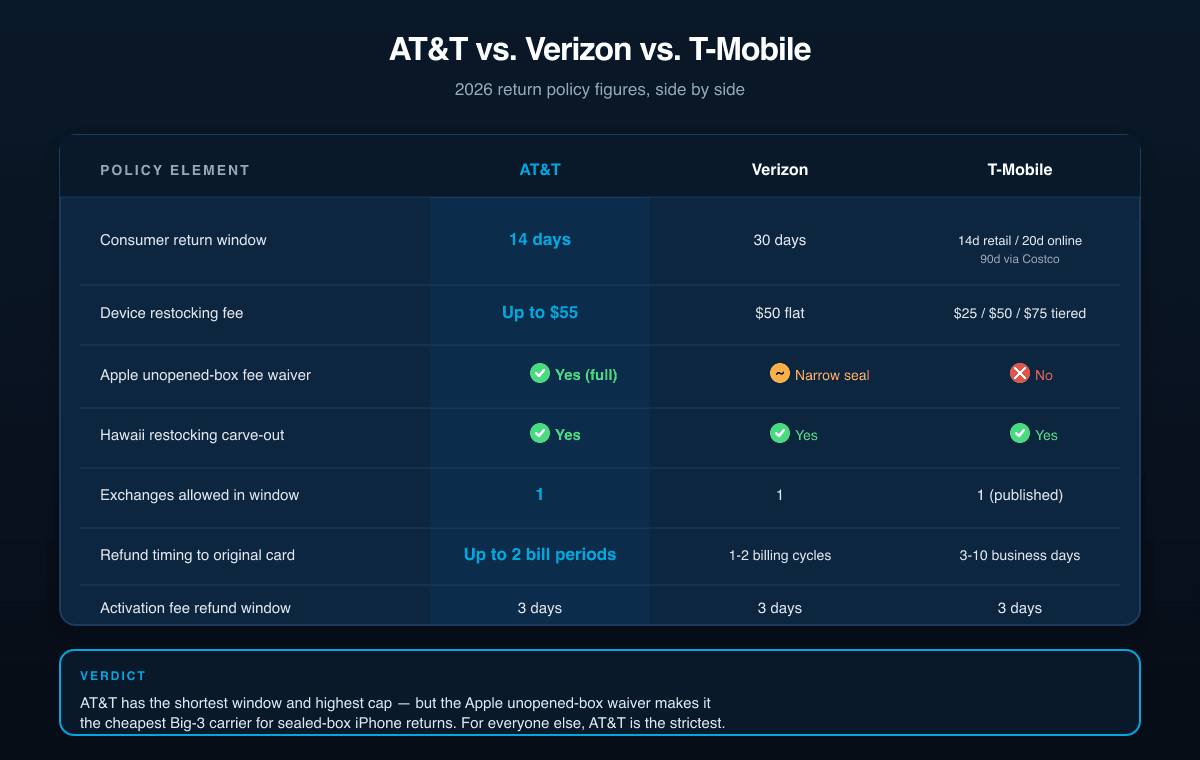
The Big Three carriers' 2026 return policies converge on a few common rules (Hawaii carve-outs, one-exchange limits at consumer tier, like-new conditions) and diverge sharply on the headline numbers. The table below pulls every meaningful figure side-by-side so you can see which carrier's policy fits your actual buying pattern.
| Policy Element | AT&T | Verizon | T-Mobile |
|---|---|---|---|
| Consumer return window | 14 days | 30 days | 14 days (retail) / 20 days (online) / 90 days (Costco) |
| Window starts | Purchase or ship date | Purchase or delivery date | Purchase or ship date |
| Corporate / business window | 30 days (CRU) | 30 days (same as consumer) | 14–20 days (no CRU extension) |
| Device restocking fee | Up to $55 | $50 flat | $25 / $50 / $75 tiered by FRP |
| Apple unopened-box waiver | Yes — full fee waived | Narrow seal-sticker waiver | No |
| Hawaii restocking carve-out | Yes | Yes | Yes |
| Accessory restocking fee | 10% on $100+ | Generally none under $100 | Same tiered scale as device |
| Exchanges allowed | One | One | One (per published policy) |
| Refund timing to card | Up to 2 bill periods | 1–2 billing cycles | 3–10 business days |
| Activation fee refund window | 3 days | 3 days | 3 days |
| Installment plan acceleration if not returned | Yes | Yes | Yes |
Verdict: AT&T's policy is the most punitive on window length of the three carriers — half of Verizon's 30 days, less than a third of T-Mobile's 90-day Costco path. It's also the most expensive at retail return ($55 vs. Verizon's $50 vs. T-Mobile's $25-$50 for mid-tier devices). The one structural redemption is the Apple unopened-package waiver — if you're an iPhone buyer who keeps the box sealed during deliberation, AT&T effectively gives you a $55 discount on the implicit cost of a possible return that the competitors don't. For non-Apple buyers, or for shoppers who like to open and try a device, AT&T's policy is materially worse than either competitor's. For Apple buyers willing to keep the seal intact, AT&T is competitively priced.
How to Actually Return an AT&T Device, Step by Step
AT&T offers two return paths and they have different operational quirks. The policy summarizes both: "Need to return or exchange your new device? We have two easy ways to get started. Give us a call: If you bought your device online through an AT&T or non-AT&T store, give us a call. We'll be happy to initiate your return or exchange and get you a shipping label. Call 800.331.0500. Head into a store: If you bought your device online, at an AT&T store, or used the AT&T Right To You SM delivery service, you can make your return or exchange at any AT&T store. Find a store."
Path 1 — In-store at any AT&T-branded retail location. Best for: in-store original purchases, ASAP refunds, hands-on questions about exchange options. Bring (1) the device in its original packaging with all original components, (2) the receipt or proof of purchase, (3) a government-issued photo ID (AT&T scans IDs on returns to deter abuse, matching the pattern most major retailers follow). Walk to the customer-service counter (not the sales floor — sales reps cannot process returns). The associate will inspect the device for damage, verify Find My is disabled, accept the device, and process the refund to your original payment method. The credit posts to your AT&T account near-immediately; the card refund follows on the next 1-2 bill periods as described above.
Path 2 — By mail with a prepaid shipping label. Best for: online purchases when you can't get to an AT&T store, or when you bought through AT&T's phone-order channel and need to ship back. Call 800.331.0500 within the 14-day window to start the return; the rep will email you a prepaid shipping label. From there, follow the policy's checklist: "Pack your device and everything that was included in the original manufacturer's packaging. Include a copy of the invoice with your return and keep a copy for your records. Make a copy of the USPS prepaid label tracking number. Mail your device via USPS. Track your return at tracking.smartlabel.com." USPS is the carrier — most AT&T return labels are SmartLabel USPS Priority Mail.
Critical mail-return warning from the policy: "If the device isn't in like-new condition, or items are missing, your return or exchange may not be accepted. Please be advised, if it's not accepted or you cancel your order, we won't ship the device back to you. We also won't ship it back if your account's not eligible for the promo offer." In plain English: AT&T can reject a mail-in return that arrives damaged or incomplete, and they will not return the device to you — they hold it. The remedy if a mail return gets rejected is to dispute the rejection through customer service, but you no longer have the device in hand while you dispute. This is a strong argument for in-store returns whenever practical: you get to see the associate accept the device, get a written acceptance receipt, and remove ambiguity about its condition on the spot.
Either way: disable Find My / Find My Mobile, factory reset, remove the SIM and any storage cards, and back up your data before handing the device over. A device returned with Activation Lock engaged will be rejected; a device returned without a factory reset still has your personal data on it; a device returned with a SIM still inserted may delay AT&T's processing while they pull the SIM and store it.
For broader return-tracking and refund-monitoring help across all your devices and online orders, Purchy tracks every order receipt in your inbox, surfaces upcoming return windows on a calendar view, and reminds you before the AT&T 14-day clock expires.
Frequently Asked Questions
How many days do I have to return an AT&T device in 2026?
14 days from the purchase date for consumer purchases, or 14 days from the shipping date if the device was shipped to you. Corporate Responsibility Users on a company-billed line get 30 days. The clock starts on the purchase or shipping date — not the delivery date — and the deadline is measured from when you initiate the return (calling 800.331.0500 or walking into a store), not when AT&T finishes processing it.
What is AT&T's restocking fee in 2026?
AT&T charges a restocking fee of up to $55 at AT&T-branded retail returns, with Hawaii excluded from the fee entirely. Accessories priced at $100 or above carry a separate 10% restocking fee; accessories under $100 carry no restocking fee. The most important exception: Apple devices returned in unopened packaging carry no restocking fee at all.
Does AT&T charge a restocking fee on iPhone returns?
It depends on whether you opened the box. AT&T's policy reads verbatim: "You will not be charged a restocking fee for an Apple device returned in unopened packaging." If you took the iPhone out, set it up, and decided to return it, the up-to-$55 fee applies. If you kept the box sealed during your deliberation period and returned it untouched within 14 days, the restocking fee is zero. Read also: the AppleCare+ refund policy and the Apple return policy complete guide.
Can I return an AT&T phone after 14 days?
No — the 14-day window is firm for consumer purchases. After day 14, your device is no longer eligible for return or exchange under AT&T's policy. Your remaining options are the manufacturer warranty (Apple's 1-year limited warranty for new Apple devices, 90-day warranty for AT&T Certified Pre-Owned/Restored), AT&T Mobile Insurance if you have it (for damage/loss/theft replacement), or the AT&T Next Up upgrade option if your installment plan includes Next Up — none of which provide refunds, only replacements or new-device pricing breaks.
How do I cancel my AT&T wireless service?
Call 800.331.0500 to cancel. Per the policy: "You are responsible for all applicable fees, prorated access charges, taxes, surcharges, or other charges through the termination date. CRU customers are also responsible for any applicable Early Termination Fee (also referred to as a Cancellation Fee)." If you cancel within 3 days of activation, your activation fee is refunded. If you're mid-installment-plan, see the Installment Plan Acceleration section — canceling service mid-plan triggers an acceleration of the remaining device-payment balance.
How long does AT&T take to refund a return?
"Your refund for a return, less any applicable restocking fees, may be made through the original payment method (credit, debit, check, etc.) and may take up to 2 AT&T bill periods." Two bill periods is approximately two months in calendar terms. The AT&T account credit posts faster (usually within days of return acceptance), but the push-back to your underlying card or check follows the slower billing-cycle schedule. For tighter monitoring, see how long does a refund take and the steps in how to dispute a credit card charge if a refund hasn't appeared within the two-bill-period window.
Can I exchange an AT&T device more than once?
No. AT&T's policy explicitly limits exchanges to one and only one within the 14-day return window: "You may exchange item(s) for another device once within the applicable return period." If you exchange a new device for a different new device on day 7 and then realize on day 12 you want the original device after all, that second exchange is not allowed under policy. Verizon imposes the same one-exchange cap; T-Mobile's published policy is slightly more flexible.
What happens to my AT&T Installment Plan if I return the device?
Within the 14-day return window: you cancel the installment plan and return the device; any refundable down payment posts back to your card "within up to 2 AT&T bill periods." After the 14-day window — if you cancel service or stop paying installments without returning the device — the policy notes that "the installment plan balance may be accelerated, and the cost of the equipment (less any down payment) will be charged to your account and becomes due in full." The lesson: if you want to return a financed device, you must do it within the 14-day window. After day 14, your only path to walk away cleanly is paying the installment balance off in full before canceling service.
Are AT&T prepaid refill cards refundable?
No. The policy is unambiguous: "Prepaid refill cards, PINs, or other account payments are not refundable or redeemable for cash or credit." A refill card you bought as a gift, in the wrong amount, or for the wrong recipient is non-recoverable money. Buy AT&T prepaid refills only in the exact amount you intend to use, and verify the recipient is on an AT&T Prepaid line before gifting.
Related Purchy guides:
- Verizon Return Policy 2026: 30 Days, $50 Restock, 1 Exchange
- T-Mobile Return Policy 2026: 14 Days, 20 Online, 90 Costco
- Cell Phone Return Policy & Restocking Fees 2026: Complete Guide
- AppleCare+ Refund Policy 2026
- Apple Return Policy 2026 Complete Guide
- Samsung Return Policy 2026
- Best Buy Return Policy 2026 Complete Guide
- Costco Return Policy 2026 Complete Guide
- How Long Does a Refund Take in 2026?
- How to Dispute a Credit Card Charge 2026
- Holder Rule and BNPL Refunds 2026
- Cooling-Off Rule: The 3-Day Right to Cancel 2026
- Return Policy Laws by State 2026
Sources verified: AT&T Wireless Return & Exchange Policy (legal modal CMS feed, current as of 5/28/2025 Wayback snapshot) · AT&T CRU Equipment and ETF Terms (Feb 2024 snapshot) · Wikipedia: AT&T Mobility
Wake to one edition. Only what matters.
$12.99 a month or $99.99 a year. Cancel any time from your Apple Account.
Download on iOS →