T-Mobile Return Policy 2026: 14 Days, 20 Online, 90 Costco
T-Mobile gives you 14 days at retail, 20 days online — with a tiered $25–$75 restocking fee. Costco buyers get 90 days. Here's exactly how it works in 2026.
The T-Mobile return policy in 2026 is one of the few national carrier policies where buying through the wrong door costs you nothing — but waiting one extra day costs you everything. T-Mobile's own Legal Center sets two different windows for two different doors: 14 days at any T-Mobile retail store and 20 days for phone or online orders, measured from the date the device shipped. There is a third door almost nobody talks about — buying a T-Mobile phone through Costco — that quietly extends the window to 90 days and gives you a dedicated Costco-T-Mobile support line. This guide pulls every clause from the live T-Mobile policy verbatim — the 14-day retail rule, the 20-day online rule, the 90-day Costco partnership, the tiered $25 / $50 / $75 restocking fee by Full Retail Price, the strict condition language, the rebate-and-tax deduction math, the prepaid-and-gift-card carve-outs, the authorized-third-party-dealer trap, and the two different phone numbers you must call depending on whether you're a new customer or an upgrade — and compares T-Mobile head-to-head with Verizon and AT&T so you know exactly which carrier's window favors a careful shopper.
The T-Mobile Return Policy in 60 Seconds
If you read nothing else, this is the official T-Mobile policy compressed into the rules you actually need at the register or at the keyboard.
- In-store: 14 days from the purchase or lease date of the original device. Bring the receipt, the original packaging, and every accessory and cable.
- Online or phone order: 20 days from the date the device shipped to you — not the date it arrived, not the order date. Ship it back or take it to a T-Mobile store.
- Costco partnership: 90 days from the purchase or lease date of the original device. Costco's dedicated T-Mobile support team handles these returns at 833-906-2803.
- Restocking fee, tiered by Full Retail Price (FRP): $75 for devices with FRP of $600 or more, $50 for FRP between $300–$599, $25 for FRP under $300.
- Condition requirement, verbatim: "in its package, with all contents, undamaged and in good working condition, with no material alterations to the Device's hardware or software."
- Deducted from your refund: any rebates received, applicable taxes and fees, and shipping costs.
- Non-refundable, full stop: prepaid services, e-coupons, and gift cards.
- Authorized third-party dealers (think kiosks, mall stores, big-box partners other than Costco) follow their own return policies — T-Mobile's policy does not bind them.
- Two return phone numbers: 1-866-675-1292 if you are new to T-Mobile, 1-800-937-8997 if you are an existing customer returning an upgrade.
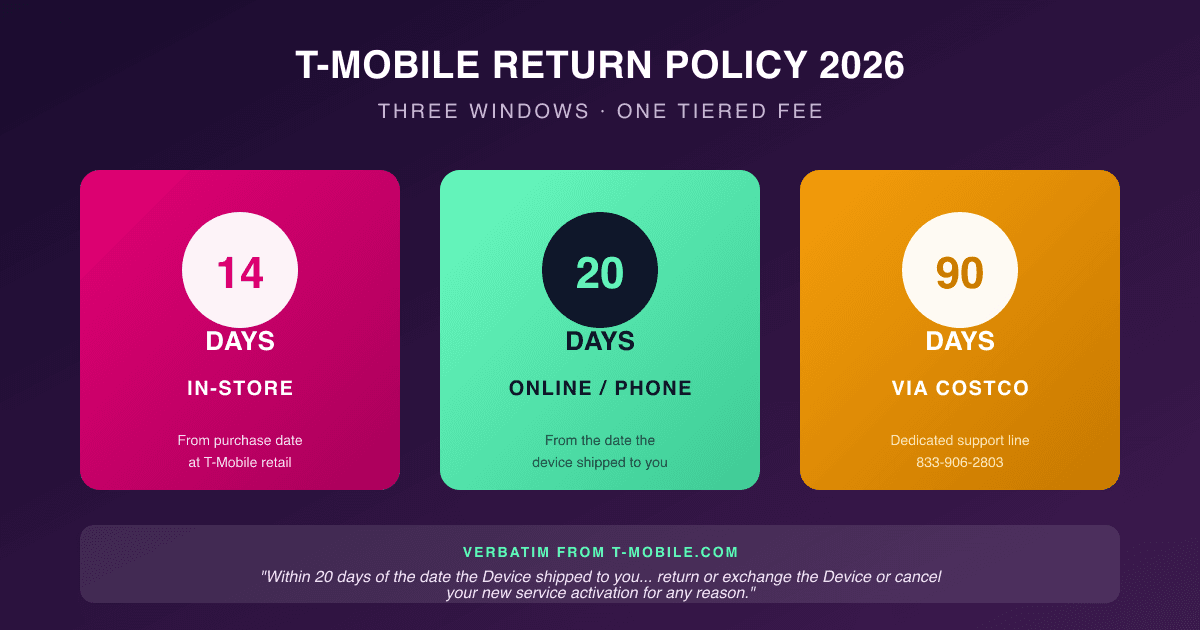
The hook most aggregators miss: T-Mobile's online window is longer than its in-store window — 20 days vs 14. If you're undecided about a phone, ordering online buys you an extra week of testing. And Costco's 90-day partnership window is six times longer than walking into a T-Mobile store for the same device on the same day.
In-Store Returns: The 14-Day Retail Window
T-Mobile's policy for purchases made at a T-Mobile retail store is exactly 14 days — and the clock starts on the purchase or lease date of the original device, not on activation, not on the date you first opened the box.
Here's the rule, pulled verbatim from t-mobile.com/responsibility/legal/return-policy:
"You can return or exchange a Device or accessory ('Device') for a refund within 14 days of the purchase or lease date of the original Device. Return the Device with your receipt, in its package, with all contents, undamaged and in good working condition, with no material alterations to the Device's hardware or software, to a T-Mobile retail location."
A few non-obvious mechanics fall out of that one paragraph.
Day 0 is the purchase date. A phone you bought on June 1 must be returned by June 15 at the latest. If your store closes on June 15 because of weekend hours, plan for June 14 — T-Mobile does not add weekend grace.
The clock applies to the original device. If you exchange Phone A for Phone B on day 8, the 14-day window does not reset to start over for Phone B. You get the remainder of the original window, which is the language carriers use to discourage serial exchanges.
Receipt is required. Unlike apparel retailers, T-Mobile does not run a no-receipt path for in-store returns. The policy assumes you have either the printed receipt, the eReceipt emailed to you at checkout, or — if you activated service — the order number in your T-Mobile account.
"All contents" means everything in the box. Charging cable, SIM tray pin, paperwork, the cardboard insert. T-Mobile reserves the right to charge for any missing component.
"No material alterations to the Device's hardware or software" is the clause that catches jailbreaks, custom ROMs, unauthorized network unlocks, and physical case modifications. If you sideloaded a custom Android image to test something, restore the factory image before returning.
If you've already opened the phone and you're close to day 14, pull the receipt out of your email now and walk it to the nearest T-Mobile store the same day. The 14-day window is one of the shortest in mainstream retail — clothing chains often give 60 days, and Costco gives a year on most electronics.
Online and Phone Orders: The 20-Day Window From Ship Date
If you bought the phone on T-Mobile.com, through the T-Mobile app, or by calling T-Mobile customer care, the window is six days longer — 20 days from the date the device shipped to you. Verbatim from the official policy:
"Return the Device or accessory ('Device') to a T-Mobile retail location or ship the Device back to us within 20 days of the date the Device shipped to you, to return or exchange the Device or cancel your new service activation for any reason."
That single sentence does three things many online buyers miss.
The clock starts at ship date, not delivery date. If your phone shipped on June 1 and arrived on June 4, you do not have 20 days from June 4 — you have 20 days from June 1, which means your true return-by date is June 21. The three days in transit ate three days of your window.
You can return online orders to any T-Mobile retail store. You are not forced to ship a 1.4-pound box back through FedEx. Walking into a store is faster, removes the transit-loss risk, and lets you cancel the service activation at the same time.
The window also covers canceling a new service activation. This is the "buyer's remorse" path for people who switched carriers, hated the coverage in their neighborhood, and want to undo the whole port-in. T-Mobile expressly lets you cancel inside the 20-day window.
When you do ship the device back, T-Mobile emails you a prepaid shipping label — you do not pay the outbound return shipping. But, as we'll see in the refund-deduction section, the original shipping you paid at checkout is not refunded.
Restocking Fees: $25, $50, or $75 by FRP Tier
This is the line item that surprises most T-Mobile returners and it is identical in the in-store rule and the online rule. The official policy:
"You may also be required to pay a restocking fee based on the Full Retail Price ('FRP') of the Device as follows: $75 for devices with a FRP of $600 or more; $50 for devices with a FRP between $300-$599; and $25 for devices with a FRP of less than $300."
Two clarifications carriers sometimes elide:
Restocking fee is tied to Full Retail Price, not your discounted out-of-pocket cost. If you bought a $1,200 iPhone through T-Mobile's 36-month equipment installment plan (EIP) and only paid $0 down at the register, the FRP is still $1,200 — you'd owe the $75 tier, not the $25 tier, because the restocking calculation looks at the phone's sticker price.
The fee is on the device, not the bill. It comes out of the refund you'd otherwise get back, or off the credit card you used to put any down payment on the device. You are not billed for it separately.
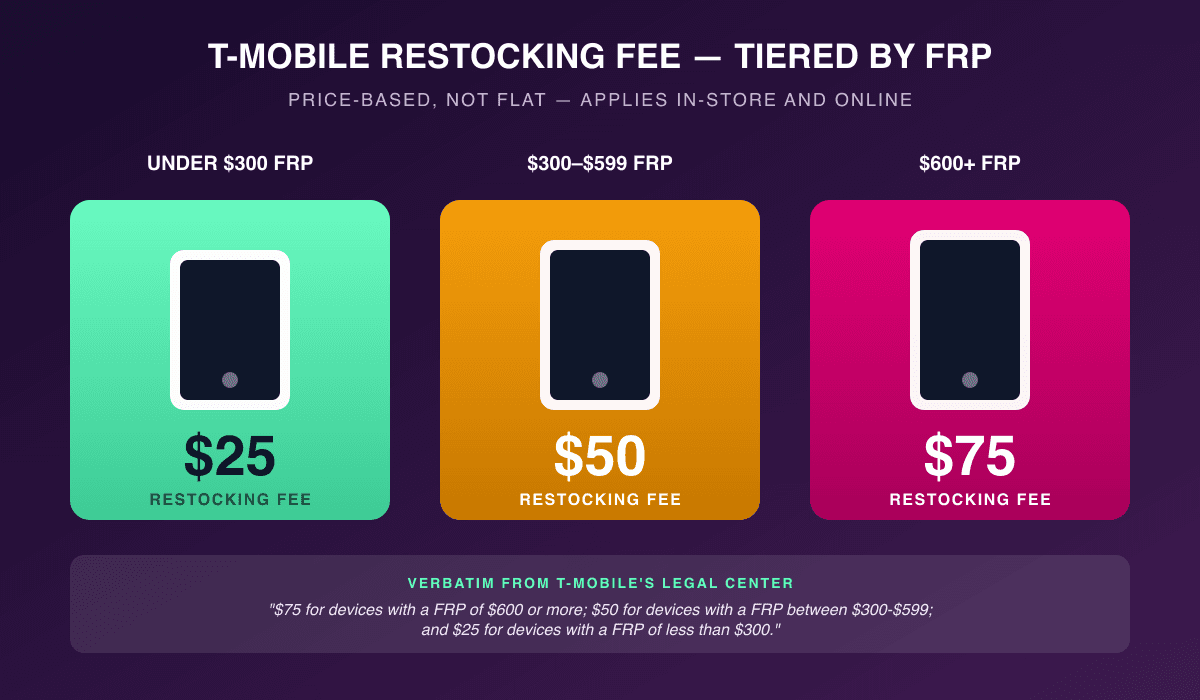
A small but meaningful note in the official text: T-Mobile says the fee "may be required" — not "will be." There is implicit room for the retail associate or the customer-care rep to waive it. They will not waive it because you ask nicely; they may waive it if you can document a clear T-Mobile failure (a sales rep misrepresented coverage, the phone arrived defective inside the first 72 hours, or a promotional offer was misapplied). Waivers exist in state laws that prohibit restocking fees as well — California, Connecticut, Massachusetts, Rhode Island, Oklahoma, and New Jersey limit or ban them under different statutes.
For a deeper dive on how every major retailer structures its restocking fee, see our complete guide to restocking fees in 2026.
What "Good Working Condition" Actually Means
The condition clause is short, but each adjective carries weight. From the policy:
"Return the Device with your receipt, in its package, with all contents, undamaged and in good working condition, with no material alterations to the Device's hardware or software."
In practice, T-Mobile retail staff evaluate four things in this order:
- Physical inspection. Visible cracks, scratches past hairline, dents, water indicator triggered, or bent frame trigger an automatic rejection or a charge equal to the full retail price minus any salvage value. T-Mobile's policy explicitly authorizes this in the consequences section.
- Functional inspection. The phone must power on, complete a factory reset, register on the network, place a test call, and exit recovery mode without errors. Devices that fail any of these tests get bumped to the damaged-or-defective path, which is a separate process from a buyer's-remorse return.
- Packaging and contents inventory. Charging cable, SIM tray, eject pin (in older boxes), documentation, and original box. Missing items can trigger a deduction equal to T-Mobile's wholesale cost of the missing accessory.
- Software state. Factory reset must be complete (Settings → General → Transfer or Reset → Erase All Content and Settings on iOS; Settings → System → Reset Options on Android). The phone must not be locked to your Apple ID or Google account — Find My iPhone and Google's Factory Reset Protection (FRP) both block resale and will trigger a return rejection.
If you reset the phone properly before walking in, the inspection takes under five minutes.
What's Deducted From Your Refund
T-Mobile's policy spells out exactly four categories of deduction. Verbatim:
"Refunds and exchanges will be less any rebates received, applicable taxes and fees, and shipping costs."
That short clause expands to:
Rebates received — if you got a $200 promo rebate for switching from Verizon, T-Mobile may claw it back. The exact language: "Certain promotional offers may require you to return all items you received with your Device and could cause you to become ineligible for any promotional discounts."
Applicable taxes and fees — on most state tax structures, taxes paid get refunded with the phone, but T-Mobile's policy reserves the right to net them. Some state-specific carve-outs treat the device sale tax as non-refundable, particularly when the carrier withholds the original purchase tax pending a state-level tax-credit reconciliation. Practically, T-Mobile usually refunds the tax with the device — but the policy text gives the carrier latitude.
Shipping costs — the shipping you paid at checkout for the original outbound delivery is not refunded. The return label T-Mobile emails you is prepaid by T-Mobile, so you don't pay return shipping. The original outbound shipping you paid stays charged.
Restocking fee — see the tier table above.
For a refund that started as a $1,099 phone with $20 outbound shipping and a $200 switch-rebate, the math looks something like:
$1,099 device refund
+ $$ tax refund (state-dependent, usually returned)
- $ 75 restocking fee (FRP $600+)
- $200 promotional rebate claw-back
- $ 20 original outbound shipping
= $804 + tax refund
That's why the credit card you used for the original purchase matters: if the math feels wrong when the refund posts, you have a dispute path through your card issuer's chargeback process — but only if you can document the policy and the deductions.
The Costco Partnership: 90 Days and a Dedicated Line
This is the single biggest under-publicized rule in T-Mobile's policy. Costco sells T-Mobile activations through its in-warehouse Wireless centers, and T-Mobile's own Legal Center carves out a much longer window for those buyers. Verbatim:
"Purchases made in partnership with Costco. To receive a refund or exchange, you must return the device within 90 days of the date of your purchase or lease date of the original device. Costco's dedicated T-Mobile support team is ready to assist with any returns by calling 833-906-2803. All original contents must be undamaged and in good working condition, and you must provide your original receipt."
Three things to know:
90 days is six times longer than T-Mobile retail. Buy the same iPhone at a Costco Wireless kiosk and you get from June 1 until August 30 to test it. Buy it at a T-Mobile store and you get until June 15.
The Costco return runs through Costco's dedicated T-Mobile line, not the T-Mobile customer-care numbers. Call 833-906-2803, not the general numbers we'll cover in the process section.
Costco's broader "satisfaction guarantee" does not extend the window further. Costco's famous 90-day electronics window applies to cellular phones under the wireless-carrier rules, not under Costco's broader appliance/TV/computer 90-day rule. For the full Costco electronics return rules, see our dedicated guide — but the headline is that 90 days is the T-Mobile-carved exception, not Costco's general 90-day Concierge window.
If a phone matters and you want maximum testing time, the math is clear: buying the device at Costco Wireless is the same phone, same network, same warranty, but six times the window. The downside is a smaller in-store accessory selection.
Prepaid, E-Coupons, and Gift Cards Are Non-Refundable
T-Mobile draws a hard line on three categories of purchase. Verbatim:
"Prepaid services, e-coupons, and gift cards are non-refundable."
Each line item is its own trap.
Prepaid services — if you bought a T-Mobile Prepaid plan with airtime credit, the airtime credit is not refundable, even within the 20-day window. Returning the prepaid SIM and any prepaid handset is still possible under the standard rules, but the minutes you bought are gone.
E-coupons — promotional codes you redeemed at checkout reduce the refundable basis to zero for that line item. If you applied a $50 e-coupon to an accessory and returned the accessory, you get back the cash you actually paid, not the coupon-adjusted credit.
Gift cards — T-Mobile gift cards once activated cannot be refunded. The general consumer rule under state gift card expiration laws keeps the balance valid for the holder, but the carrier will not refund the original purchaser's cash payment.
This carve-out matters most for gift purchases. If your relative bought you a phone using a T-Mobile gift card, the cash paid for the gift card is not refundable to the buyer; you can only return the phone for store credit on a T-Mobile gift card.
Authorized Third-Party Dealers: A Separate Rulebook
This is the trap that surprises customers who bought a phone at a mall kiosk, a "T-Mobile Authorized Retailer" storefront, or a third-party big-box partner. T-Mobile's own policy hands the entire return question to the dealer:
"For Device and accessory refunds and exchanges, see the individual authorized dealer's return policies applicable to your purchase. To cancel service, return your Device in its original package with all original contents undamaged and in good working condition with no material alterations, within 14 days of the purchase date of the original Device to the authorized dealer location where you purchased it."
Two practical effects:
The 14-day "cancel service" clause is what binds the dealer minimum. Even if the dealer's return policy says "all sales final," T-Mobile binds them to a 14-day service-cancellation window. So you can always cancel the service activation within 14 days — but the device refund depends on the dealer's separate policy.
Authorized dealers can charge restocking fees that T-Mobile does not match. Some dealers run 25% restocking, others have flat $50 fees, others limit you to exchanges only. Read the receipt at point of sale, especially the small print on the back.
A simple test if you're not sure whether you're at a corporate T-Mobile store or an authorized dealer: corporate stores list the address as "T-Mobile" on the receipt, and the storefront signage uses the official T-Mobile typeface. Authorized dealers usually list an LLC name (e.g., "Premier Wireless LLC") on the receipt and may have additional non-T-Mobile branding inside.
Costco is also a partner channel, but as we saw in the Costco section, T-Mobile carves Costco out into a specific 90-day rule rather than leaving Costco subject to the generic dealer carve-out.
Trade-Ins, Promotions, and Bundle Returns
T-Mobile's policy gives the carrier broad latitude to claw back promotional discounts when you return a phone that anchored the promotion:
"Certain promotional offers may require you to return all items you received with your Device and could cause you to become ineligible for any promotional discounts."
In practice, this affects three common scenarios:
Trade-in promos. If you traded in an old phone for a $1,000 device credit toward a new phone, returning the new phone within the window typically does not automatically reinstate your old phone. The trade-in transaction is treated as a separate completed sale. T-Mobile may credit your account for the trade-in value, but the physical old phone is gone. Always remove personal data from a trade-in before you hand it over — the old phone is rarely recoverable.
Bundle deals. A "Buy One, Get One free" line activation requires both lines stay open. Cancel one line within the window and the BOGO discount is reversed on the remaining device, which usually means the second device's price jumps to full retail and gets billed across the EIP.
Promo credits paid as monthly bill credits. Many T-Mobile switching promos pay out as 24- or 36-month bill credits rather than as upfront discounts. Return the phone within the window and the future bill credits stop — you don't owe a clawback on credits already received because they never paid out yet, but you do lose the future stream.
If you're considering a switch, scan the T-Mobile vs Verizon vs AT&T comparison below to understand which carrier's promotional clawback structure is friendliest for hesitant buyers. The general guide to carrier price-match and promotion mechanics goes deeper.
How to Start an Online Return: The Two Phone Numbers
T-Mobile's policy spells out two separate phone numbers for online return authorizations, and which one you call depends entirely on whether you're a new customer or an existing customer upgrading.
"If you chose to ship the Device contact us and we will email you a prepaid shipping label for your return. If you are new to T-Mobile contact us at 1-866-675-1292 to request a Return Authorization for all returns and exchanges or to return your Device and cancel your new service activation. If you are a current T-Mobile customer returning an upgrade Device contact us at 1-800-937-8997 to request a Return Authorization for all returns and exchanges."
The two-number system exists because:
1-866-675-1292 (new customer line) routes to a team trained on service-cancellation flow. Their job is to take the return, refund the activation fee if applicable, and process the port-out of any number you ported in.
1-800-937-8997 (existing customer upgrade line) routes to the upgrade-return team. Their job is to take the return, reinstate your previous device on the account, and roll back any device-installment-plan changes.
Calling the wrong number doesn't break anything, but it slows the call by 10–15 minutes because the rep has to transfer you. If you're tracking the order online, the order confirmation usually lists which line to call.
Six steps to a clean online return:
- Day 1 of decision — find the order in your T-Mobile account or the original order email. Note the ship date (not delivery date).
- Call the appropriate number (new vs upgrade) — request a Return Authorization. The rep will email you a prepaid shipping label and an RMA number.
- Factory reset the device. iOS: Settings → General → Transfer or Reset → Erase All Content and Settings. Android: Settings → System → Reset → Factory Reset. Disable Find My iPhone or Google Factory Reset Protection.
- Repackage with every original component — charging cable, paperwork, eject pin if applicable.
- Attach the prepaid label and drop the package with the carrier specified on the label (usually FedEx or UPS).
- Track the return until T-Mobile confirms receipt and processes the refund — typically 5–14 business days after the carrier shows delivery.
The alternative is walking the box into any T-Mobile retail store. Same window applies; you skip the carrier transit. If you do ship it, the refund timing guide gives realistic expectations for how long the credit takes to land back on your card.
If You Don't Return On Time: Four Specific Consequences
T-Mobile's policy lists four specific things the carrier can do if you blow the window. Verbatim:
"Prevent your Device from working; Elect not to process your service cancellation; Charge you the cost to repair a damaged or altered Device; or Charge you the suggested full retail price of a destroyed or altered Device, or a non-returned Device, (which may be greater than the price you paid), plus any shipping and handling charges."
Each consequence is real and each has a workflow inside T-Mobile.
1) Prevent your Device from working. T-Mobile can remotely place the IMEI on its internal block list. The phone still powers on, but it cannot register on any T-Mobile or T-Mobile-MVNO network, and many secondary carriers honor industry IMEI blocks. Walking the phone to AT&T or Verizon to activate it as a SIM-swap is not a workaround if the IMEI is blocked.
2) Elect not to process your service cancellation. This is the porting-out trap. If you returned the device late and ported in from another carrier, T-Mobile can keep your number on its network — meaning your new home carrier cannot complete the port reversal until you cancel the service through T-Mobile's normal channels (which may carry an Early Termination Fee or contract obligation).
3) Charge you the cost to repair. A returned phone that's damaged but within the device's salvage path gets routed through repair, and T-Mobile bills the repair cost to your card on file.
4) Charge you the SRP of a destroyed or non-returned device. This is the most expensive consequence. T-Mobile expressly notes the SRP "may be greater than the price you paid" — which means a phone you bought on promo for $799 with a $500 switch incentive can be billed back at the full $1,299 if you fail to return it or return it destroyed.
Bonus: if any of these consequences land on your bill and the math feels off, document everything and consider a credit card dispute. Card-issuer chargeback rights cover services and goods not delivered as promised, but the dispute window is typically 60 days from the statement date — moving fast matters.
Hawaii, Puerto Rico, and "All Other States"
T-Mobile's main policy page references three separate state-tier documents and instructs the customer to consult the appropriate one for state-specific carve-outs:
"Select the return policy for your state below for specific details: Hawaii: All other states: Puerto Rico:"
The state-tier carve-outs typically address three categories that vary by jurisdiction:
State restocking-fee bans. California, Connecticut, Massachusetts, Rhode Island, Oklahoma, and New Jersey have various statutes that either ban or limit restocking fees on certain returned merchandise. T-Mobile's general policy nods to this implicitly with the "may be required" language on restocking, but the state-tier documents usually carve out explicit waivers for these jurisdictions.
Sales-tax refundability. State-level tax handling varies; Hawaii's General Excise Tax and Puerto Rico's IVU treat refunds differently than mainland state-and-local sales tax. T-Mobile's state documents reflect these accounting differences.
Service-cancellation specifics. Some states have stronger consumer-protection rules around wireless service-contract cancellation that override the carrier's general policy. The state-tier documents are where the exceptions live.
For a comprehensive look at return-policy laws state by state, our broader guide covers California, New York, Florida, and other major-population states' specific consumer-protection rules that override carrier policies.
The practical takeaway: if you're returning a T-Mobile device in one of the six states that limit restocking fees, mention the state statute by name at the retail counter — many associates default to charging the fee unless prompted.
JUMP! Upgrades vs Returns: When Each Path Applies
T-Mobile's JUMP! Upgrade program is sometimes confused with the return policy, but the two are different mechanisms with different windows.
The return policy covers buyer's remorse and defects — 14 days at retail or 20 days online for a new device purchase, full refund minus deductions.
JUMP! is an upgrade-on-payment program — at the JUMP! benefit milestone (typically after 50% of the device installment payments), you can hand the phone back and roll into a new device's installment plan. JUMP! is not a refund; it is an early-trade-in on a new contract.
A few rules where the two intersect:
JUMP! does not extend the return window. If you bought a phone yesterday and are JUMP!-eligible (which happens almost immediately on new lines), you cannot use JUMP! to return-and-refund the phone — JUMP! always rolls into a new device on a new EIP.
The return path will cancel JUMP! enrollment. If you return a phone within the 20-day window, the JUMP! enrollment on that device is undone along with the EIP.
Defective devices bypass both paths. A defective phone in the first 14 days of in-store purchase usually triggers a like-for-like exchange under T-Mobile's defect handling, not a JUMP! upgrade and not a buyer's remorse return. The path matters because defect exchanges typically waive the restocking fee.
For wireless device repairs covered by insurance plans similar to AppleCare+, the defect path is separate from a return — file the warranty claim through T-Mobile Insurance instead.
T-Mobile Home Internet and 5G Gateway Returns
T-Mobile Home Internet uses a 5G Gateway device (the "Trashcan" or the wall-mount variant) that customers receive on the same shipping-based fulfillment as a new line activation. The return policy treats the gateway as a Device under the general return rules — meaning 20 days from the ship date to return for a refund.
A few internet-specific notes:
The gateway is a leased device on most Home Internet plans. When you cancel service, T-Mobile expects the gateway returned — the policy's consequences (FRP charge for non-return, see consequences section) apply.
Installation does not extend the window. Whether you set up the gateway on day 1 or day 18, the 20-day clock from ship date governs.
Speed-test cancellations are common and legitimate. Many Home Internet returns happen because the customer ran a real speed test in their actual home and the 5G signal didn't meet the marketing claim. T-Mobile's customer-care team accepts these returns under the general policy — no special "speed-test" exception is needed.
The accessories (cables, mounting brackets) count as "all contents." Return the box complete to avoid the missing-component deduction.
T-Mobile vs Verizon vs AT&T: Side By Side
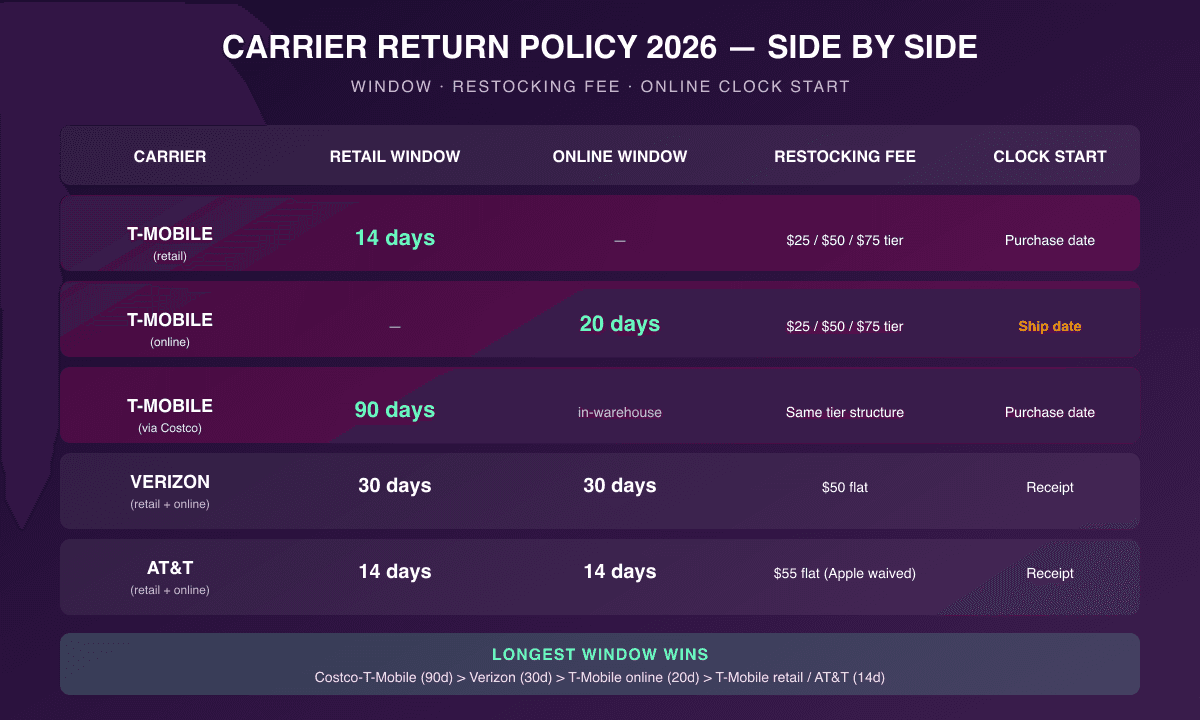
The big-three carrier return policies look similar at a glance but differ in three of the numbers that matter most. Here's how they compare on the dimensions T-Mobile's policy text addresses directly:
| Dimension | T-Mobile (retail) | T-Mobile (online) | T-Mobile (Costco) | Verizon | AT&T |
|---|---|---|---|---|---|
| Return window | 14 days from purchase | 20 days from ship date | 90 days from purchase | 30 days from purchase | 14 days from purchase |
| Restocking fee | $25 / $50 / $75 by FRP tier | $25 / $50 / $75 by FRP tier | Same tier structure | $50 flat (waived in some states) | $55 flat (waived on never-opened Apple devices) |
| Condition | Original package, all contents, undamaged | Same as retail | Same as retail | Original box, like-new, original receipt | Like-new, original packaging, all components |
| Online clock | n/a (purchase date) | 20 days from ship date | n/a (in-warehouse) | 30 days from receipt | 14 days from receipt |
| Prepaid services | Non-refundable | Non-refundable | Non-refundable | Non-refundable | Non-refundable |
| Authorized dealer | Dealer policy applies; 14-day service cancel | Same | n/a | Dealer policy applies | Dealer policy applies |
| Where to read it | t-mobile.com Legal Center | Same | Same | verizon.com/support/return-policy | att.com/shop/wireless/returnpolicy.html |
A few practical conclusions from this table:
Verizon gives the longest window for a direct-carrier purchase at 30 days, measured from purchase, but it's a flat $50 restocking fee. If you suspect you may want to return, Verizon is the most forgiving direct purchase — though state-level restocking-fee bans apply equally across carriers.
T-Mobile's online window is longer than its retail window. This is unusual — most retailers do the reverse — and it reflects the inclusion of shipping transit time inside the 20-day clock.
Costco beats every direct carrier window by a factor of three to six. If you're buying a phone and there's any doubt, the Costco Wireless route is the longest possible buyer's remorse window — 90 days — on the same exact device and same exact network.
AT&T's Apple-device restocking waiver is unique. AT&T waives the $55 restocking fee on Apple devices returned unopened, which can be a meaningful saving if you ordered an iPhone but never opened the box.
For the deeper category-level comparison, see our cell phone return policy guide with windows and restocking fees and the best return policies of 2026 comparison.
Five T-Mobile Return Mistakes That Cost You a Refund
Each of these is a real failure mode pulled from the policy text or its absences — and each has a fix that takes under five minutes.
1) Counting the wrong day as Day 0. Online buyers consistently miscount from delivery rather than ship. The clock starts at ship date, not delivery — if your phone shipped on June 1 and arrived on June 4, your true return-by date is June 21, not June 24.
2) Walking into an authorized dealer expecting T-Mobile's policy. The kiosk in the mall is not the carrier. Its return policy may be far stricter than 14 days, may include a higher restocking fee, or may permit exchanges only. Buy at corporate stores or order online if you want T-Mobile's policy to apply directly.
3) Returning a JUMP!-enabled phone and assuming JUMP! reactivates on the new device. JUMP! re-enrollment must be done on the new device at purchase. Returning a JUMP!-enrolled phone within the window cancels the enrollment, and the new device starts at JUMP!-not-enrolled by default.
4) Forgetting to disable Find My iPhone or Google FRP. A device with active activation lock cannot be resold. T-Mobile will reject the return on the spot or charge a hold while they contact you to release the lock. Always run the factory reset and sign out of iCloud and Google before walking to the store.
5) Not asking about state-level restocking waivers. California, Connecticut, Massachusetts, Rhode Island, Oklahoma, and New Jersey have various restocking-fee restrictions. The retail associate will charge the fee unless you cite the state law — and the state-tier policy document explicitly carves out the waiver if applicable.
For more strategies to recover refunds you've already missed, our guide on how to get money back after the return window covers credit card protections, manufacturer warranties, and chargeback flows.
How Purchy Tracks Your T-Mobile Deadlines
T-Mobile's policy has three different windows on the same phone purchase — 14 days at retail, 20 days online from ship date, 90 days at Costco. Most of the time, the customer doesn't even know which window applies because the email confirming the order doesn't label the deadline clearly. That's exactly the gap Purchy was built to close.
Purchy reads your inbox for receipts and order confirmations, identifies the merchant (T-Mobile, Costco-T-Mobile, an authorized dealer, or another carrier), and applies the right return-window rule automatically. For a T-Mobile online order, Purchy parses the ship date out of the shipping notification email and counts forward 20 days — not 20 days from delivery, and not 20 days from order. For a Costco-T-Mobile purchase, Purchy applies the 90-day partnership window automatically. For an in-store T-Mobile purchase, Purchy applies the 14-day rule. And when your return-by date is 48 hours out, Purchy sends a notification — with the right phone number for the right return path included.
The result is that you stop tracking return windows in your head and the phone you weren't sure about stops timing out into a non-return.
Frequently Asked Questions
How long do I have to return a T-Mobile phone in 2026?
It depends on the door you walked in through. T-Mobile retail stores: 14 days from the purchase or lease date. Phone or online orders: 20 days from the date the device shipped to you. Costco partnership purchases: 90 days from the purchase or lease date, handled through Costco's dedicated T-Mobile support line at 833-906-2803. Authorized third-party dealers follow their own return policies, but T-Mobile binds them to a 14-day service-cancellation minimum.
How much is T-Mobile's restocking fee?
T-Mobile's restocking fee is tiered by the device's Full Retail Price (FRP): $75 if the FRP is $600 or more, $50 if the FRP is between $300 and $599, and $25 if the FRP is under $300. The fee is calculated on FRP — the phone's sticker price — not on the discounted out-of-pocket cost you actually paid. T-Mobile's policy says the fee "may be required," which leaves room for waivers in cases of documented carrier error, defects within the first few days, or in states that limit restocking fees by law.
Why does Costco give 90 days when T-Mobile retail gives only 14?
T-Mobile and Costco have a specific partnership carve-out written into T-Mobile's official policy: "Purchases made in partnership with Costco. To receive a refund or exchange, you must return the device within 90 days of the date of your purchase or lease date of the original device." Costco's dedicated T-Mobile support team at 833-906-2803 handles these returns. The 90-day partnership window is six times longer than T-Mobile's own retail window for the same phone on the same network — which is one of the strongest reasons to buy a T-Mobile activation through Costco Wireless if you might want testing time.
Is the 20-day online window from delivery or ship date?
From ship date. T-Mobile's policy is explicit: "Return the Device or accessory ('Device') to a T-Mobile retail location or ship the Device back to us within 20 days of the date the Device shipped to you." If your phone shipped on June 1 and arrived on June 4, your true return-by date is June 21, not June 24. The three days in transit count against the 20-day window.
How do I return a T-Mobile phone I bought online?
Two options. (a) Walk it into any T-Mobile retail store within 20 days of the ship date — the store will process the return and cancel any service activation. (b) Call T-Mobile for a Return Authorization and prepaid shipping label. The right phone number depends on your customer status: 1-866-675-1292 if you are new to T-Mobile, 1-800-937-8997 if you are an existing customer returning an upgrade device. T-Mobile emails the prepaid label after the Return Authorization is issued.
What does T-Mobile deduct from my refund?
Four things: (a) any rebates received as part of a promotional offer, (b) applicable taxes and fees, (c) original shipping costs you paid at checkout (the return label T-Mobile emails you is prepaid; only the outbound shipping isn't refunded), and (d) any applicable restocking fee. T-Mobile's policy: "Refunds and exchanges will be less any rebates received, applicable taxes and fees, and shipping costs." Promotional bill credits that haven't paid out yet simply stop — they aren't clawed back.
Can I return a T-Mobile prepaid plan or gift card?
No. T-Mobile's policy is unambiguous: "Prepaid services, e-coupons, and gift cards are non-refundable." You can return the prepaid SIM or prepaid handset under the standard physical-device return rules, but the airtime credit, prepaid service charges, redeemed e-coupons, and activated gift card balances are not refundable.
What if I bought my phone from an authorized T-Mobile dealer in a mall?
Authorized third-party dealers follow their own return policies, not T-Mobile's. T-Mobile's official position: "For Device and accessory refunds and exchanges, see the individual authorized dealer's return policies applicable to your purchase." However, T-Mobile binds dealers to a minimum 14-day service-cancellation window, so you can always cancel the wireless activation within 14 days at the dealer location — but the device refund itself depends on the dealer's separate policy. A simple test: corporate T-Mobile receipts list "T-Mobile" as the retailer; authorized dealer receipts list an LLC name (e.g., "Premier Wireless LLC").
What condition does the phone have to be in for a refund?
T-Mobile's exact wording: "in its package, with all contents, undamaged and in good working condition, with no material alterations to the Device's hardware or software." In practice that means: powers on, completes a factory reset, registers on the network, has no cracked screen or water-indicator trigger, contains every original accessory (cable, paperwork, eject pin), and is not jailbroken, custom-ROM'd, or locked to an Apple ID or Google account. Disable Find My iPhone and Google Factory Reset Protection before returning.
The Bottom Line on the T-Mobile Return Policy in 2026
T-Mobile's policy reads short but it carries real teeth. The two-window structure — 14 days in store, 20 days online from ship date — is one of the shortest in mainstream retail, and the tiered restocking fee of $25, $50, or $75 based on Full Retail Price is one of the few major-carrier policies that scales with the phone's price tag rather than charging a flat fee. The Costco partnership is the single biggest under-publicized rule: 90 days through Costco Wireless on the same device and same network. The condition language is strict, the dealer carve-out is real, and the four documented consequences for a late return — IMEI block, refused service cancellation, repair cost charge, and full SRP for a destroyed or non-returned device — give the carrier broad latitude to recover its losses.
Read the policy the day you walk out of the store or the day the device ships. Decide within the first week whether the phone earns its keep. If it doesn't, the return path is well-defined and inexpensive — provided you're inside the window and the device is in good working condition.
For the head-to-head category comparison, our cell phone return policy guide with windows and restocking fees drops T-Mobile alongside Verizon and AT&T. For the broader retail context, our 2026 best return policies comparison shows how T-Mobile's 14/20-day window sits against every other major retailer. And if you bought a phone at Costco Wireless, our Costco electronics return policy guide explains exactly how the 90-day partnership rule sits next to Costco's own 90-day Concierge service for non-phone electronics.
Wake to one edition. Only what matters.
$12.99 a month or $99.99 a year. Cancel any time from your Apple Account.
Download on iOS →