How Long Do Pending Charges Take to Clear in 2026?
How long do pending charges take to clear? The Visa and Mastercard rules behind gas, hotel, rental and restaurant holds in 2026 — and how to get one released.
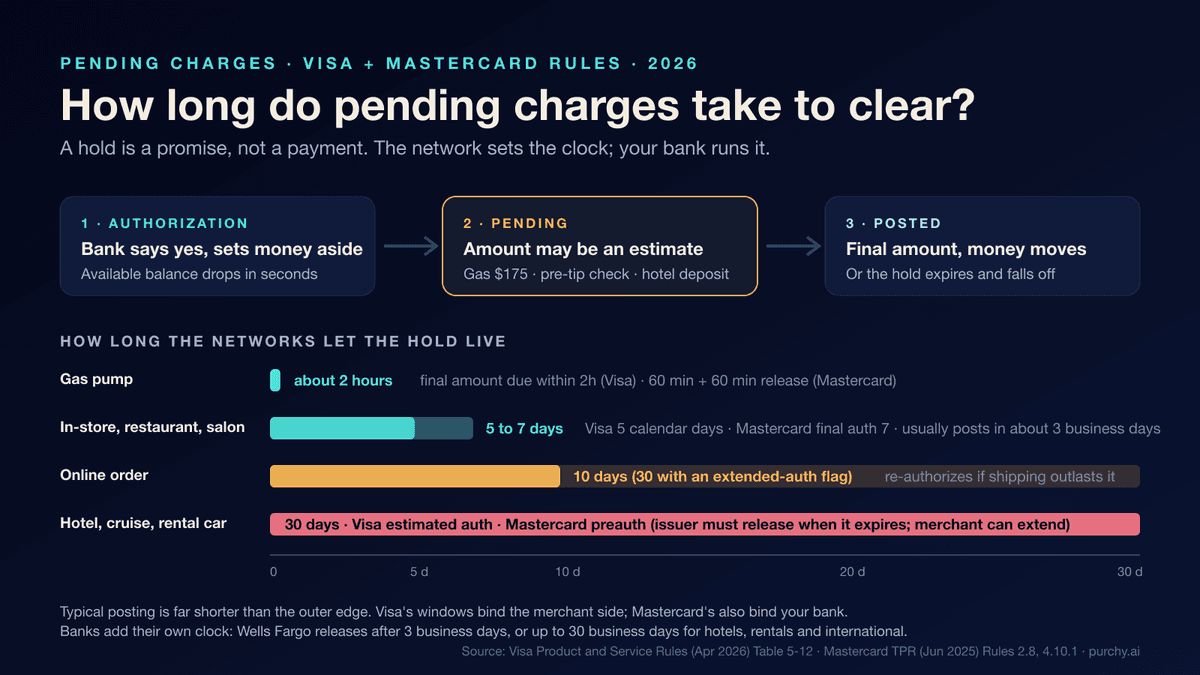
How long do pending charges take to clear? For an ordinary card-present purchase, the honest 2026 answer is about three business days (Capital One's own guidance says three to five) — but the rulebook behind that number is more specific than any bank's help page lets on. Visa's rules give the merchant 5 calendar days to clear a card-present authorization, 10 for an online one, and 30 for a hotel or rental-car estimate; Mastercard goes further and tells issuers a preauthorization hold must be released once its 30-day protection period expires (counted from the most recent authorization). The gas-pump hold that shows up as $175 is supposed to shrink to your real fill-up within about two hours under Mastercard's rules — and Visa tells issuers not to display the pump's status-check amount at all. And since February 21, 2026, a US restaurant can clear a tab up to 30% above the amount it authorized — up from 20% — which is why the pending line and the posted line so often disagree. This guide reads the actual Visa and Mastercard rules, the banks' stated release windows, and the federal rules that decide whether a hold can cost you an overdraft fee — verified September 12, 2026.
The 30-second version
A "pending" charge is an authorization: the merchant asked your card network whether the money was there, your bank said yes and set that amount aside, and nobody has actually moved it yet. It clears when the merchant sends the final amount and your bank matches it to the hold — or it falls off when the hold expires. The clocks are set by the card networks, and they vary by what you bought:
| Where you paid | What the network rules say | What you usually see |
|---|---|---|
| Gas pump (pay at the pump) | Status-check hold up to $175 on Visa and Mastercard; final amount due within 2 hours (Visa) or 60 minutes (Mastercard), and Mastercard issuers must release the excess within 60 minutes after that | Real amount within hours; a lingering $175 line is almost always a bank display or release lag, not a merchant charge |
| Store, restaurant, salon (card present) | Visa authorization valid 5 calendar days; Mastercard final authorization protected 7 days | Posts within about 3 business days (Capital One: 3 to 5) |
| Online order (card absent) | Visa authorization valid 10 calendar days (30 with an extended-authorization flag); Mastercard 7 days (final) or 30 (preauthorization) | Posts when the item ships; may vanish and reappear |
| Hotel, cruise, rental car | Visa estimated authorization valid 30 calendar days; Mastercard preauthorization 30 days | Hotels: hold released at checkout, funds back in 3 to 7 business days (Marriott), up to 30 days on international cards. Rentals: released at return on credit; refunded in 5 to 10 business days on debit (Enterprise) |
| Bank's own fallback | Not a network rule; issuer policy | Wells Fargo: releases after 3 business days, or up to 30 business days for hotels, rentals, cash and international |
Three things most explainers get wrong: the merchant's clock and your bank's clock are different clocks; a debit hold reduces cash you can spend today while a credit hold only reduces available credit; and you generally cannot "dispute" a pending charge, because federal error-resolution rules attach to transactions that have actually posted.
What a pending charge actually is
Every card payment is really two events with a gap between them.
The first is authorization. When you tap, swipe, or click "place order," the merchant's processor sends a request through Visa, Mastercard, American Express or Discover to the bank that issued your card. The bank checks the account, approves the amount, and places a hold — the FDIC's description is precise: it "is sometimes referred to as a debit hold, a temporary debit authorization hold, or a preauthorization." That hold reduces your available balance (debit) or available credit (credit card) immediately, which is why the purchase shows up in your app within seconds.
The second is clearing and settlement. Sometime later — minutes for a gas pump, days for an online order, a week or more for a hotel — the merchant sends the final amount through its processor. Your bank matches that record to the hold, releases the hold, and posts the real transaction. Only then does the money move.
The pending line you are looking at lives in the gap. It is a promise the bank made on your behalf, sized to whatever the merchant asked for, and the merchant is allowed to ask for an estimate when it does not yet know the final figure. Visa's rules require an estimated authorization to be "a genuine estimation of what the Cardholder will spend," require the merchant to tell you the estimated amount, and specifically forbid padding it with "any amount covering potential damage, theft, other delayed charges, insurance premiums, or tips." Marriott's and Enterprise's published hold structures, covered below, are examples of that estimate at work.
Two balance definitions matter for the rest of this guide, and the FDIC spells them out. The ledger balance counts only settled transactions and "does not take into account authorization holds." The available balance subtracts pending debit holds and is "generally the amount of money/funds the consumer can access" — the number you see online or at the ATM. Wells Fargo says the same thing in its own words: "Pending withdrawals, including debit card transactions we authorize and authorized payments known to us, reduce your available balance."
How long a hold can live: the Visa and Mastercard clocks
The card networks do not publish a single "holds last X days" number, but they publish something better: the period during which an authorization is valid. On Visa that period is a deadline for the merchant's side (the acquirer must clear the transaction within it); on Mastercard it is also a deadline for your bank (the issuer must release the hold once it expires). These tables are in the public rulebooks — Visa's Core Rules and Product and Service Rules (April 2026 edition) and Mastercard's Transaction Processing Rules (June 2025 edition) — and they are where the 7-day and 30-day figures banks quote come from (the "3 business days" you see on bank help pages is the bank's own number).
| Transaction type | Visa (Table 5-12, April 2026) | Mastercard (Rule 2.8, June 2025) |
|---|---|---|
| Card-present purchase (store, restaurant, salon) | 5 calendar days | 7 calendar days for a final or undefined authorization |
| Card-absent purchase (online, phone) | 10 calendar days; 30 with an extended-authorization indicator | 7 days (final) or 30 days (preauthorization) |
| Estimated authorization: lodging, cruise line, vehicle rental | 30 calendar days | 30 calendar days (preauthorization) |
| Estimated authorization: equipment, tool, furniture, boat, motorcycle, motor-home, clothing or DVD rental; campgrounds | 10 calendar days | 30 calendar days (preauthorization) |
| Merchant-initiated (subscriptions, card-on-file) | 5 calendar days | 7 days (final) or 30 days (preauthorization) |
| Gas pump preauthorization | Merchant must confirm the final amount within 2 hours of the transaction (no issuer release deadline) | Final-amount advice within 60 minutes; issuer releases excess within 60 minutes of receiving it |
Mastercard states the consequence for your bank outright: "The Issuer must release any hold placed on the Cardholder's Account after the expiration of the message reason code 4808 chargeback protection period for a particular Transaction, at the latest." Thirty days for a preauthorization, seven for a final authorization. An authorization older than that "is deemed to be zero." One caveat: under Rule 2.9 a merchant "may later submit an additional preauthorization request for the same Transaction" to extend that period — even for a zero amount — so a hotel can legitimately keep a hold alive through a long stay. The 30-day clock runs from the most recent authorization, not the first one.
Visa's rules, by contrast, contain no issuer release deadline. Table 5-12 is the acquirer's processing window; Visa's only issuer-side rule that touches holds is a disclosure rule (4.1.8.1), covered in the gas-station section below. That is why the same hotel hold can behave differently on a Visa and a Mastercard from the same bank.
Visa's rules approach the same problem from the merchant's side. Under Table 5-14, when the final amount is less than what was authorized, the merchant "must submit an Authorization Reversal" for the difference "within 24 hours of Transaction completion." If the transaction never completes — you cancelled, or paid another way — the reversal is due within 24 hours of that decision. The acquirer that receives a reversal "must accept the Authorization Reversal and immediately forward it to Visa." That rule is the lever you pull when you ask a merchant to "release the hold": you are asking for an authorization reversal, and the network requires the merchant to send one.
Gas station holds: the $175 rule and the two-hour clock
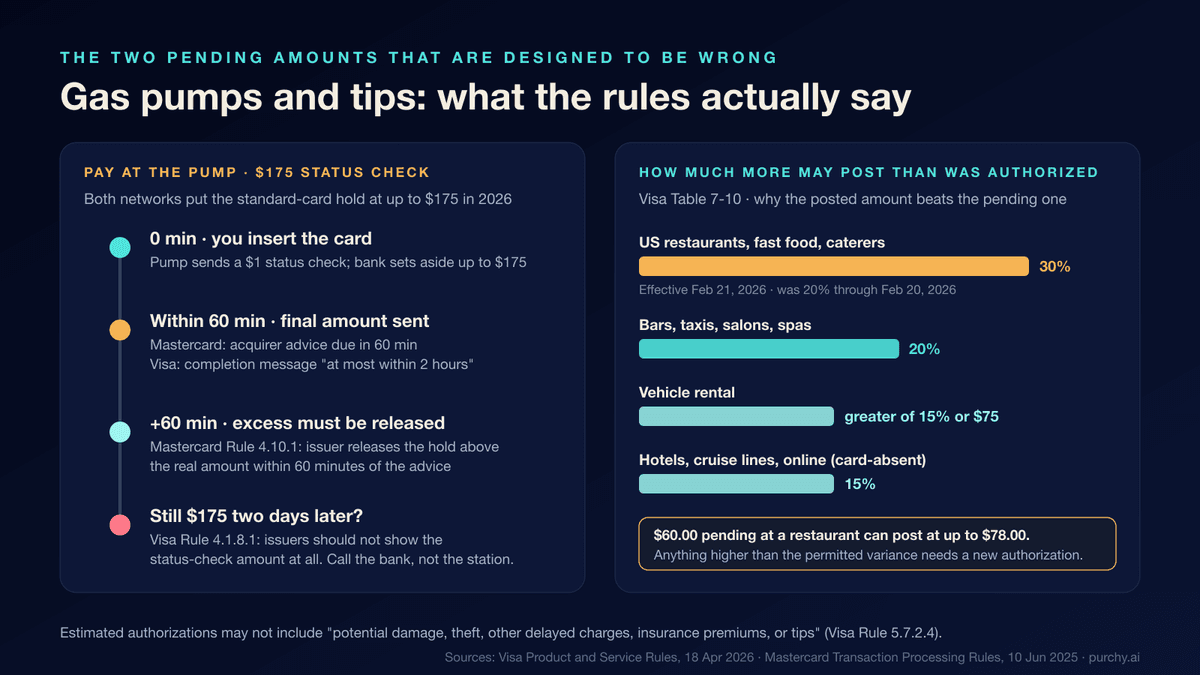
Pay-at-the-pump is the one place where a pending charge is designed to be wrong. The pump has to authorize before it knows how much fuel you will take, so it sends a small "status check" (Visa) or a $1 preauthorization (Mastercard) and the network tells your bank how much to set aside.
That amount has climbed with gas prices. Visa's own March 2020 bulletin raised the US status-check limit to $125 for non-fleet cards (effective October 17, 2020, for chip-and-partial-authorization pumps; $100 before that). In mid-2022, with pump prices approaching $5 per Kelley Blue Book's report at the time, both Visa and Mastercard raised it again, and the current rulebooks agree on $175 for ordinary cards — Visa's rule sets it as the status-check amount for everything but a Visa Fleet Card ($1,000); Mastercard's rule advises issuers to hold "up to USD 175" on everything but its corporate and fleet products ($500).
The part almost nobody quotes is how fast that $175 is supposed to disappear:
- Visa: the merchant "must send to the Issuer either a Completion Message or an Acquirer Confirmation Advice message confirming the final Transaction amount ... as soon as possible and, at most, within 2 hours of the completion of the Transaction."
- Mastercard: the acquirer's advice with the final amount "must be sent no later than 60 minutes ... after the original preauthorization request," and then "Within 60 minutes of receiving the advice message, the Issuer must release any hold that the Issuer placed on the Cardholder's available funds or credit in excess of the Transaction amount ..." If no fuel is dispensed, a zero-amount reversal is due within the same 60 minutes.
Both networks also tell your bank what to show you. Visa's Rule 4.1.8.1 says an issuer must "not notify its Cardholder of the amount of the Authorization Request" for a fuel transaction in an online statement or alert — it may show only the final amount. Mastercard's version: "If the Issuer displays pending automated fuel dispenser Transaction information in Cardholder-facing applications, the information must be based on the advice message Transaction amount."
So if a $175 line is still sitting in your app two days after a $42 fill-up, the merchant is very unlikely to be the problem. The advice message was due within an hour or two; what you are seeing is your bank's display or release logic lagging the rule. That is worth knowing before you call the station — and it is the fact to cite when you call the bank. (A station is not required to use the $1 status check: Mastercard's rule also lets it authorize "a maximum fuel dispense amount as determined by the Merchant or Acquirer" or an amount you select, and — as a stated best practice rather than a requirement — says the merchant should tell you the estimated amount "on a screen display or sticker at the Terminal" before you start.)
Hotels and rental cars: the 30-day category
Hotels and car-rental companies are the merchants Visa's tables single out for a 30-day estimated authorization, and they are the source of the largest holds most people ever see.
Hotels. Marriott's help center describes the structure plainly. At check-in the property places a temporary hold that "typically includes" the room rate for the entire stay, applicable taxes, and an incidental deposit — "a predetermined daily amount to cover potential charges like room service, parking, or mini-bar purchases." You are "not billed for the hold amount unless the incidentals become an actual charge." On the release side: "Marriott releases the hold at the time of checkout; however, the time it takes for the funds to reappear in your account depends entirely on your financial institution's policies. ... Most banks release hold within 3 to 7 business days. ... Holds on cards issued by international banks may take up to 30 days to clear."
Note what that means arithmetically. A four-night stay at a $220 room with a $50-per-night incidental deposit produces a hold near $1,080 plus tax before you have bought a single thing — and the incidental portion is money the hotel will only charge if you actually run up incidentals. On a credit card that is a temporary dent in available credit. On a debit card it is cash you cannot spend until the hold drops.
Rental cars. Enterprise publishes the number range most rental companies keep vague: renters without a ticketed return travel itinerary must present a credit card "with sufficient available credit to cover the estimated total amount for the rental and a deposit between $200-$850 depending on the rental location and class of vehicle rented." The mechanics differ sharply by card type, in Enterprise's own words:
- Credit card: "the full cost of the rental and the security deposit will be authorized on your card when you pick up your vehicle. When you return the vehicle, Enterprise immediately releases the authorization and only charges your card the full amount of the rental."
- Debit card: "the full cost of the rental and security deposit will be charged to your checking account when you pick up your vehicle. Once the vehicle is returned, Enterprise will refund your checking account the amount of the deposit. ... Typically, you should see a refund in approximately 5 to 10 business days."
That is the whole debit-versus-credit story in two bullets: a credit deposit is a hold that is released; a debit deposit is a charge that is refunded, and a refund is a new transaction that takes its own 5 to 10 business days to land. Enterprise adds the sentence that should be printed on every rental counter: if you pay with a debit card, "Renter is responsible for any overdraft fees incurred."
Visa's estimated-authorization rule is also the fact to cite at the counter. The estimate must exclude "any amount covering potential damage, theft, other delayed charges, insurance premiums, or tips," and any later increase must be submitted as an incremental authorization tied to the same transaction rather than a fresh, separate hold. If a rental desk tells you it is holding an extra amount "in case of damage," that is exactly what the rule says the estimate may not include. (Visa's one carve-out is narrow: under Rule 5.8.8.4 a vehicle-rental merchant in its Asset Protection Program may estimate high "to protect them from potential losses associated with extended rental periods," but even then the request "must not include an amount to cover for potential damage, theft, or other delayed charge.")
Restaurants, bars and salons: why the pending amount is wrong
Sit-down restaurants authorize before you write in the tip, so the pending amount is the pre-tip check and the posted amount is the total. The networks let the two differ by a set percentage, and Visa changed that percentage this year.
Under Visa's Table 7-10 (Permitted Variations between the Authorization Amount and the Clearing Amount), through February 20, 2026, a US restaurant or fast-food merchant could clear up to 20% above the authorized amount. Effective February 21, 2026, in the US, caterers (MCC 5811), restaurants (MCC 5812) and fast-food restaurants (MCC 5814) may clear up to 30% above the authorization — restaurants and fast food up from 20%, caterers newly added to the list. Bars (MCC 5813), taxis and limousines (MCC 4121), beauty and barber shops (MCC 7230) and spas (MCC 7298) stay at 20%. Lodging and cruise lines are allowed 15%; vehicle rental the greater of 15% or $75; other card-absent transactions 15%.
In practice this is why a $60.00 pending restaurant line posts as $72.00 after a 20% tip, why it could post as high as $78.00 under the new 30% ceiling, and why a $60.00 authorization that posts at $85.00 is worth a second look — that is 42% over, beyond what the rule permits without a new authorization.
Wells Fargo describes the same gap from the bank's side: the merchant "may request authorization for an initial amount and send us the actual transaction amount later for payment. This is often the case in places where you can add a tip to your bill (such as restaurants or salons), hotels and car rental agencies, where there can be a significant difference between the amount that's authorized initially (authorization hold amount) and the actual transaction amount."
Online orders: the 10-day authorization and the vanishing charge
Online purchases produce the most confusing pending behavior because the merchant authorizes at checkout and settles at shipment — and those can be days apart.
Visa gives a card-absent authorization 10 calendar days of validity, or 30 if the merchant flags it as an extended authorization; Mastercard's preauthorization gets 30. Visa's rules separately require that for shipped goods "the Transaction Date must be on or after the date on which the goods are shipped," which is why a retailer that takes a week to ship can legitimately leave a pending line on your statement for a week.
Three patterns follow from that:
- The charge disappears, then comes back. If shipping slips past the authorization's validity window, the merchant can no longer clear against it — so your bank drops the line (on a Mastercard the issuer must release it once the 7- or 30-day protection period expires; on Visa the timing is the bank's own policy, and Wells Fargo, for example, releases most debit holds after 3 business days). When the order finally ships, the merchant authorizes again and a new pending line appears — sometimes with a different date, which people misread as a double charge. It is one purchase with two authorizations; only the second will post.
- You see two pending lines for one order. Some retailers run a $0 account verification (which places no hold) or a $1 authorization alongside the real one, or re-authorize a split shipment per box. A $1 hold that is never completed falls off when the authorization's validity window ends — Visa obliges the merchant to reverse it within 24 hours of that point; split shipments post separately and add up to the order total.
- A cancelled order still shows pending. Cancelling tells the merchant to reverse the authorization — due within 24 hours under Visa's rule — but your bank may keep the line until the reversal arrives or the validity window ends. Capital One's guidance is that banks "can't usually cancel pending transactions"; the fix is a reversal from the merchant, not a dispute with the bank.
If you buy on a buy-now-pay-later plan or a store card, the same authorize-then-capture logic applies, but the "pending" line lives in the BNPL app rather than on your bank statement. The refund and dispute rules for BNPL under the FTC's Holder Rule are a separate topic.
Why it is still pending after the merchant "released" it
The most common support call goes like this: the hotel says it released the hold at checkout; the bank says it has not received anything. Both can be telling the truth, because a release is a message that has to travel merchant → processor → network → your bank, and then your bank has to act on it.
What the banks say about their own side:
- Wells Fargo (debit and ATM cards): "For most debit card purchases, we receive the payment request, including the actual transaction amount, within three (3) business days of the transaction. If we don't receive a final payment request from the merchant within three (3) business days, [or up to thirty (30) business days for certain types of debit or ATM card transactions including but not limited to car rental, hotel, cash disbursements, and international transactions], we release the authorization hold on the transaction." (Brackets in the original.)
- Chase (credit cards): a hold "is an authorization to temporarily freeze your credit," and "these holds can last from a few days to a week, and can be influenced by how quickly a merchant processes the transaction and your card issuer's policies."
- Capital One (article dated February 3, 2026): "Transactions usually take three to five business days to post, though some can take as long as 14 days." For credit cards specifically, purchases "generally post in three days, but in some cases may take up to 30 days."
Put the merchant clock and the bank clock together and you get the realistic ranges: a store purchase posts within about 3 business days (Capital One: 3 to 5, occasionally up to 14); a hotel deposit on a credit card is released at checkout and the funds reappear 3 to 7 business days later (Marriott); a rental deposit on a credit card is released at return (Enterprise), while the same deposit on a debit card is refunded, not released, and takes 5 to 10 business days to reappear; and a bank's outer fallback for travel categories is 30 business days — which is six weeks of calendar time, not one month.
Debit vs. credit: why a debit hold can cost you an overdraft fee
A credit-card hold reduces the credit you can use. A debit-card hold reduces the cash you can spend — and that difference has been a recurring target of bank regulators since 2019.
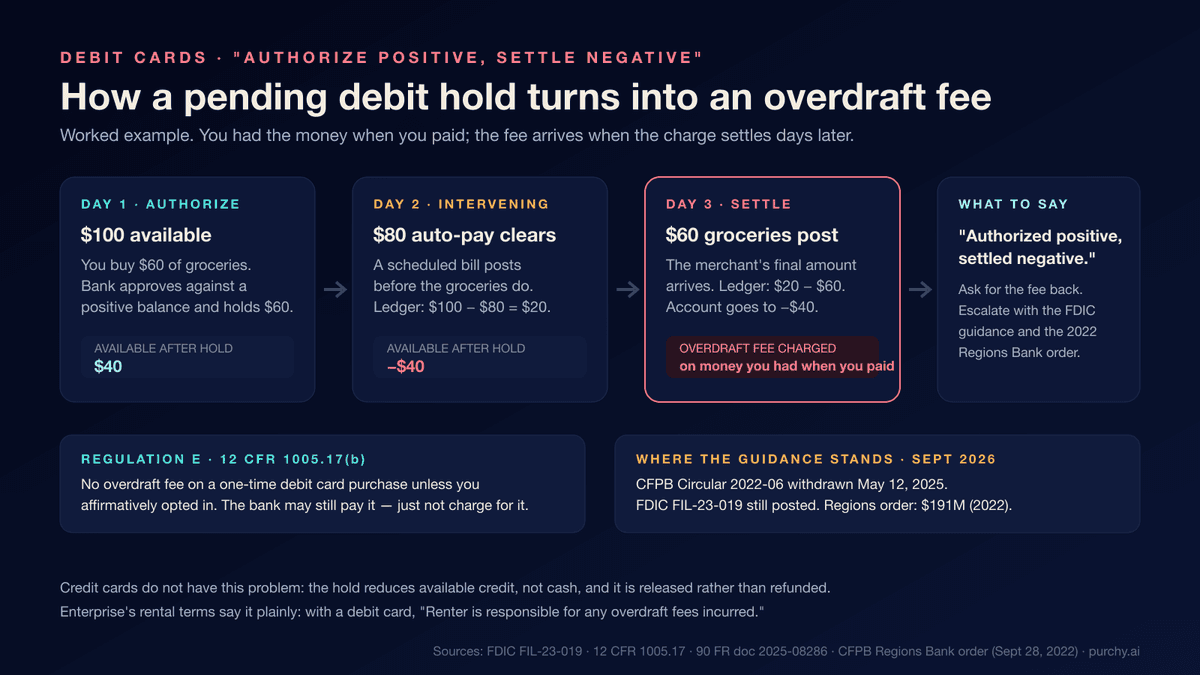
The mechanism regulators call "authorize positive, settle negative" (APSN) works like this, in the FDIC's words: "Some banks assess overdraft fees on debit card transactions that authorize when a customer's available balance is positive but later post to a customer's account when their balance is negative. In this scenario, a customer's account has a sufficient available balance to cover a debit card transaction when the transaction is authorized but, due to one or more intervening transactions, has an insufficient balance to cover the transaction at the time it settles." Some banks then charged an overdraft fee on the original transaction and on the intervening ones.
Where the law stands in September 2026:
- The CFPB's guidance was withdrawn, the enforcement record was not. CFPB Circular 2022-06, "Unanticipated overdraft fee assessment practices" (October 26, 2022), said APSN fees were likely unfair under the Consumer Financial Protection Act. On May 12, 2025, the CFPB withdrew that circular along with dozens of other guidance documents (90 FR, document 2025-08286). A withdrawn circular does not undo the orders issued under the same theory: on September 28, 2022, the CFPB ordered Regions Bank to pay $191 million — a $50 million penalty plus $141 million in consumer redress — for "illegal surprise overdraft fees," including authorized-positive fees. The unfairness standard itself (12 U.S.C. §§ 5531 and 5536) is a statute, not guidance.
- The FDIC's guidance is still posted. FDIC FIL-23-019 (April 2023), "Supervisory Guidance on Charging Overdraft Fees for Authorize Positive, Settle Negative Transactions," remains on fdic.gov as of this writing and tells FDIC-supervised banks the practice carries "heightened risks" under Section 5 of the FTC Act and the Dodd-Frank Act's unfairness standard. It also notes that account-agreement disclosures "may not mitigate these concerns."
- The opt-in rule is unchanged. Under Regulation E, 12 CFR § 1005.17(b), a bank "shall not assess a fee or charge on a consumer's account for paying an ATM or one-time debit card transaction pursuant to the institution's overdraft service, unless" you received a separate notice and affirmatively opted in. If you never opted in, the bank may still choose to pay a one-time debit purchase that overdraws the account, but it cannot charge you an overdraft fee for doing so.
The practical read: a debit hold that sits for days on a low-balance account is the setup for an APSN fee, because every other transaction that clears in the meantime is measured against a balance that already has the hold subtracted. Enterprise's "Renter is responsible for any overdraft fees incurred" line is a merchant telling you this in advance. If a hold costs you an overdraft fee, the fact to cite to your bank is that the transaction was authorized against a positive balance; the documents to cite if you escalate to a regulator are the FDIC guidance and the Regions order.
For the full comparison of the two rulebooks — liability caps, deadlines, provisional credit — see debit vs. credit card disputes in 2026.
Can you dispute a pending charge?
Generally not, and the reason is in the definition of an "error." Regulation E's error-resolution rule, 12 CFR § 1005.11, lists what a bank must investigate: "an unauthorized electronic fund transfer," "an incorrect electronic fund transfer to or from the consumer's account," an omission from a statement, a computational error, and similar items — all of them things that happened to a transfer. A pending authorization is a hold on a transfer that has not been made yet. Capital One says the same thing operationally: institutions "can't usually cancel pending transactions."
What that means for the three situations people actually face:
- The pending amount is wrong (restaurant, hotel, pump). Wait for it to post. If the posted amount is still wrong, that is an "incorrect electronic fund transfer" on a debit card and a billing error on a credit card, and the clock starts: under Reg E the bank must "investigate promptly and ... determine whether an error occurred within 10 business days," or take up to 45 days if it provisionally credits your account within those 10 business days. The step-by-step is in how to dispute a credit card charge.
- The pending charge is one you never made. Do not wait. Report the card as compromised immediately — Reg E caps your liability more tightly the faster you report, and the bank will block the card and let the authorization expire.
- The pending charge was cancelled or released but is still showing. This is not an error the bank can investigate; it is a reversal that has not arrived. Ask the merchant for the reversal (Visa requires it within 24 hours) and ask the bank whether it will release the hold on the merchant's written confirmation — many will.
How to get a hold released faster
- Identify which kind of pending charge it is. A gas-pump amount that looks like $175 is a status check that should shrink within hours. A hotel or rental amount is an estimated authorization with a 30-day network window. A store or online amount is a 5- to 10-day authorization. Different problems, different calls.
- Ask the merchant for an authorization reversal, in those words. Visa's Table 5-14 obliges the merchant to send one within 24 hours of a cancellation or a lower final amount, and the acquirer to "immediately forward it." Front-desk and rental-counter staff often call this "releasing the hold"; the processor calls it a reversal. Ask for the reversal reference or a release letter on letterhead with the amount, date, and last four digits of the card.
- Take the merchant's confirmation to the bank. Many issuers will drop a hold early when the merchant confirms in writing that it will not capture the amount, though none is required to. Chase's own advice is to contact the merchant first, then the issuer, and to have receipts or billing statements ready as documentation.
- Invoke the network rule by name if the bank hesitates. For a fuel hold on a Mastercard: Rule 4.10.1, sixty-minute release after the advice message. For a Visa fuel hold: Rule 4.1.8.1 — the bank should not be showing you the status-check amount at all. For a stale hotel or rental hold on a Mastercard: Rule 2.8, release required once the 30-day protection period from the last authorization expires. (Visa has no equivalent issuer rule — there, the merchant's reversal is your lever.)
- Wait out the bank's own fallback if nothing else works. Wells Fargo's stated rule is 3 business days for ordinary purchases and 30 business days for travel categories. Your bank's deposit agreement will state its equivalent.
- Use a credit card for anything with a deposit. The hold reduces available credit rather than cash, it is released rather than refunded, and the purchase-protection benefits on most rewards cards come along for free.
Mistakes people make with pending charges
- Filing a dispute on a pending line. The bank cannot investigate an authorization; you lose days waiting for a "we can't act on this yet" letter while the reversal you should have requested from the merchant never gets sent.
- Treating the pending amount as the final amount. A $60 restaurant authorization will post at $60 plus tip, up to 30% over under Visa's 2026 US rule; a $1 or $175 pump authorization will post at your actual fill-up.
- Spending "down to" the available balance on a debit card while a hold is pending. That is exactly the pattern that produces an authorize-positive, settle-negative fee. Treat the hold as spent until it drops.
- Paying a rental or hotel deposit with a debit card when a credit card is available. The deposit becomes a real charge plus a real refund (5 to 10 business days at Enterprise) instead of a hold that is released.
- Assuming a vanished pending charge means the purchase was cancelled. It usually means the authorization expired before the merchant shipped; a new authorization — and the real charge — is coming.
- Calling the merchant about a stale $175 fuel line. The merchant's message was due within an hour or two; the display is your bank's.
- Counting calendar days when the bank said business days. Thirty business days is about six weeks.
Where Purchy fits in
Pending charges are the part of your money you cannot see clearly: the amount is an estimate, the date it will post is unknown, and the line may disappear and reappear under a different label. That is precisely where a purchase you meant to return, a subscription you meant to cancel, or a deposit you were owed back gets lost. Purchy connects to your bank and your receipts, so a hotel deposit that should have been released, a rental refund that was promised in 5 to 10 business days, or a pending charge that posted at a different amount than the receipt shows is something you can check against a record instead of a memory — and it watches the return deadline on each purchase whether the charge is still pending or already posted. If you would rather have those clocks tracked than reconstruct them from a statement, that is what Purchy is built for.
Frequently asked questions
How long do pending charges take to clear in 2026?
Most in-store purchases post within about three business days (Capital One says three to five). Under the card-network rules, a Visa card-present authorization is valid for 5 calendar days and a card-absent (online) authorization for 10; Mastercard protects a final authorization for 7 days and a preauthorization for 30, and tells issuers to release the hold once that period expires (for a preauthorization, counted from the most recent authorization, since a merchant can extend it by re-authorizing). Hotels, cruise lines, and rental cars get a 30-day estimated authorization on Visa; Marriott says hotel holds are released at checkout and reappear in 3 to 7 business days, and Enterprise releases a credit-card rental authorization at return.
Why is there a $175 pending charge from a gas station?
Pay-at-the-pump transactions authorize before the pump knows how much fuel you will take, so on both Visa and Mastercard your bank sets aside up to $175 on an ordinary card (more on fleet and corporate cards). Visa requires the merchant to confirm the real amount within 2 hours; Mastercard requires the acquirer's advice within 60 minutes and the issuer to release the excess within 60 minutes after that. Visa's rules also tell issuers not to display the status-check amount at all, so a $175 line that lingers for days is almost always a bank display or release lag, not a merchant charge.
How long does a hotel hold stay on your card?
Marriott's help center says the hold — room rate plus taxes plus a daily incidental deposit — is released at checkout, and that most banks then take 3 to 7 business days to make the funds reappear, or up to 30 days for cards issued by international banks. Visa's rules give a lodging estimated authorization 30 calendar days of validity, and Mastercard's rules require issuers to release a preauthorization hold once its 30-day protection period expires, measured from the most recent authorization — a hotel can extend it by re-authorizing during a long stay.
How long does a rental car deposit hold take to be released?
It depends on the card. Enterprise states that on a credit card the rental cost and deposit are authorized at pickup and the authorization is released immediately at return, with only the rental amount charged. On a debit card the rental cost and deposit are charged at pickup and the deposit is refunded after return, typically appearing in 5 to 10 business days. Enterprise's published deposit range for renters without a ticketed return itinerary is $200 to $850 depending on location and vehicle class.
Can you dispute a pending charge?
Usually not. Regulation E's error-resolution rule covers electronic fund transfers that were actually made — unauthorized transfers, incorrect amounts, omissions — and a pending authorization is a hold on a transfer that has not happened yet; Capital One notes that banks can't usually cancel pending transactions. Wait for the charge to post, then dispute the posted amount if it is wrong. If the pending charge is fraudulent, report the card as compromised immediately rather than waiting.
Why did a pending charge disappear and then come back?
Online merchants authorize at checkout and charge at shipment. If shipping takes longer than the authorization's validity window — 10 calendar days on Visa for a standard card-absent authorization — the merchant can no longer clear against it, your bank drops the line (on Mastercard the issuer must release it once the protection period expires; on Visa the timing is the bank's own policy), and the merchant authorizes again when the order ships. It is one purchase with two authorizations; only the second one posts.
Why is the posted restaurant charge higher than the pending amount?
Restaurants authorize the pre-tip check and clear the total with the tip. Visa's rules allow a set variance between the two: effective February 21, 2026, US restaurants and fast-food restaurants may clear up to 30% above the authorized amount, up from 20%, and caterers were added to the 30% list. Bars, taxis, salons, and spas remain at 20%; lodging and cruise lines at 15%; vehicle rental the greater of 15% or $75.
Can a pending charge cause an overdraft fee?
Yes, on a debit card. A hold reduces your available balance, and if other transactions clear while it is pending, the original purchase can settle into a negative balance — the "authorize positive, settle negative" pattern. FDIC guidance (FIL-23-019) still identifies charging overdraft fees on those transactions as a heightened unfairness risk, and the CFPB's 2022 Regions Bank order ($191 million) was built on the same theory, although the CFPB withdrew its own 2022 circular on the subject on May 12, 2025. Under Regulation E, a bank cannot charge an overdraft fee for paying a one-time debit card transaction under its overdraft service unless you affirmatively opted in.
How do I get a hold removed from my card?
Ask the merchant for an authorization reversal — Visa's rules require merchants to submit one within 24 hours when a transaction is cancelled or the final amount is lower than authorized — and get a written confirmation with the amount, date, and card's last four digits. Then ask your bank to release the hold on that confirmation; many will, though none is required to. If the bank declines, cite the network rule: Mastercard issuers must release fuel excess within 60 minutes of the advice and preauthorization holds once the 30-day protection period expires; Visa fuel status-check amounts should not be displayed to you at all, and on Visa the merchant's reversal is the lever.
Is a pending charge on a credit card different from one on a debit card?
The hold works the same way on the network side, but the consequences differ. A credit hold reduces available credit and is released; a debit hold reduces cash you can spend today, can expose you to an overdraft fee if other transactions clear first, and a debit deposit at a rental counter is charged and refunded rather than held and released. Federal dispute rights also differ once the charge posts: Regulation E for debit, the Fair Credit Billing Act and Regulation Z for credit.
Sources and citations
Card network rules (primary)
- Visa Core Rules and Visa Product and Service Rules, 18 April 2026 — §§ 4.1.8.1 (issuer disclosure of authorization amounts), 5.7.2.4 (estimated authorizations), 5.7.2.6 and Table 5-10 (fuel status checks, $175), 5.7.3.5 and Table 5-12 (authorization validity), 5.7.3.6 and Table 5-14 (authorization reversals), 5.8.8.4 (vehicle-rental Asset Protection Program), 7.3.7.1 (acquirer forwarding), 7.5.6 and Table 7-10 (permitted variance; 30% US restaurant rule effective 21 February 2026), 7.6.1.1 (transaction date for shipped goods)
- Visa Business News AI09801, "U.S. Automated Fuel Dispenser Authorization Limits Will Be Increased," 19 March 2020 — the $125 / $350 limits effective 17 October 2020
- Mastercard Transaction Processing Rules, 10 June 2025 — Rule 2.8 (chargeback protection periods and issuer hold release), Rule 2.9 (multiple authorizations and extending the protection period), Rule 4.10.1 (automated fuel dispenser transactions, $175, 60-minute release)
- Kelley Blue Book, "Gas Stations Can Now Place $175 Bank Hold," June 28, 2022 — secondary source for the timing of the 2022 increase
Bank and merchant practice
- Wells Fargo — Account Activity Questions — 3-business-day and 30-business-day authorization release language
- Chase — What Is a Credit Card Hold?
- Capital One — Pending Transactions (February 3, 2026)
- Marriott Help Center — What Is an Incidental Hold?
- Enterprise — Accepted Rental Car Payment Methods and How Do Rental Car Refunds Work by Payment Method?
Federal rules and regulators
- 12 CFR § 1005.11 — Procedures for resolving errors (Regulation E) (Cornell LII)
- 12 CFR § 1005.17 — Requirements for overdraft services (Regulation E) (Cornell LII)
- 12 U.S.C. § 5531 — Prohibiting unfair, deceptive, or abusive acts or practices (Cornell LII)
- FDIC FIL-23-019, Supervisory Guidance on Charging Overdraft Fees for Authorize Positive, Settle Negative Transactions (April 2023)
- CFPB, "CFPB Orders Regions Bank to Pay $191 Million for Illegal Surprise Overdraft Fees" (September 28, 2022)
- Interpretive Rules, Policy Statements, and Advisory Opinions; Withdrawal, 90 FR (May 12, 2025), document 2025-08286 — withdrawing CFPB Circular 2022-06 (item 11) as of May 12, 2025
Related Purchy guides
- How long does a refund take? 2026 guide
- How long can a bank hold a check? 2026 Reg CC rules
- Debit vs. credit card disputes 2026
- How to dispute a credit card charge 2026
- How to get a refund for a forgotten subscription charge
- Best credit cards for purchase protection 2026
- Holder Rule and BNPL refunds 2026
- How to track online purchases
Last verified September 12, 2026 against the public Visa Core Rules and Visa Product and Service Rules (18 April 2026 edition), the Mastercard Transaction Processing Rules (10 June 2025 edition), 12 CFR §§ 1005.11 and 1005.17, FDIC FIL-23-019, and Federal Register document 2025-08286. Network rules describe what merchants and issuers are required to do; individual banks' release times are their stated policies and can differ. Educational content only; not legal or financial advice.
Wake to one edition. Only what matters.
$12.99 a month or $99.99 a year. Cancel any time from your Apple Account.
Download on iOS →