Do You Get Sales Tax Back on a Return? 2026 Rules
Do you get sales tax back on a return? Usually, but Connecticut and Massachusetts cut it off at 90 days and a restocking fee can shrink it. Check in 60 seconds.
You return a $100 jacket in Connecticut four months after buying it, and the refund that lands is $100 — not the $106.35 you actually paid. So do you get sales tax back on a return? Usually yes, and in most states the retailer has a direct tax incentive to hand it back. But two things can cut into it, and they are not the ones shoppers expect. Connecticut and Massachusetts both end your right to the tax at 90 days — and in Connecticut, sooner still if you lost the receipt. And a store that keeps part of your money is treated very differently depending on why — a flat restocking fee and a sliding scale that shrinks your refund the longer you wait are separate things in law. In 2009 one retailer put the sliding-scale question to several states at once. Massachusetts and New York answered it opposite ways, and Washington's own regulation answers it a third. Here is how to tell which rule applies to you, and how to check in under a minute whether your refund was short.
The short answer: yes — in most states a full refund includes the sales tax, because a retailer can only reclaim that tax from the state if it refunded it to you first. The exceptions: Connecticut and Massachusetts both stop refunding the tax after 90 days (Connecticut also requires a receipt), and in Connecticut a restocking fee shrinks the tax refund too.
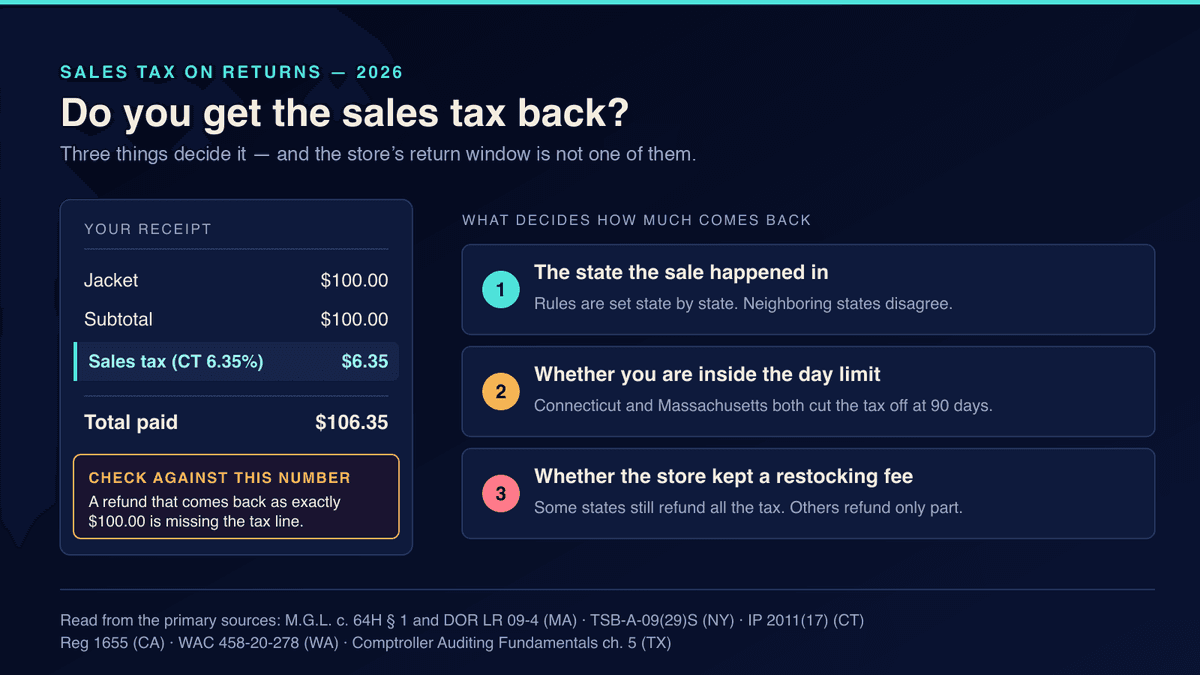
The 30-second version
- A full refund normally includes the sales tax. In most states the retailer only gets to back the sale out of its own taxable receipts if it refunded the tax to you, so the money is supposed to come back through the store, not from the state.
- Connecticut has a hard 90-day cliff. Return after 90 days — or with no receipt — and Connecticut says you are "not entitled to sales tax on the refund." The price comes back; the tax does not.
- Massachusetts also uses 90 days (180 days for a motor vehicle), and after that no tax is refunded either.
- A flat restocking fee usually costs you no tax at all. Massachusetts, Texas, Washington and California all keep the full tax refundable alongside the fee, and New York has held that a reasonable charge imposed solely for restocking is not a taxable receipt in the first place. Connecticut is the outlier that prorates: on a $100 item refunded at $90, its own worked example gives back $5.72 instead of $6.35.
- A sliding scale is a different animal, and it splits the authorities three ways. Where a policy refunds less the longer you wait, Massachusetts says refund the entire tax, New York says prorate it, and Washington says it is not a return at all but a repurchase — so no deduction, and nothing obliges the tax to come back.
- An even exchange can beat a refund. In Connecticut, swapping an item for an identical or similar one at the same price is tax-free even after 90 days and even with no receipt — because the state treats it as an extension of the original sale rather than a rescission.
- Warranty replacements are not returns. Connecticut explicitly exempts them from the 90-day and receipt requirements.
- Five states have no statewide sales tax at all, so there is nothing to argue about: Alaska, Delaware, Montana, New Hampshire and Oregon.
- Your receipt is the whole case. Connecticut requires you to produce one showing the purchase date and the tax paid. No receipt, no tax refund.
The single most useful habit here: when a refund posts, compare it against the total on your receipt, not the price on the tag. A refund that matches the shelf price exactly is the one worth a second look — it may be missing the tax line.
Why the tax is the store's to refund, not the state's
Most people picture sales tax as money the state took from them. Mechanically, that is not quite what happened, and the difference is the reason returns work the way they do.
When you bought the jacket, you paid the retailer the price plus an amount of tax reimbursement. The retailer then reported that sale and sent the tax to the state. Nothing in that chain created a direct account between you and the revenue department.
So when you bring the jacket back, the state does not write you a check. Instead, the retailer gets to remove that sale from its own taxable receipts — and then claim a credit or refund from the state for the tax it already remitted. The catch, and the thing that protects you, is that nearly every state attaches a condition to that deduction: the retailer only gets it if it actually refunded the tax to you.
Washington states this as plainly as any state does. Under WAC 458-20-278, a seller may deduct the selling price from its gross proceeds when goods come back and "the entire selling price is refunded or credited to the buyer" — and then adds the clincher: "A deduction is available under the retail sales tax classification only if the amount of sales tax previously collected from the buyer has been refunded by the seller to the buyer."
Texas frames it the same way. The Comptroller's own Auditing Fundamentals manual tells auditors that returns of taxable merchandise are deductible only if "[t]he original sale has been reported as taxable" and "[t]he taxable sales price including tax is refunded".
California does it through the definition of the taxable measure. Regulation 1655 excludes returned-merchandise amounts from the figure tax is computed on only where two conditions are met: "(1) the full sale price, including that portion designated as 'sales tax', is refunded either in cash or credit, and (2) the customer, in order to obtain the refund or credit, is not required to purchase other property at a price greater than the amount charged for the property that is returned." That second limb has teeth even though it is not phrased as a consumer right: a California store that conditions your refund on buying something pricier loses the exclusion and absorbs the tax itself.
New York carries the same condition alongside its consumer-facing rule: the retailer "may file the claim for refund or credit in a case only when the tax has actually been refunded to the customer."
That is why a store clerk telling you "we can't refund tax, that goes to the state" has it backwards. The store is the party that gets the tax back from the state, and in these states it only qualifies for that by passing it to you first.
Two caveats, because the rest of this depends on them:
- A rule about the retailer's books is not automatically a stated consumer right. The Washington, Texas and California provisions above are written as conditions on the seller's deduction. The practical effect for a shopper is the same in the ordinary case, but they are not phrased as an entitlement you hold. Massachusetts, New York and Connecticut do speak directly to what the customer is entitled to. The table in the next section keeps those two categories separate rather than blurring them.
- None of this creates a right to return the item in the first place. No federal law requires a store to accept a return at all, and state law mostly regulates disclosure rather than forcing a refund policy. Our guide to return policy laws by state covers that separate question. Everything here is about what happens to the tax once a refund is agreed.
The two kinds of money a store keeps
If a store refunds the whole price, every state covered here says the tax goes back too. The divergence appears the moment the store keeps something — and the first thing to understand is that the law does not ask whether the store kept something. It asks what kind of something.
There are two, and they are treated as different animals:
- A flat restocking fee. A fixed charge for the work of putting the item back into saleable stock. Washington's regulation supplies the test in one line: "The restocking fee is the same regardless of when a purchased item is returned to the seller by the buyer."
- A sliding-scale holdback. A policy that refunds you less the longer you wait — 100% in the first month, 75% in the second, and so on. This is not a fee for restocking work. It is the store pricing in the fact that your item lost value while you had it.
Almost every shopper lumps these together. No tax authority does. Get the category right and the rest follows.
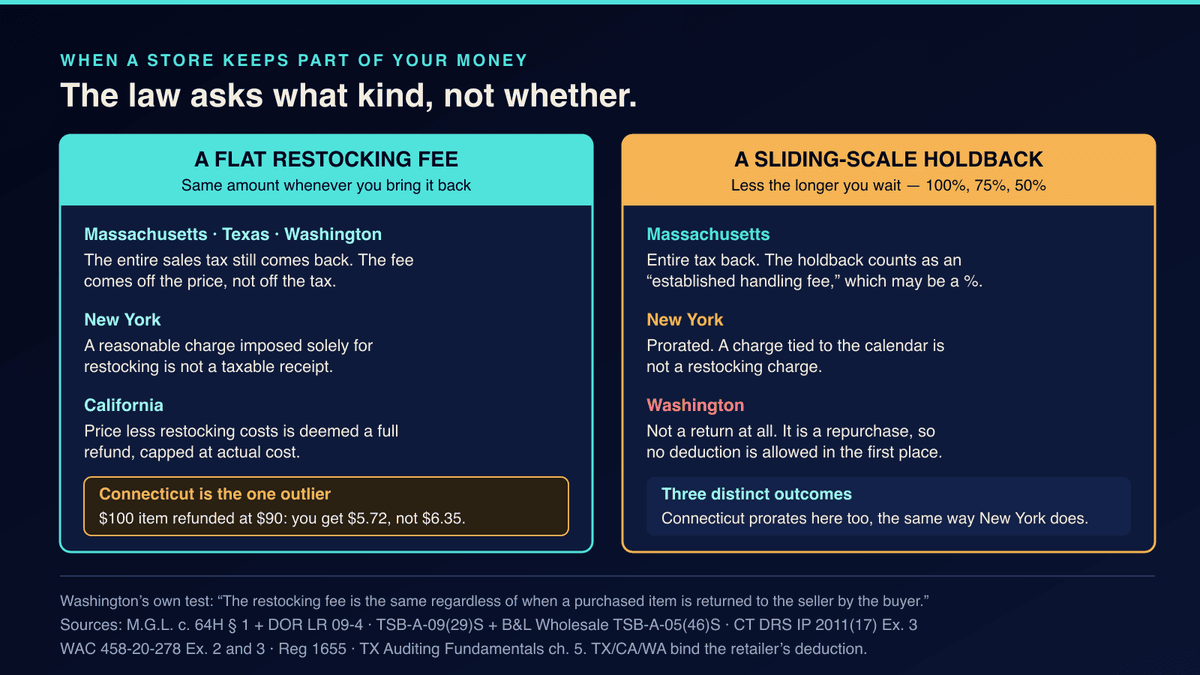
| State | Flat restocking fee | Sliding-scale holdback | Day limit on the tax | What the authority binds |
|---|---|---|---|---|
| Massachusetts | Entire sales tax still refunded | Entire sales tax still refunded, where the holdback is an "established handling fee" | 90 days (180 days for a motor vehicle) | Stated consumer entitlement |
| New York | A reasonable charge solely for restocking is not a taxable receipt | Tax prorated to the share of price actually refunded | None stated in the opinion | Consumer entitlement, plus a retailer-side condition |
| Connecticut | Tax prorated to the portion actually returned | Prorated the same way — the rule turns on the portion refunded, not on why | 90 days, and a receipt is required | Stated consumer entitlement |
| Texas | Does not affect the retailer's deduction | Not addressed in the audit manual | None stated in the audit manual | Condition on the retailer's deduction |
| California | Price less rehandling and restocking costs is deemed a full refund | Not addressed in Reg 1655 | None stated in Reg 1655 | Condition on the retailer's taxable measure |
| Washington | Still a sale return; tax refunded, fee taxed to the seller | Treated as a repurchase — no deduction allowed at all | The contract's guaranty period | Condition on the retailer's deduction |
Two things in that table are worth pausing on.
Connecticut is the odd one out on ordinary restocking fees. Everywhere else, a flat fee and your tax refund are separate questions. Connecticut alone ties the tax to the amount actually handed back, which is why its own worked example returns $5.72 rather than $6.35.
The last column matters more than it looks. In Massachusetts, New York and Connecticut, the tax authority answered a question about what the shopper gets, and said so. In Texas, California and Washington, the published rule is addressed to the seller's books. If you are at a customer service desk in Houston, you are on solid ground pointing out that the Comptroller conditions the store's own deduction on the tax being refunded — but you are arguing from the retailer's incentive, not quoting a consumer-rights provision. That is a weaker position than a Massachusetts shopper has, and it is worth knowing which one you are in.
One policy, three different answers
The clearest proof that this is real divergence rather than paperwork noise sits in two documents issued fifty days apart in 2009 — and in a third state's regulation that answers the same question without anyone having to ask.
In March 2009 a retailer introduced a sliding return policy. Returns within 60 days got 100% of the purchase price. Days 61–120 got 75%. Days 121–180 got 50%. After 180 days, nothing. The stated reason was that merchandise loses value as models age and seasons turn.
The retailer then put the question to more than one state. The Massachusetts ruling records it in a footnote: the request stated that the retailer "is currently requesting similar rulings in the District of Columbia, Florida, Minnesota and New York."
Massachusetts said all of it. Letter Ruling 09-4, issued May 26, 2009, concluded that the answer was "a full refund of sales tax based upon the original purchase price, provided that the return is made within 90 days from the date of sale." The ruling was blunt about why: "a purchaser may obtain a refund of the entire sales tax previously paid on returned merchandise, despite the fact that the Retailer charges or retains a separate handling fee covering the vendor's handling, restocking or similar administrative costs."
Its worked example, at the 5% rate Massachusetts charged at the time: a customer buys a taxable item for $100 and pays $5.00 in tax. On day 65 they return it and are credited $75 under the policy. "[t]he Retailer must, however, also refund the entire tax previously paid, i.e., $5.00." (Massachusetts has since raised its rate; the state's own Sales and Use Tax guide, updated May 7, 2026, puts it at 6.25%. The ruling's logic is unchanged — only the arithmetic moved.)
New York said only part of it. Advisory Opinion TSB-A-09(29)S, issued July 15, 2009, reached the opposite conclusion: "the customer is entitled to only a partial refund of the sales tax, based upon a percentage of the purchase price refunded." Its reasoning was that New York's sales tax is a transaction tax, so "the customer is entitled to a refund of sales tax only to the extent the original transaction is undone."
The retailer had argued its holdback should be treated as a restocking charge — which New York had already held was not a taxable receipt at all. The Department refused, and the sentence it used is the one every shopper should know:
"Here, the prorated charge bears no relationship to a cost for 'restocking' the merchandise... Were that the case, Petitioner would charge a flat restocking fee whenever merchandise was returned, regardless of the date of the return."
That is the whole distinction in a line. A fee that changes with the calendar is not a restocking fee.
Washington says it is not a return at all. No petition was needed here; the answer sits in the regulation. WAC 458-20-278 works through a department store that discounts refunds by elapsed time on a tiered schedule of its own — 100% inside 30 days, 75% from 31 to 60, 50% after that. A customer returns a dress on day 45 and is credited 75%. The regulation's verdict: "The amount retained by Breen's is not considered a restocking fee. This is considered a repurchase by Breen's, and thus no deductions are allowed under the retailing B&O tax or retail sales tax classifications on Breen's excise tax return."
Washington reaches New York's distinction — a sliding scale is not a restocking fee — and then draws the opposite consequence. If the store bought the dress back rather than accepting a return, there was no rescinded sale to unwind, so nothing requires the tax to come back.
Three authorities. One policy structure. Three outcomes: refund all the tax, refund part of it, or treat the whole thing as a fresh purchase. Connecticut, as we will see, lands on the second — making it four states and still three answers.
Why this matters beyond trivia: an inconsistent tax refund across two of a chain's stores is not necessarily a mistake by either one. Both can be following the law of the state they are standing in. Which is also why "but the store in Boston refunded my tax" is not, on its own, an argument that works in Albany.
Is there a time limit to get sales tax back on a return?
In Connecticut and Massachusetts, yes: 90 days from the date of purchase, on a clock that runs completely independently of the store's return window. Connecticut's Informational Publication 2011(17) — which the Department of Revenue Services still lists as current, and which superseded IP 2006(13) — says it in one sentence:
"If the goods are returned after 90 days from the date of purchase or without a receipt, the customer is not entitled to sales tax on the refund."
It has two independent triggers. Past 90 days, you lose the tax. And with no receipt, you lose the tax — even on day three.
Connecticut's own Example 4 makes the day limit concrete: a customer buys a bicycle for $100 plus $6.35 tax and returns it 120 days later. The retailer refunds the $100. "The customer is not entitled to a sales tax refund, whether or not the customer presents a receipt to the retailer, because the bicycle was returned after 90 days from the date of purchase."
Massachusetts runs the same 90-day clock from the other direction. The exclusion in M.G.L. c. 64H, § 1 applies only "when the property is returned within 90 days from the date of sale, and the entire sales tax paid is returned to the purchaser" — with a longer 180-day window where a motor vehicle is returned on rescission of the contract. Letter Ruling 09-4 spells out the consequence: "no sales tax is to be refunded if the return is made more than 90 days from the date of sale."
What makes this genuinely counterintuitive is that generous retailers can outrun their own state's tax rule. A store with a 365-day return policy in Connecticut will happily take your item back on day 200 and refund the price — and is correct not to refund the tax, because the state's 90-day window closed four months earlier. The store is not keeping your tax. Nobody is giving it back.
Several states set no day limit at all in the authority governing the question. New York's advisory opinion addresses proration without imposing a deadline. California's Regulation 1655 sets conditions on the refund but no number of days. Washington ties the question to "the guaranty period as established by contract" — which is to say, the store's own policy rather than a fixed statutory count. The absence of a stated limit in a document is not proof that no limit exists anywhere in that state's law, so treat these as "not found in the governing rule," not as a guarantee.
The practical takeaway is simple and it is about habit, not law: a return made early is worth more than the same return made late, and in Connecticut that difference is quantifiable at 6.35% of the price. If you are the kind of shopper who lets a maybe-return sit in the hallway for a few weeks, that habit has a price tag. Our guide to getting money back after the return window closes deals with the harder case, and return-deadline reminders deal with avoiding it.
Do you get sales tax back if there's a restocking fee?
In most of the states covered here, yes: a flat fee comes off the price, not the tax. Connecticut is the exception, and a holdback that grows the longer you wait is treated differently again. Here is the arithmetic for each.
A flat restocking fee
Start with the ordinary case: a fixed fee, the same whenever you bring the item back. Here the states line up almost unanimously, and the lone exception is the one shoppers never expect.
Massachusetts requires the whole tax back. The statute conditions the retailer's exclusion on refunding "the entire amounts charged therefor, less the vendors' established handling fees, if any," and on "the entire sales tax paid" being returned to the purchaser. The fee comes off the price; it does not come off the tax.
Texas keeps the two separate. The Comptroller's audit manual states flatly: "A handling or restocking charge does not affect the deduction allowed for returned merchandise." The deduction itself requires that "[t]he taxable sales price including tax is refunded".
Washington says the fee does not even break the return. Its regulation is explicit: "If all the conditions of this subsection are met for returned merchandise with the exception of a restocking fee, the transaction will be viewed as a sale return and not as a repurchase." The fee is then "considered income and taxable under the service and other business activities B&O tax classification" — a tax on the store, not on you. Washington's own example: a $400 car part comes back against a $35 restocking fee, and the store "computes Stan's refund of $400.00 plus sales tax minus the $35.00 restocking fee." Full price, full tax, then the fee.
New York answers it one step earlier. In B&L Wholesale Supply, issued December 28, 2005, the Department held that "a reasonable charge by Petitioner imposed solely for restocking returned merchandise... is not a receipt subject to the sales tax," because the charge "represents a transaction separate from the cancelled sale." The sale is rescinded; the fee is its own untaxed transaction alongside it.
That opinion also draws a line worth knowing. If the store charges you not for restocking but for having used the item, New York switches to proration: "if Petitioner's customer is charged for making some use of the returned merchandise, the sales tax will only be refunded on the portion of the original receipt actually refunded to the customer." A fee for shelving your return is one thing; a deduction because you wore it is another.
California deems the refund complete without the fee. Regulation 1655 says "Refund or credit of the entire amount is deemed to be given when the purchase price, less rehandling and restocking costs, is refunded or credited to the customer" — but fences it tightly. The amount withheld "may not exceed the actual cost of rehandling and restocking the returned merchandise," and may be set as a percentage based on the prior accounting cycle's average only if the seller commits to that percentage for the whole cycle. It explicitly may not include "compensation for increased overhead costs because of the return, for refinishing or restoring the property to salable condition where the necessity therefore is occasioned by customer usage, or for any expense prior to the 'sale'."
That last clause is worth knowing: a California restocking charge is meant to reflect genuine restocking cost, not the cost of repairing what you did to the item.
Connecticut is the outlier. Alone among these, it ties the tax to the amount actually handed back. Its own Example 3: a $100 item, $6.35 in tax, the store refunds $90 and keeps a $10 restocking fee. "The customer is entitled to a sales tax refund of $5.72 ($90 x 6.35% = $5.72)." You paid $6.35 and get $5.72. The 63 cents of tax riding on the $10 the store kept stays with the state.
Massachusetts has not always allowed this. In 1983, on a flat handling charge, it ruled the other way: a retailer "may not exclude from its taxable sales the price of merchandise returned within 90 days for which less than a full refund is made; nor is the customer entitled to a refund of his sales tax payment in this instance." The current statute carries language that ruling's recitation does not — "less the vendors' established handling fees, if any" — and that allowance is what Letter Ruling 09-4 turns on.
A sliding-scale holdback
Now the harder case, and the one the 2009 rulings were actually about: a policy that returns less the longer you wait.
Massachusetts still hands back the entire tax — because its statute allows the deduction for an "established handling fee," and Directive 06-4's standard is broad enough to cover a percentage. Such a fee "must be reasonable, may be a flat fee or a percentage of the sales price, and may be established by the dealer's customary policy or by written contract." Letter Ruling 09-4 found a 25% deduction applied between days 61 and 120 was not unreasonable as a matter of law, and expressly declined to opine on any higher amount charged after 120 days. Directive 06-4 is itself limited to motor vehicles, but the ruling's footnote makes the borrowing explicit: the statutory requirement about an established handling fee "is applicable to all returns of taxable merchandise."
New York prorates, for the reason quoted earlier — a charge tied to the calendar is not a restocking charge.
Washington treats it as a repurchase, so no deduction arises at all.
Connecticut answers both columns the same way, because its rule never asks why the store kept the money. The entitlement is to tax "based on the portion of the purchase price returned by the retailer to the customer" — so a sliding scale prorates exactly as a restocking fee does, provided you are inside the 90 days.
If restocking fees are the broader problem, our restocking fees complete guide covers which retailers charge them and when they can be waived. The separate practice of deducting return postage is covered in paid return fees.
Do you pay sales tax again on an exchange?
Not on an even exchange in Connecticut — which makes swapping, rather than returning, the most useful move in this whole piece. The rule comes straight out of the state's publication.
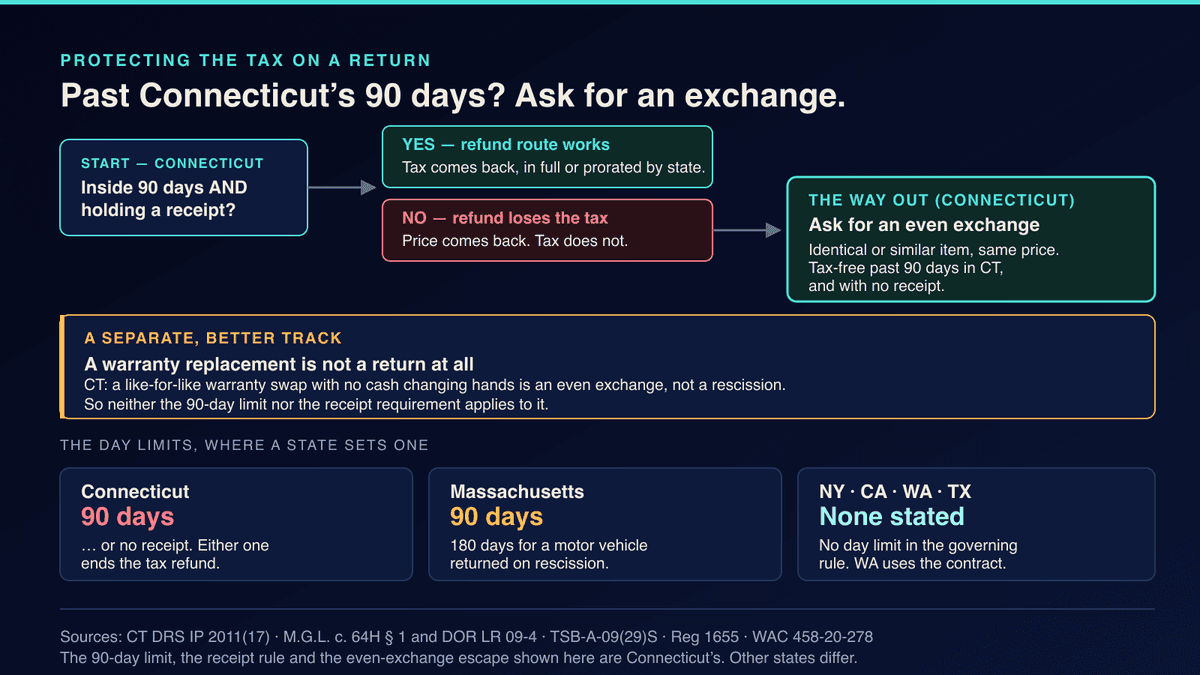
If you are past the 90-day window, or you cannot find the receipt, ask for an even exchange instead of a refund. Connecticut's reasoning is that an exchange is not a rescission of the sale at all:
"If a customer purchases a taxable item of tangible personal property from a retailer and exchanges it for an identical or similar item of tangible personal property priced the same, no tax is due on the exchange even if the original item is exchanged after 90 days from the date of purchase. The Department of Revenue Services (DRS) does not require the customer to produce the original sales receipt or other verification of the date and place of purchase."
Both of the triggers that destroy your tax refund — the 90 days and the missing receipt — are disarmed. The state treats the swap as "an extension of the original sales contract," so there is no new taxable sale and no tax to recover.
Connecticut defines "identical or similar" generously: the same type of commodity at the same price, "even if the item given in exchange is manufactured by a different company than the item originally purchased." Its own example is a $15 CD exchanged, after 90 days, for a different $15 CD by a different artist on a different label — no tax applied. The publication also lists categories that do not qualify, so the latitude is not unlimited.
There is a bookkeeping condition attached, and it is the retailer's to meet rather than yours: "The retailer's books and records must contain sufficient information to substantiate that the transaction was an even exchange." Connecticut also allows the mechanic where a store gives you cash or store credit and you immediately buy the identical item — but only if the retailer "can track or show that the cash or credit was used to purchase an identical or similar item of the same price." Connecticut sets no same-counter or same-day requirement, but the burden of showing the link sits with the retailer — so doing it as a single transaction is the version least likely to be refused.
Warranty replacements get the same protection, explicitly. Connecticut states that when a retailer replaces an item with an identical or similar one because of a defect under a manufacturer's or the retailer's warranty and no cash changes hands, it is an even exchange: taxes "are not due on the replacement item even if the customer does not produce a sales receipt or the goods are replaced after 90 days from the date of purchase." The publication is direct that a warranty replacement "is not considered a rescission of sale subject to the 90-day or sales receipt requirements for returned goods." If you are dealing with a defect rather than a change of mind, that is a different and more favorable track — and your underlying warranty rights are covered in our Magnuson-Moss Warranty Act guide.
Where an exchange is not even, Connecticut taxes the replacement item on its full price and credits you the original tax if you are inside 90 days with a receipt. Its worked example: a $20 hair dryer bought before the rate change is swapped under warranty for a $25 one with $5 to pay. The $1.20 of original tax is credited, the new item is taxed at 6.35% ($1.59), and the customer owes the 39-cent difference.
Do you get sales tax back with store credit or no receipt?
Store credit instead of cash. Taking store credit does not by itself forfeit the tax. The Massachusetts exclusion applies where amounts "are refunded either in cash or credit," and California's Regulation 1655 uses the same "in cash or credit" phrasing. Connecticut's rule is framed as returning an item "for cash or credit." The form the refund takes is not the deciding factor; the state, the timing and the receipt are. If you are weighing the choice, our guide to refund versus store credit covers the trade-offs, and gift card expiration laws by state covers what happens to the credit afterwards.
No receipt. This is the single most expensive thing you can do to your own tax refund in Connecticut, where the publication conditions the refund on presenting "a sales receipt showing the date of purchase and the tax paid on the original sale." It is also a problem elsewhere in practice rather than in law — a store cannot verify what tax rate you paid without a record of the sale. Our guide to returning without a receipt covers the workarounds; note that most of them restore your ability to return the item, not necessarily your ability to prove the tax.
Partial refunds generally. If a store refunds part of the price for any reason — a damage allowance, a goodwill adjustment, a price concession to keep the item — the prorated-camp logic is what applies: tax follows the portion of the transaction actually undone. California's Regulation 1655 handles the defect version of this directly, allowing amounts "credited or refunded by sellers to consumers on account of defects in merchandise sold" to be excluded from the taxable measure.
Trade-ins are a different animal. Connecticut treats a trade-in as an exclusion that reduces the taxable price of the new item, not as a return — and requires the traded item to be genuinely used, with the credit less than the original purchase price. Swapping a new item toward a like-kind purchase is handled as a return or exchange instead.
What if you return something bought on a sales tax holiday?
Sales tax holidays look simple: if you paid no tax, there is no tax to refund. The complication arrives when you want a different size in November.
Connecticut's 2026 Sales Tax Free Week ran Sunday, August 16 through Saturday, August 22, 2026 — the state's 27th — and exempted clothing and footwear costing less than $300 per item, including from online retailers. That $300 threshold is itself newly raised; the per-item exemption previously stood at $100, and the legislature also brought cleated shoes and backpacks inside the exemption.
Say you bought $250 shoes tax-free in August, and in November they do not fit.
- Return for a refund: you paid no tax, so you get the price back and there is nothing further to recover. Straightforward.
- Exchange for the same shoes in another size: no tax. Connecticut's Sales Tax Free Week page answers this directly in its FAQ on exchanges made after the week ends: "If you purchase a qualifying item during Sales Tax Free Week and you later exchange it for a like kind item that costs less than $300, there are no tax consequences associated with said transaction."
- Swap for something that costs $300 or more, or is not like-kind: this is where it bites. The DRS answer stops at a like-kind item under $300. Past that line, the ordinary exchange rules in IP 2011(17) apply: for a more expensive replacement, the retailer charges tax at the applicable rate "on the entire sales price of the replacement item," and a swap for something that is not identical or similar is handled under the returned-goods rules, so the new item is taxed like any other purchase. The holiday does not travel with your credit.
So the rule of thumb for a Connecticut tax-holiday buy: if you must change it, swap it for a like-kind item that still costs less than $300 rather than trading up past that line.
Connecticut is one of many states running these holidays, and the details — dates, per-item caps, eligible categories — are set state by state and change by legislation. Check your own state's revenue department for the current year rather than assuming last year's thresholds carried over; Connecticut's own jump from $100 to $300 is a good illustration of why.
The five states with no sales tax to refund: AK, DE, MT, NH, OR
Five states impose no statewide sales tax, which makes the entire question moot for purchases made there: Alaska, Delaware, Montana, New Hampshire and Oregon.
Two qualifications. Alaska has no state-level sales tax but permits local governments to levy their own, and many municipalities do — so a return in an Alaskan town with a local sales tax is governed by that municipality's rules, not by a statewide rule that does not exist. Certain Montana resort communities likewise levy local-option taxes. Delaware, New Hampshire and Oregon are the cleanest cases.
Worth noting for online shoppers: what governs your transaction is generally the rate applicable to where the goods are delivered, not where you happen to live or where the retailer is headquartered. A New Hampshire resident who ships an order to a Massachusetts address has made a Massachusetts-taxed purchase and is inside the Massachusetts rules on the way back out.
How to check your refund in 60 seconds
- Find the total you actually paid, not the price on the tag. The number that matters is the receipt total — price plus tax. If you only remember the tag price, you do not yet know whether your refund was short.
- Find the tax line on the receipt. It will be a separate line, usually just under the subtotal. Note the dollar amount and, if printed, the rate.
- Compare the refund amount to the total. If the refund equals the subtotal rather than the total, the tax did not come back. If it equals the total, it did. If it is somewhere in between, something was withheld — which is your cue to ask what.
- Work out whether the gap is explainable. A gap exactly equal to the tax line, on a return made inside 90 days with a receipt, is worth questioning in most states. A gap equal to a disclosed restocking fee plus that fee's share of tax is Connecticut's proration working as designed. A gap equal to the whole tax line on a 200-day-old Connecticut return is the 90-day cliff, and nobody did anything wrong.
The arithmetic where tax is prorated, if you want to verify it yourself: multiply the amount the store actually refunded by the tax rate you originally paid. That is the tax refund you should see. Connecticut's own example is $90 × 6.35% = $5.72.
For a card refund, give it time to post before concluding anything is missing — refunds and the original charge settle on different timelines, which our guides to how long a refund takes and how long pending charges take to clear cover in detail.
If the store will not refund the tax
Work through this in order. Most cases resolve at step two.
1. Establish which rule you are actually under. Before escalating, check the state of the sale, the number of days elapsed and whether you have the receipt. If you are a Connecticut shopper on day 120, you are not owed the tax and pressing the point will not help. Being right about the rule is what makes the next steps work.
2. Ask at the right level, with the citation. Front-line staff are following a point-of-sale system, not a tax regulation, and frequently cannot override it. Ask for a manager and name the authority: in Massachusetts, that the statute conditions the store's own exclusion on returning "the entire sales tax paid"; in Connecticut or New York, that you are asking for tax on the portion actually refunded. A specific, correctly-scoped ask lands far better than a general complaint.
3. Point out the store's own incentive. In Washington, Texas, California and New York alike, the retailer's ability to deduct or claim credit for that sale is conditioned on having refunded the tax to you. A store that keeps your tax has not saved itself money — it has jeopardized its own deduction. Managers tend to find this more persuasive than consumer-rights framing, because it is their problem rather than yours.
4. Go to the state revenue department. Every state covered here publishes guidance and takes inquiries, and several of the documents quoted here exist precisely because someone asked. Massachusetts issues letter rulings, New York issues advisory opinions, and Connecticut publishes informational publications. A written determination from the state is the strongest thing you can bring back to a retailer. Be realistic about proportion, though: this is a sensible route for a large purchase and an unreasonable amount of effort for 63 cents.
5. Dispute the charge as a last resort for a material amount. If a retailer refuses a refund it agreed to, the card networks and the Fair Credit Billing Act provide a path. See how to dispute a credit card charge and debit versus credit card disputes. Note the honest limitation: a dispute is a blunt instrument aimed at the whole transaction, and it is poorly suited to recovering a few dollars of tax on a refund you otherwise received.
Mistakes shoppers make
- Checking the refund against the tag price. The most common error, and the reason missing tax goes unnoticed. The receipt total is the benchmark.
- Assuming the store's return window is the tax window. They are set by different authorities and routinely differ. A 365-day retail policy does not extend Connecticut's 90-day tax rule.
- Throwing away the receipt because the store "has it in the system." A store lookup may let you return the item. In Connecticut it does not substitute for the receipt the state requires in order to refund the tax.
- Asking for a refund when an exchange would be tax-free. Past 90 days or receipt-less in Connecticut, the even-exchange route preserves value that a refund destroys.
- Treating a warranty replacement as a return. It is a separate, more favorable category, and saying "I want to return this" instead of "this is defective under warranty" can put you in the wrong one.
- Assuming a chain applies one national rule. The same retailer can legitimately refund tax differently in Boston and Albany. That is the law differing, not the store improvising.
- Expecting the state to pay you directly. The refund runs through the retailer in the ordinary case. Going to the revenue department first wastes the step that usually works.
Where Purchy fits
Most of what goes wrong above is a record-keeping problem wearing a tax costume. You cannot check a refund against a total you no longer have, and you cannot claim a Connecticut tax refund without the receipt the state asks for.
Purchy is built around that gap. It captures receipts so the total and the tax line are still there when a refund posts weeks later. It reminds you of return deadlines and can put them on your calendar, which matters more once you know some states attach their own clock to the tax. Its recurring-charge review lists the charges that repeat on your account, and the daily budget — The Perch — shows what you have left to spend today. Ask Purchy answers questions about a specific charge or receipt in plain language. Linking a bank account is optional for everyone.
Purchy is free to download. Purchy Pro is $12.99 per month or $99.99 per year, and you can cancel it from the App Store or Google Play. If receipts are the part you want solved, our round-ups of receipt tracker apps and digital receipt tracking compare the options, including the ones that are not us.
Frequently asked questions
Do you get sales tax back on a return?
In most cases yes. A full refund normally returns the sales tax too, because a retailer can only reclaim that tax from the state if it refunded the tax to the buyer. The main exceptions are Connecticut, which ends the entitlement after 90 days or without a receipt, and Massachusetts, which also stops refunding the tax after 90 days.
Is sales tax refunded if the store charges a restocking fee?
Usually it does not touch the tax at all. Massachusetts, Texas, Washington and California all return the full sales tax alongside a flat restocking fee, and New York has held that a reasonable charge imposed solely for restocking is not a receipt subject to sales tax at all. Connecticut is the exception: it refunds tax only on the amount actually returned, so on a $100 item refunded at $90, its own worked example gives back $5.72 instead of the $6.35 originally paid.
Is there a deadline for getting sales tax back?
In some states, yes, and it is independent of the store's return policy. Connecticut's Department of Revenue Services states that goods returned after 90 days from the date of purchase, or without a receipt, do not entitle the customer to sales tax on the refund. Massachusetts applies a 90-day window too, extended to 180 days where a motor vehicle is returned on rescission of the contract. The other states covered here set no day limit in the governing rule.
Do I need the receipt to get sales tax refunded?
In Connecticut, effectively yes — the publication conditions the refund on presenting a sales receipt showing the date of purchase and the tax paid. Elsewhere it is less a legal condition than a practical one: without a record of the sale, a retailer cannot establish what rate you paid. Keeping the receipt is the single cheapest way to protect the tax.
Is an exchange taxed differently from a return?
Yes, and usually in your favor. Connecticut treats an even exchange — an identical or similar item at the same price — as an extension of the original sales contract rather than a rescission, so no tax is due even after 90 days and even without a receipt. If the replacement costs more, the new item is taxable at its full price, with credit for the original tax if you are inside the window with a receipt.
What about a warranty replacement?
Connecticut treats a warranty replacement with an identical or similar item, where no cash changes hands, as an even exchange: no tax is due on the replacement even without a receipt or after 90 days, because it is not considered a rescission of the sale. That makes "this is defective under warranty" a materially different request from "I would like to return this."
Do I get the tax back if I take store credit instead of cash?
Taking credit rather than cash does not by itself forfeit the tax. The Massachusetts exclusion and California's Regulation 1655 both contemplate amounts refunded "in cash or credit," and Connecticut's rule is framed around returning an item for cash or credit. What governs is the state, the timing and whether you can document the sale.
Does the state refund my sales tax, or the store?
The store, in the ordinary case. You paid the tax reimbursement to the retailer, which remitted it; on a return the retailer claims the credit or deduction from the state and is generally required to have refunded the tax to you in order to qualify. That is why a clerk saying the tax "goes to the state" has the mechanics backwards.
What if I bought it during a sales tax holiday?
You paid no tax, so a refund simply returns the price. In Connecticut, the Department of Revenue Services says that exchanging a Sales Tax Free Week purchase later for a like-kind item that costs less than $300 has no tax consequences. A replacement that costs $300 or more, or is not like-kind, is an ordinary taxable sale at its full price. Other states set their own holiday rules, so check your state's revenue department.
Which states have no sales tax to refund?
Alaska, Delaware, Montana, New Hampshire and Oregon impose no statewide sales tax. Alaska permits local sales taxes and many municipalities levy them, and some Montana resort communities levy local-option taxes, so those two are not blanket exemptions. For online orders, what generally matters is the delivery destination rather than your home state.
Can a store legally keep my sales tax?
Framing it as the store keeping your tax is usually wrong. Either the tax came back, or a state rule means there is nothing to come back — Connecticut's 90-day cliff being the clearest example. Where a store does withhold tax that a state says you are entitled to, it is also putting its own deduction at risk, which is often the most effective thing to point out.
Sources and citations
Every rule above was read from the primary document. Links go to the source, not to a summary of it.
- Massachusetts statute: M.G.L. c. 64H, § 1 — definition of "sales price," clause (c)(ii), containing the 90-day window, the 180-day motor-vehicle window, the "established handling fees" language and the requirement that "the entire sales tax paid is returned to the purchaser."
- Massachusetts ruling: DOR Letter Ruling 09-4, Refund of Sales Tax on Returned Merchandise (May 26, 2009).
- Massachusetts current rate: Sales and Use Tax guide, 6.25%, updated May 7, 2026.
- New York opinion: Advisory Opinion TSB-A-09(29)S (July 15, 2009, Petition No. S090422A).
- New York, restocking charges: Advisory Opinion TSB-A-05(46)S, B&L Wholesale Supply (December 28, 2005, Petition No. S040913A).
- New York regulation: 20 NYCRR 534.6 — refunds and credits by reason of cancelled sales and returned merchandise, reproduced by Cornell's Legal Information Institute.
- Connecticut: IP 2011(17), Sales and Use Taxes on Returned Goods, Even Exchanges, and Trade-Ins — listed as current by DRS, superseding IP 2006(13).
- Connecticut current rate: DRS Sales and Use Tax Information — 6.35% general rate, no local sales taxes, and the 7.75% rate on certain luxury items.
- Connecticut holiday: 2026 Sales Tax Free Week — August 16–22, 2026, clothing and footwear under $300 per item, including its answer on exchanges made after the week ends.
- California: Regulation 1655, Returns, Defects and Replacements as published by CDTFA.
- Washington: WAC 458-20-278, Returned goods, defective goods.
- Texas: Comptroller's Auditing Fundamentals manual, chapter 5 — "Returned Merchandise."
A note on scope and currency. Connecticut's 6.35% is its general rate. Connecticut taxes certain luxury items at 7.75% — clothing, footwear, handbags, luggage, umbrellas, wallets and watches above $1,000, jewelry above $5,000 and most motor vehicles above $50,000 (IP 2011(17) still shows the 7% rate that applied in 2011) — so a high-value item may not be taxed at the headline rate. IP 2011(17) ties the refund to "the rate that was applied to the original purchase," so a luxury item returned inside the 90 days, with a receipt, gets its tax back at the rate you actually paid. More broadly, this piece covers the general retail case in six states and is not tax advice; motor vehicles, aircraft, vessels and leases carry their own rules, and several states have provisions we did not read. The 2009 Massachusetts and New York rulings are quoted as issued — the Massachusetts example's $5.00 reflects that state's then-5% rate, not today's 6.25%. State rates and holiday thresholds change by legislation, which is exactly why Connecticut's per-item holiday exemption is now $300 rather than $100. Forty-four states are not covered here, and rather than guess at them this piece stops where the primary sources do. For anything consequential, check your own state's revenue department.
Wake to one edition. Only what matters.
$12.99 a month or $99.99 a year. Cancel any time from the App Store or Google Play.