Credit Card Surcharge Laws 2026: Caps, Bans, Rules
Credit card surcharge laws in 2026: a 3% cap on Visa, 4% on Mastercard, never on debit, banned in three states. Oklahoma changed on Nov 1, 2025.
A credit card surcharge is the extra percentage some stores add when you pay with a credit card instead of cash. Under the card-network rules and the credit card surcharge laws in force in 2026, it is legal in most of the United States — but it is fenced in far more tightly than most shoppers realize. Visa's own rulebook caps it at 3%, forbids it on debit cards entirely, and treats a sign at the door in 32-point Arial as the safe harbour for disclosing one. Three states ban it outright, and at least six others set their own caps or disclosure rules — including Oklahoma, which quietly switched from a ban to a 2% cap on November 1, 2025, a change many published state lists, including Visa's own merchant Q&A, still describe as a ban. Here is what a legal surcharge looks like, what an illegal one looks like, and how to get an improper one taken off your bill.
Are credit card surcharges legal in 2026?
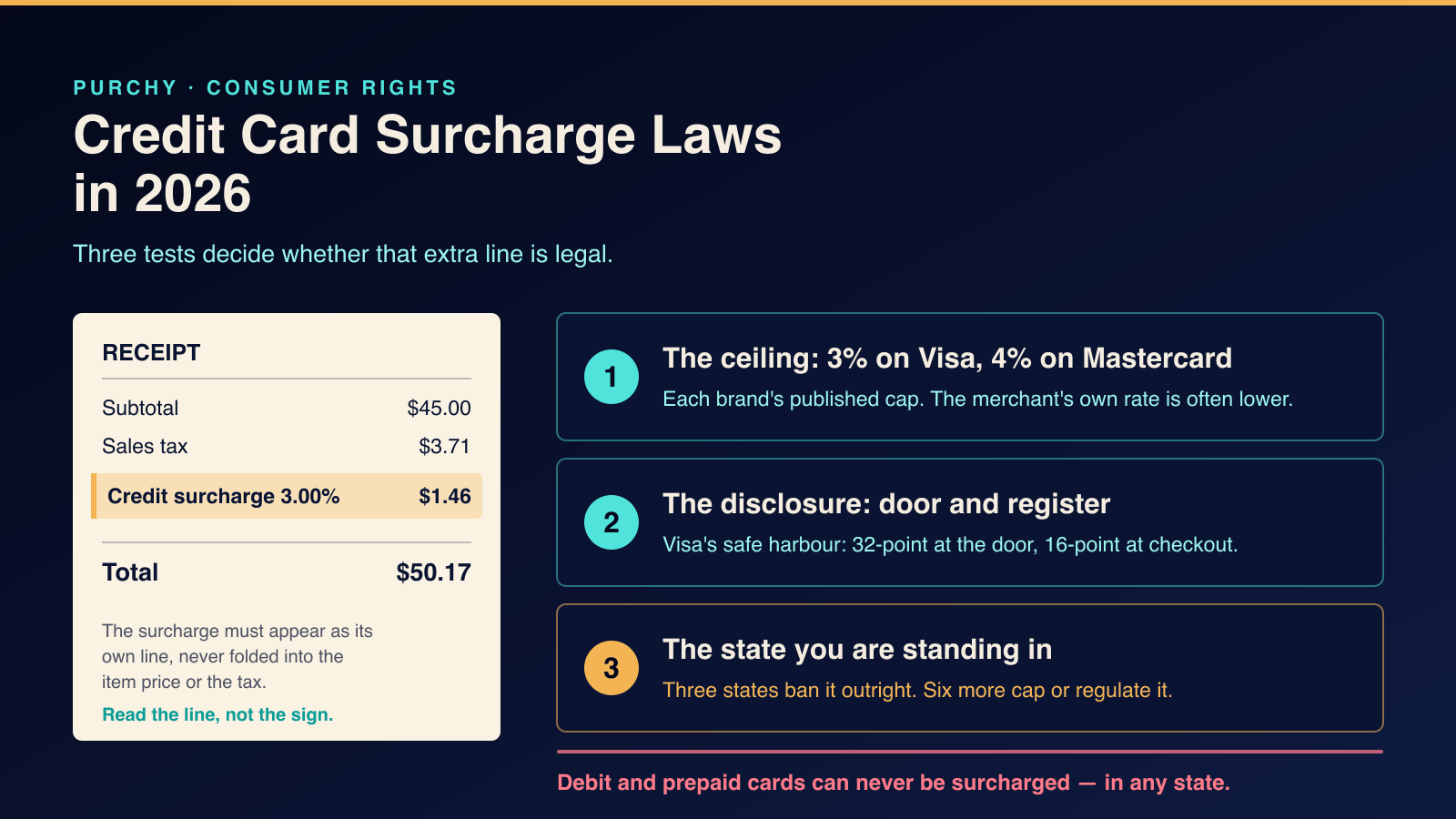
Yes, in most of the US. A store can add up to 3% on Visa or 4% on Mastercard, capped at its own processing cost, if it posts the fee at the entrance and the register and itemizes it on the receipt. Connecticut, Maine and Massachusetts ban it, Colorado, Oklahoma and New York set stricter rules, and debit cards can never be surcharged.
- Visa's hard ceiling is 3%, and often lower. Mastercard's published cap is 4%. Visa's rules set a US maximum of 3.00%, and Visa's own merchant Q&A puts it more plainly: a merchant may charge "your merchant discount rate (MDR) for the applicable credit card or 3% whichever is lowest." A merchant paying 2.1% to process your card may not charge you 3%.
- Debit is off-limits, always. Surcharging "applies only to credit transactions in the U.S. and U.S. territories. Debit and prepaid cannot be surcharged." Pressing the "credit" button on a debit card does not change that — that button picks signature versus PIN, not the card type.
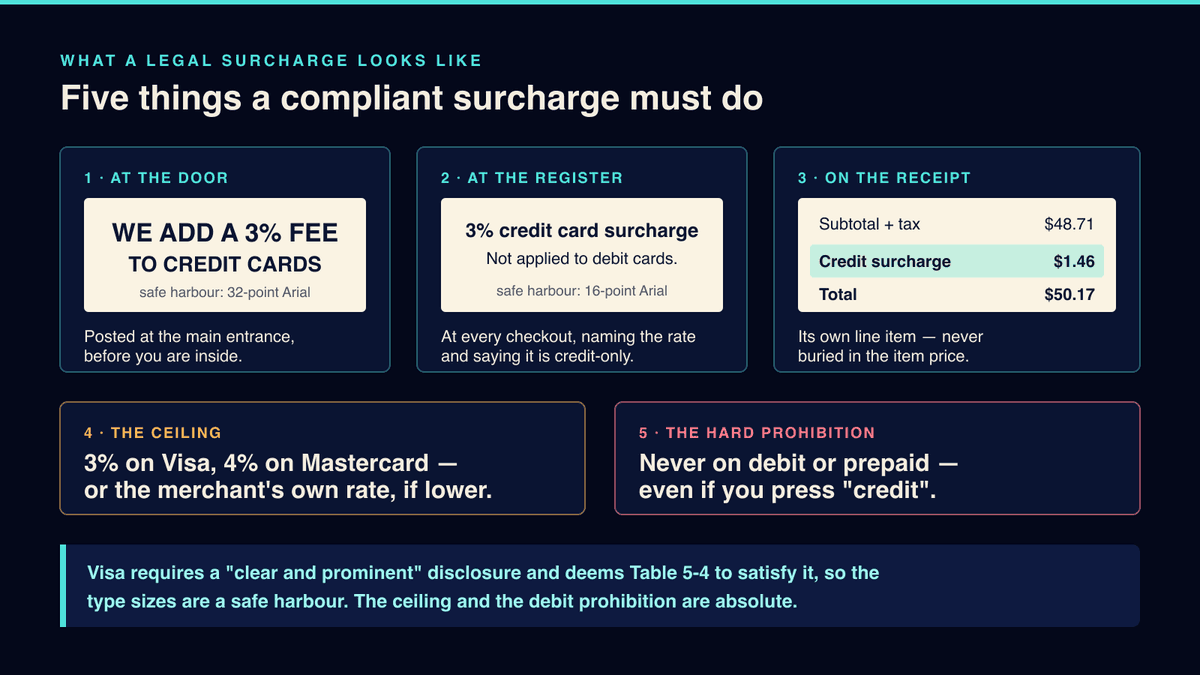
- A surcharge has to be announced before you shop, not just at the register. Visa requires disclosure at the point of entry and the point of transaction, and its safe harbour for doing so specifies minimum type sizes: 32-point Arial at the main entrance, 16-point at every checkout.
- It has to show up as its own line on your receipt. Visa's receipt rules require the surcharge amount "shown separately on the front of the receipt in the same type and size of font as other wording." Mastercard's rules and Colorado's statute require an itemized line too.
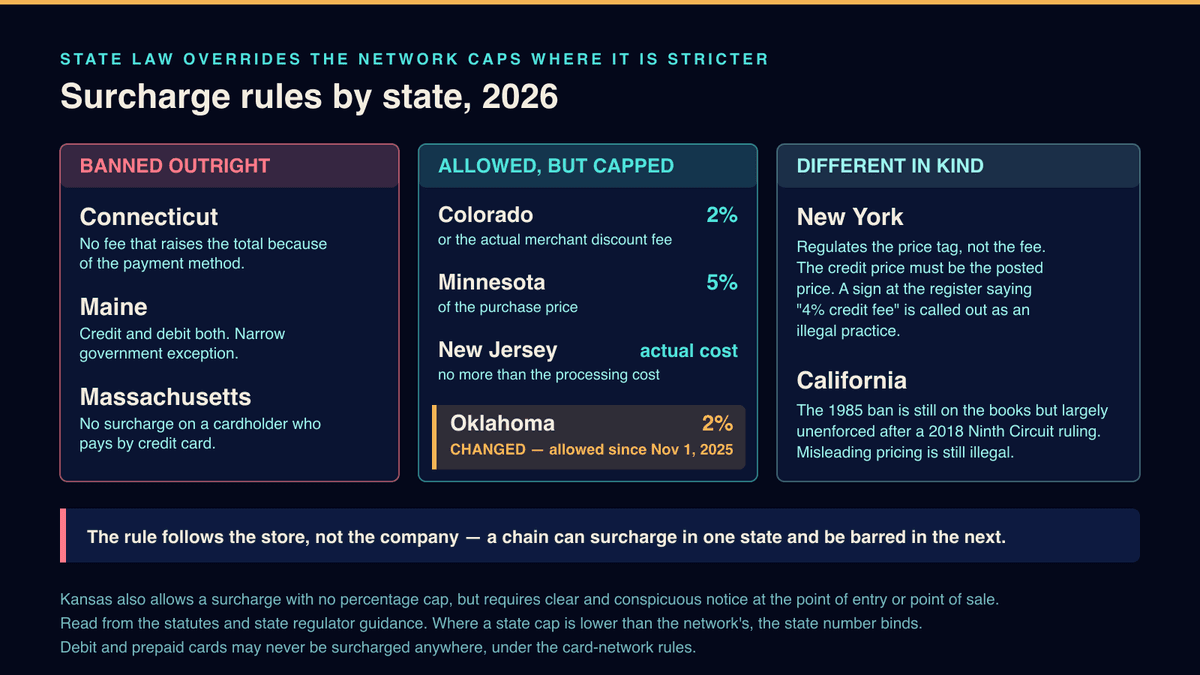
- Three states ban it outright: Connecticut, Maine and Massachusetts. Maine's ban also covers debit cards.
- At least six states allow it under their own rules: Colorado (2% or actual cost), Kansas (disclosure required, no percentage cap), Minnesota (5%), New Jersey (actual cost), New York (you must post the credit price itself), and — since November 1, 2025 — Oklahoma (2% or actual cost, whichever is less).
- Nothing about the big 2026 swipe-fee settlement has taken effect yet. US District Judge Brian Cogan granted preliminary approval in Brooklyn on June 9, 2026. The objection period has since produced what the Merchant Payments Coalition counts as 978 objecting businesses and associations, and a final approval hearing is set for November 16, 2026. Preliminary is not final, and today's rules are still the old ones.
- If a surcharge broke the rules, the rulebook puts the refund on your own bank. Visa's compliance rule is unusually blunt: where a member bank files a compliance case and the issuer has already billed you for a non-compliant surcharge, "the Issuer must credit the Cardholder for the Credit Card Surcharge amount."
What actually counts as a surcharge
The definition is the whole ballgame, because most disputes are about a fee that has been renamed rather than removed.
Mastercard's global rule states it cleanly: a surcharge is "any fee charged in connection with a Transaction that is not charged if another payment method is used." Visa's core rule gets at the same thing from the other direction — a merchant "must not add any amount over the advertised or normal price to a Transaction" unless applicable laws or regulations "expressly require" that a merchant "be permitted to" impose one, and any amount that is allowed "must be included in the Transaction amount and not collected separately." That core rule is the global baseline: in the US Region and US Territories it expressly does not apply to credit card transactions, which are carved out into Rule 5.5.1.7 and the surcharging rules that follow.
That means the label on the receipt is irrelevant. Connecticut's Department of Consumer Protection spells this out for shoppers in as many words: charges "will often be represented as a 'transaction fee', 'processing fee', or 'non-cash adjustment' on the receipt. This would be a surcharge."
New York's Department of State publishes the same warning as a list of illegal practices, naming six euphemisms specifically — convenience fee, service fee, administration fee, non-cash adjustment, technology fee, processing fee — when they are added to credit card users on the receipt "without clearly posting the total price prior to purchase."
So the test is not what it is called. The test is: would this amount have been charged if you had paid another way? If the answer is no, it is a surcharge, and every rule below applies to it.
One important exception sits inside that definition. Mastercard's global rule allows "a bona fide commission, postage, expedited service or convenience fees, and the like" — but only "if the fee is imposed on all like transactions regardless of the form of payment used, or as the Corporation has expressly permitted in writing." A $3 delivery fee everyone pays is not a surcharge. A $3 fee only credit card users pay is.
What is the maximum credit card surcharge?
The maximum credit card surcharge in the US is 3% on Visa and 4% on Mastercard, and usually less, because neither network lets a merchant charge more than its own card-processing rate. Some states set a lower number still. Those caps come from the card-network rules merchants accepted when they signed up to take cards, which touch almost every card transaction in America. Both rulebooks are public documents, and both were read directly for this guide.
The cap is the lower of two numbers. Visa Rule 5.5.1.8 states that "In the US Region or a US Territory: The Credit Card Surcharge maximum amount is 3.00%." But 3% is only the ceiling. A brand-level surcharge also may not exceed the merchant's "Visa Surcharge Cap," which the Visa glossary defines as "the average Merchant Discount Rate that a Merchant pays to its Acquirer for Credit Card Transactions" over the preceding one or twelve months. Visa's merchant Q&A collapses this into one sentence: limit the surcharge to "your merchant discount rate (MDR) for the applicable credit card or 3% whichever is lowest." A product-level surcharge is capped differently again — at the merchant's Visa Credit Card Surcharge Cap "less the Debit Card Cost of Acceptance." And the 3% figure is a hard ceiling in both directions: Visa's merchant requirements sheet adds in a footnote that "in cases when the merchant's cost of acceptance exceeds 3% of the underlying transaction amount, the merchant cannot assess a surcharge above 3%."
Mastercard's US cap is derived rather than written into the rule. Its US Region rule defines the "Maximum Surcharge Cap" as "no less than the product of 1.8 times the sum of the system-wide average effective U.S. domestic Mastercard Credit Card interchange rate plus average network fees," published by Mastercard from time to time — and a brand-level surcharge is separately limited to the merchant's own average effective merchant discount rate. The published figure matters, and it is not the same as Visa's: Mastercard's own merchant surcharge rules page states, under "Relevant data for merchants who surcharge," that "The Maximum Surcharge Cap - 4%." So a 3.5% surcharge that would break Visa's ceiling can be within Mastercard's. In both cases the merchant's own processing rate is usually lower still, and that is the ceiling that actually binds.
A note on a figure you will see repeated online: Mastercard's "2.4%" cap is real, but it is in the Canada Region chapter of the Mastercard Rules, not the US one. Quoting it as a US number is a common error in merchant-services blog posts, and it is the kind of mistake that is easy to make when a rulebook is read by section number without checking which regional chapter the section sits in.
It is one surcharge, one way. A merchant may surcharge at the "brand level" (the same percentage on every Visa credit card) or the "product level" (a percentage tied to a particular card product, such as Visa Traditional versus Visa Signature) — "A Merchant must not assess a Credit Card Surcharge on Visa Credit Card Transactions at both the brand and product level." Mastercard's US rule works the same way. Both networks also close the issuer loophole: Visa requires the surcharge to be the same "regardless of the Card's Issuer" at either level, and Mastercard's US rule reaches the same result by defining both surcharge methods as applying "regardless of the Issuer." Your bank's name cannot change the price. (Mastercard does state an issuer-level prohibition and a parallel bar on third-party agents in so many words — but those sentences sit in its Canada Region chapter, not the US one, so do not quote them at a US merchant.)
The merchant had to give 30 days' notice. Visa Rule 5.5.1.5 puts the duty on the bank rather than the store — an acquirer "must ensure that its Merchant notifies its Acquirer in writing at least 30 calendar days before publicly announcing its intention to impose a Credit Card Surcharge, or 30 calendar days before first assessing a Credit Card Surcharge, whichever is earlier." Mastercard requires "no less than 30 days' advance written notice" to both Mastercard and the acquirer, through a dedicated web form, after which the acquirer must register the merchant within 10 days. A surcharge that appeared overnight with no registration behind it is already out of compliance before anyone looks at the sign.
It must be inside the transaction, not collected on the side. Visa Rule 5.5.1.7 requires the surcharge to "be included in the Transaction amount and be identified within the Transaction data." Mastercard likewise requires the surcharge to sit inside the transaction amount, and requires acquirers to offer merchants dedicated fields to carry it — DE 28 on the authorization and DE 54 on the clearing message, tagged with amount type 42. This is why a merchant asking you to Venmo them the "card fee" separately is not a compliant surcharge; it is a separate payment that the network never sees.
And it must appear on the receipt. Mastercard's US rule: "A Merchant that chooses to Surcharge must provide clear disclosure of the Surcharge amount on the Transaction receipt." Visa's merchant guidance says the same: "Itemization of the final surcharge amount must be identified separately on the transaction receipt."
And a merchant cannot surcharge Visa while sparing a rival brand that costs the same or more. Visa Rule 5.5.1.6, "Similar Treatment of Visa Transactions," bars a merchant from surcharging Visa credit cards in a payment channel where a competing credit card brand prohibits or effectively prohibits it. Visa's merchant Q&A states the practical version: merchants "typically must surcharge Visa on the same terms and conditions as any equal or higher cost competitor that imposes limits on surcharging." If a store surcharges your Visa but waves through an equally expensive competing card, that asymmetry is itself a rule problem.
For context on where the networks stand, Visa's own merchant-facing document says it out loud: "Visa remains opposed to surcharging, a practice that penalizes cardholders for using their preferred form of payment." The rules above are the terms Visa attaches to something it would rather merchants did not do at all.
The signage rules, down to the font size
This is the part shoppers most often miss, and it is the easiest thing to check.
Visa Rule 5.5.1.9 requires disclosure at both the point of entry to the store and the point of transaction. The point-of-transaction disclosure has three required elements: the exact amount or percentage of the surcharge; a statement that the surcharge is being assessed by the merchant and applies only to credit transactions; and, in the US, a statement that the surcharge is not greater than the merchant's merchant discount rate for Visa credit cards.
The rule itself requires only that the surcharge be disclosed "clearly and prominently," then adds that this requirement "will be satisfied if" the disclosure follows Table 5-4 — a safe harbour rather than a hard mandate, so a 28-point entrance sign is not automatically non-compliant. The table sets minimum type sizes by transaction type:
| Transaction type | At the point of entry | At the point of transaction |
|---|---|---|
| In person (face-to-face) | Main entrance, minimum 32-point Arial | Every checkout or payment location, minimum 16-point Arial |
| Online (e-commerce) | First page that references accepted card brands, minimum 10-point Arial | Checkout page, minimum 10-point Arial |
| Mail order | First catalog page referencing card brands, minimum 8-point Arial | Mail order form, minimum 10-point Arial |
| Telephone order | First catalog page referencing card brands, minimum 8-point Arial | Verbal notice from the clerk, including the surcharge amount |
| Unattended terminal (such as a gas pump) | Main entrance of the outlet where applicable, minimum 32-point Arial | On the terminal or its payment screen, minimum 16-point Arial |
In every case with a printed or on-screen disclosure, the type must also be "no smaller or less prominent than surrounding text," so a technically-32-point sign swimming in 40-point marketing copy does not satisfy the rule either.
There is one more provision worth knowing for online and phone orders, and for gas pumps: after the surcharge is disclosed, "the Cardholder must be provided the opportunity to cancel the Transaction." A checkout flow that reveals the fee only on the confirmation screen, after the charge has gone through, has skipped a required step.
Mastercard's US rule is less prescriptive about typography but requires the same two-point disclosure, plus the statement that the surcharge "is not greater than the Merchant's Merchant Discount Rate for Mastercard Credit Card Transactions." It also adds a rule about tone: the disclosure "must not disparage the brand, network, Issuer, or payment card product being used," although a merchant is expressly allowed to say it prefers a cheaper payment method.
Debit cards can never be surcharged — even if you press "credit"
This is one of the easiest violations for a shopper to spot, and it has a simple explanation.
Visa's merchant Q&A instructs merchants to "Limit surcharging to credit cards only (debit cards and prepaid cards cannot be surcharged)." The rules then close the obvious loophole. Where a terminal offers "credit" and "debit" buttons, the merchant must ensure that debit card transactions are not surcharged, and must make clear "that surcharges are not permitted on debit Transactions regardless of whether a Cardholder selects the 'credit' or 'debit' button."
Visa explains why, in plain language in its merchant Q&A: "The cardholder is still using a Visa debit card. The option to select a 'credit or debit' refers to the cardholder selecting either a signature-based transaction or a PIN-based transaction."
Two states name debit cards expressly in their own statutes. (Connecticut gets to the same place by a different route: its ban is written around any fee charged for using a "particular method of payment," so it is method-agnostic rather than card-type specific.) Maine's statute bans surcharges on "a credit card or debit card." Colorado's statute forbids a surcharge where the customer pays with a debit card "whether or not a personal identification number is used," where a payment is processed as a debit payment, or where a gift card is redeemed.
If you paid with a debit card and a percentage-based card fee appeared on your receipt, you have very likely found a violation — whatever the fee was called and whichever state you were in. There is one real exception, worth knowing so you do not chase a fee that is actually allowed: in a narrow set of merchant categories — government agencies, utilities, schools and colleges, courts and tax payments — Visa's separate Service Fee rules (Rule 5.5.3.1 and Tables 5-6 and 5-7) permit a fee on any card, debit included, and expressly allow it to be "a flat, fixed, banded, or ad valorem amount." If you are paying property tax, tuition, a utility bill or a court fine, a percentage fee on a debit card can be entirely legitimate. In an ordinary retail store or restaurant, it is not.
Credit card surcharge laws by state
State law overrides the network rules where it is stricter, and it varies more than most lists suggest. Every entry below was read from the statute or the state regulator's own guidance.
| State | Status | The limit | Citation |
|---|---|---|---|
| Connecticut | Banned | No fee that increases the transaction total because of the payment method. Municipalities, state agencies, courts and state marshals collecting town taxes are excepted. | Conn. Gen. Stat. § 42-133ff, as rewritten by Sec. 36 of Public Act 22-104 and last amended by Sec. 28 of Public Act 24-142 |
| Maine | Banned, credit and debit | No surcharge on a credit or debit card. A governmental entity may surcharge taxes, fines and license or permit fees if disclosed in advance and capped at actual cost. | 9-A M.R.S. § 8-509 |
| Massachusetts | Banned | No seller may impose a surcharge on a cardholder who elects to use a credit card instead of cash or check. | M.G.L. c. 140D § 28A(a)(2) |
| Colorado | Allowed, capped | Either 2% of the total, or the actual merchant discount fee — each with its own statutorily scripted sign. One surcharge per transaction, shown as a separate line item on the receipt. | C.R.S. § 5-2-212 (S.B. 21-091, effective July 1, 2022) |
| Kansas | Allowed, disclosure required | No statutory percentage cap. The amount must be disclosed "through a clear and conspicuous notice to the customer at the point of entry or the point of sale and in advance of such transaction." | K.S.A. 16a-2-403, as amended by L. 2024, ch. 6, § 51, effective January 1, 2025 |
| Minnesota | Allowed, capped | Maximum 5% of the purchase price, with oral notice at the time of sale plus a posted sign in person. A store may not surcharge its own store-issued card. | Minn. Stat. § 325G.051, subd. 1 |
| New Jersey | Allowed, capped | No more than the actual processing cost. Notice at point of entry and point of sale; restaurants must post it in the customer service area and on the menu. Motor fuel is excluded. | N.J.S.A. 56:8-156.2 (P.L. 2023, c. 146) |
| New York | Allowed, but the posted price must be the credit price | Capped at the merchant's actual processing cost, and the business must display the highest total price, excluding sales tax. A register sign announcing a fee is not enough. | N.Y. Gen. Bus. Law § 518, in force since February 11, 2024 |
| Oklahoma | Allowed since November 1, 2025 | 2% of the total or the actual processing cost, whichever is less, with notice required at the point of entry and the point of sale for in-person transactions, and on the home page and the point-of-sale webpage for online transactions, with verbal disclosure for phone orders. | 14A O.S. § 2-211, as amended by Enrolled S.B. 677 |
| California | On the books, largely unenforced | The 1985 ban still exists, but the state Attorney General says it will generally apply the Ninth Circuit's January 2018 ruling, which held the ban unenforceable against the businesses that brought the case, to merchants that are similarly situated. Misleading pricing is still illegal. | Cal. Civ. Code § 1748.1; Italian Colors v. Becerra (9th Cir. 2018) 878 F.3d 1165 |
If your state is not in this table, the card-network rules above still apply there in full: no more than 3% on Visa or 4% on Mastercard, never more than the merchant's own processing rate, never on a debit or prepaid card, and posted at both the entrance and the register.
Colorado wrote the warning for you. Colorado does not just cap the fee, it scripts the sign. A merchant choosing the 2% option must post statutory language reading, in part, that "a seller or lessor may impose a processing surcharge in an amount not to exceed 2% of the total payment," followed by the sentence that matters most to a shopper: "A seller or lessor shall not impose a processing surcharge on payments made by use of cash, a check, or a debit card or redemption of a gift card." The actual-cost option has its own separate scripted sign saying the same thing about debit and gift cards. So in Colorado the store's own legally required notice tells you the fee cannot touch a debit card — and § 5-2-212(1)(f) repeats it as a flat prohibition covering cash, checks, debit "whether or not a personal identification number is used," any payment processed as a debit payment, and gift card redemptions. A violation makes the seller "subject to liability as a creditor" under the state's Uniform Consumer Credit Code, and the statute expressly makes the buyer a consumer for that purpose.
Two things about this table are worth saying out loud.
New York's rule is different in kind, not just in degree. Most states regulate the fee. New York regulates the price tag. Its Department of State's guidance is built around one requirement: a business passing along processing costs "must be transparent by displaying the highest total price (excluding sales tax)." That makes three things legal — showing both a cash and a credit price ($19.99 cash, $20.79 credit), showing the higher credit price and advertising a cash discount, or charging everyone the same price — and makes the most common arrangement in the rest of the country illegal. In New York, a sign at the register saying "4% credit card processing fee" is specifically called out as an illegal practice, as is a "+4% fee if paying with credit card" warning on a price tag. The number has to be in the posted price, not next to it.
Puerto Rico is on Visa's list, but this guide did not verify it. Visa's merchant Q&A names Puerto Rico among jurisdictions that prohibit surcharging, and Visa attaches an explicit disclaimer that its understanding "may contain errors, omissions, or inaccuracies." Puerto Rico's own statute was not read for this piece, so treat that entry as Visa's understanding rather than a confirmed citation.
A last practical note for chain stores: the rule follows the store, not the company. As Visa puts it, "The merchant outlet location must follow the state laws which the merchant outlet is located." A retailer that surcharges in Texas can be legally forbidden from doing it in its Massachusetts stores, and that is not an inconsistency — it is the law working correctly.
Oklahoma changed on November 1, 2025
If you look up "states that ban credit card surcharges" today, nearly every list you find will include Oklahoma. Visa's own merchant Q&A includes it — that document carries a version stamp of February 15, 2024. Visa's separate merchant requirements sheet also lists Oklahoma and carries a version stamp of August 14, 2023 — but it heads that list "States currently prohibiting or limiting surcharging," and Oklahoma does now limit surcharging, so its presence there is not wrong. The Q&A's flat "prohibit" is.
Oklahoma's Enrolled Senate Bill 677 passed the House on May 6, 2025 and the Senate on May 20, 2025, and states plainly: "This act shall become effective November 1, 2025." It amended 14A O.S. § 2-211 and repealed 14A O.S. § 2-417, the old surcharge prohibition.
What replaced it is a conditional permission rather than a ban. A seller may now surcharge only if:
- Notice is posted wherever the customer actually is. The bill requires notice displaying the amount of the surcharge "clearly and conspicuously posted at the point of entry and the point of sale for in-person transactions and the home page and the point-of-sale webpage for online transactions," with verbal disclosure for phone orders.
- The surcharge is capped at the lower of two numbers. "No surcharge shall exceed two percent (2%) of the total transaction or the actual amount to be charged to the person or retailer to process the credit card transaction, whichever is less." That is stricter than Visa's 3% ceiling, so in Oklahoma the state number binds.
The bill also contains a provision that deserves more attention than it has received: "A customer shall not be considered to have chosen to use a credit card as a method of payment under this section if, at the time of the transaction, the person or retailer accepts only credit cards as payment." In other words, a cashless business in Oklahoma cannot surcharge, because a customer with no alternative has not chosen anything.
Finally, the law carves out a service fee for private educational institutions, private pre-K through twelve schools, municipalities and public trusts with a municipality as beneficiary, limited to bank processing fees, financial transaction fees, secure-transaction costs, portal fees and bandwidth costs.
The practical takeaway for an Oklahoma shopper is uncomfortable but simple: a surcharge you would have been able to challenge in October 2025 may be perfectly legal now, as long as it is 2% or less, no more than the merchant's actual cost, and posted in all the required places.
One point about the amendment is easy to get wrong, because the enrolled bill shows its edits as strikethrough and most text extractions flatten them. S.B. 677 did not leave debit cards in an ambiguous position: it struck "or debit card account" from the provision's scope and added "debit card" to the list of payment methods a customer may switch to instead, and the new definitions in § 2-211 are written around credit cards. The legislature deliberately moved debit to the protected side. A debit surcharge in Oklahoma is barred by the card-network rules described above — which apply in every state — rather than by § 2-211 itself. The statute is the floor here, not the ceiling.
Cash discounts: the legal version of the same idea
A cash discount and a surcharge can produce identical prices and identical receipts, and only one of them is protected by federal law.
The protection is old and unambiguous. Under 15 U.S.C. § 1666f, a card issuer "may not, by contract or otherwise, prohibit any such seller from offering a discount to a cardholder to induce the cardholder to pay by cash, check, or similar means rather than use a credit card," and that discount is not treated as a finance charge "if such discount is offered to all prospective buyers and its availability is disclosed clearly and conspicuously." That statute dates to 1974 and was last amended in 1981.
There is, by contrast, no current federal statute that bans or caps credit card surcharges. Everything above about 3% and 32-point Arial comes from private network rules and state legislatures, not from Congress.
Where merchants get into trouble is in turning a surcharge into a "cash discount" with nothing but a sign. Visa's Q&A describes what an honest cash discount actually requires: the merchant must display either "Only the card price per item" or "Both the card and the cash price listed side-by-side per item," and when the final bill arrives the card total must be the displayed card price, "not achieved by applying an additional fee for a card payment as it may appear to be, and may be treated as, a surcharge and subject to Visa's surcharge rules."
Connecticut gives merchants a concrete compliant script — a sign reading "all listed prices are discounted by 3% if you pay in cash" — or dual pricing with both numbers on the shelf. New York explicitly lists the dishonest version as illegal: advertising that all prices include a cash discount that does not apply to credit card purchases.
The shopper's version of this test takes two seconds. Look at the shelf price, then look at the total. If the number on the shelf is the number you pay with a card, it is a cash discount. If your total is higher than the shelf price because you used a card, it is a surcharge — whatever the sign says.
The 2026 swipe-fee settlement: what actually changed
You may have seen headlines this summer about a settlement, widely reported at $38 billion, that changes surcharging rules. It is a real case with real consequences, and as of this writing it has changed nothing you will encounter at a register. One thing to be clear about first: this is an injunctive-relief settlement about rules and rates, not a fund being paid out. The $38 billion is an estimate of merchant savings carried in press coverage — there is no claims process and nothing for a shopper to file for.
On Tuesday, June 9, 2026, US District Judge Brian Cogan, sitting in the Eastern District of New York in Brooklyn, granted preliminary approval to a revised settlement between Visa, Mastercard and US merchants covering roughly 12 million merchants. He found it offered "more extensive relief" than the version before it and wrote that "none of the objectors have persuaded the Court that they will, or even can, get more through trial." An earlier version of the deal, worth roughly $30 billion, had been rejected in June 2024 by a different judge as inadequate.
Reported terms include more surcharging flexibility for merchants, a break in the long-standing "Honor All Cards" rule that would let merchants decline particular categories of US cards — separating commercial, premium consumer and standard consumer credit — a ceiling of 1.25% on standard consumer interchange rates for eight years, and a 0.1 percentage-point interchange reduction lasting five years.
Three cautions are worth stating clearly:
- Preliminary approval is not final approval. The objection window has already run, and it was loud: the Merchant Payments Coalition counts 978 objecting businesses and associations — small shops, chains, restaurants, grocers, convenience stores and fuel retailers from every state, the District of Columbia and Puerto Rico — asking Judge Cogan to withhold final approval on the grounds that the relief is "short-lived and limited." The court's scheduling order of June 15, 2026 set a final approval hearing for November 16, 2026 in Brooklyn, and objectors including Walmart filed formal notices of intention to appear at it on September 14, 2026. An October 26, 2026 order kept that date and gave each objecting class member up to six minutes to speak at the hearing. As of October 28, 2026, no final-approval decision had been issued.
- The rule changes are not live. The binding documents today are the Visa Rules edition dated 18 April 2026 and the Mastercard Rules, both of which contain the caps and disclosure rules described above.
- State law is untouched by any of it. A private antitrust settlement between card networks and merchants cannot legalize a surcharge in Massachusetts or lift Colorado's statutory cap. If and when the settlement takes effect, Connecticut's ban and New York's posted-price rule will still be exactly where they are now.
Merchant-services blogs have been publishing "2026 surcharge rules" guides for months. Read them with the date in mind: describing the settlement's terms as current rules is one of the most common errors in this subject right now.
How to get an improper surcharge refunded
This is where the rulebooks turn out to be unexpectedly useful to shoppers, because Visa wrote a remedy into them.
Start at the register. Most improper surcharges are a terminal configuration or a staffing problem, not a scheme. Ask for the charge to be reversed, and be specific about which rule was broken — "this was a debit card," or "there is no sign at the entrance," or "this is 4% on a Visa card and the Visa cap is 3%." Specificity gets results that a general complaint does not.
Then call your card issuer. Visa Rule 11.12.4 gives a member bank a compliance right to recover an improperly assessed surcharge in nine listed situations, including where the amount exceeded the allowed cap, where the surcharge was applied to a transaction type where surcharging is not permitted, where it "was not disclosed as specified in the Visa Rules," where it "did not appear on the Transaction Receipt as specified," where it was assessed by a third party, and where a convenience fee or service fee was charged on a transaction that already included a surcharge.
Two sentences in that rule matter more than the rest. First: "The Member is not required to have incurred a financial loss as a direct result of the violation" — the bank does not need to be out of pocket to act. Second, and this is the one to quote: "If the Issuer has billed the Transaction that included the Credit Card Surcharge to the Cardholder, the Issuer must credit the Cardholder for the Credit Card Surcharge amount."
That is a rule the card networks wrote for their own members, not a consumer-protection statute, and front-line phone staff will not necessarily know it exists. It is worth naming the rule number when you call.
Report it to the network. Visa states that it "receives numerous consumer complaints and have a yearly mystery shopping by outside auditors," that acquirers of violating merchants face fines, and that "the acquirer of any merchant identified as surcharging improperly may be assessed an immediate US $1,000 fine." A complaint is not theater; it feeds a compliance program with real money attached.
In a regulated state, tell the regulator. The enforcement routes are genuinely different from state to state:
- New Jersey: a violation is "an unlawful practice" under the Consumer Fraud Act, and a seller must open its books to the Director of the Division of Consumer Affairs on request to prove the surcharge did not exceed actual cost.
- New York: the Department of State's Division of Consumer Protection publishes the surcharge guidance and takes consumer complaints at (800) 697-1220, the number printed on the guidance itself.
- Connecticut: the Department of Consumer Protection publishes the surcharge rules and takes complaints directly. The statute itself goes further: § 42-133ff(f) makes a violation an unfair or deceptive trade practice under § 42-110b, which opens CUTPA's private right of action — actual damages, punitive damages and attorney's fees — alongside a civil penalty of up to $500 per violation.
- Colorado: a merchant that surcharges in violation of § 5-2-212 is subject to liability as a creditor under the state's Uniform Consumer Credit Code.
- Minnesota: the most explicit consumer refund remedy in this guide. Minn. Stat. § 325G.051, subd. 2 provides that a seller who violates the section "is subject to a civil penalty of not more than $500 and shall refund the surcharge to each buyer." The refund is not discretionary.
If the merchant refuses and the amount is worth pursuing, the general credit card dispute process is the backstop — our guide on how to dispute a credit card charge walks through the timing, and debit vs. credit card disputes explains why the debit route actually moves faster on paper — Regulation E gives the bank ten business days to investigate and requires provisional credit if it needs longer — while leaving you more exposed, because the money has already left your account and the liability caps climb the longer you wait to report.
What happens to the surcharge when you return the item
A question almost nobody thinks to ask, with a clear answer in both rulebooks: you get the surcharge back too.
Mastercard's US rule is explicit. "In the event that a Merchant provides a full or partial refund of a purchase Transaction that included a Brand-Level or Product-Level Surcharge, the refund Transaction must include the full or prorated Brand-Level or Product-Level Surcharge amount." Its transaction processing rules repeat the requirement for refunds generally.
Visa approaches it from the enforcement side: one of the nine grounds for a compliance filing under Rule 11.12.4 is that the "Credit Card Surcharge amount was not refunded as specified in the Visa Rules."
So a $100 purchase with a $3 surcharge should refund $103 in full, and a partial refund should carry a proportional share of the surcharge with it. If you return something and the refund is exactly the pre-surcharge price, the merchant has kept a fee on a sale that no longer exists — and that is a defect you can name precisely when you ask for the rest. It is a close cousin of the restocking fee problem covered in our restocking fees guide, with one useful difference: a restocking fee is usually the merchant's policy choice, while an unrefunded surcharge is a rule violation.
While you are checking, it is worth knowing how long the money should take to come back. Our guide on how long a refund takes covers the posting timelines, and how long pending charges take to clear explains why a refund can look like it has vanished for a few days.
Surcharge vs. cash discount vs. convenience fee vs. service fee
Four different things get charged at four different registers under confusingly similar names. Here is how the rules treat each.
| What it is | When it is allowed | Amount | Can it be combined with a surcharge? |
|---|---|---|---|
| Credit card surcharge | Credit cards only, in states that permit it, with disclosure at entry and at the register | Lower of the merchant's discount rate or the brand cap — 3% on Visa, 4% on Mastercard; state caps may be lower | Not applicable |
| Cash discount | Anywhere in the US; protected by federal law when offered to all buyers and disclosed clearly | No federal limit; Oklahoma explicitly sets no limit on the discount | Not a fee, so the question does not arise |
| Convenience fee | Only for a bona fide alternative payment channel outside the merchant's customary channels, and never if the merchant is exclusively card-absent | Must be a flat or fixed amount in the US, not a percentage | No. Visa's rules state it must not be charged in addition to a surcharge |
| Service fee | Limited, specific merchant categories under separate network rules | Set by the applicable rule, not by this section | No. Adding one to a surcharged transaction is a listed compliance violation |
The convenience fee row is the one that catches merchants out most often. Under Visa's Table 5-5, a US convenience fee must be charged for a genuine alternative channel, added only in a card-absent environment, applicable to all forms of payment in that channel, disclosed with an opportunity to cancel, a flat amount rather than a percentage, included in the transaction total, and never charged on a recurring or installment transaction. A percentage-based "convenience fee" on an in-store card payment fails at least four of those conditions at once.
That is also why the label-swapping never works. Renaming a surcharge a convenience fee does not make it compliant — it usually makes it less compliant, because convenience fees carry restrictions surcharges do not.
A 60-second checklist for the register
Five things to look at, in the order they are easiest to check:
- What card did you use? If it was debit or prepaid, a card-based percentage fee is improper in ordinary retail, whatever the button said — unless you are paying a government agency, utility, school or court, where Visa's separate Service Fee rules apply.
- Was there a sign at the door? Not at the register — at the entrance. If the first you heard of the fee was when the terminal showed the total, the point-of-entry disclosure is missing.
- What is the percentage? Above 3% is over Visa's ceiling; Mastercard's published Maximum Surcharge Cap is 4%. Either way the merchant's own processing rate is usually lower still, and that is the real ceiling. In Oklahoma, above 2% is over the state ceiling. In Colorado, above 2% is legal only under the actual-cost option. In Minnesota, above 5%.
- Is it its own line on the receipt? It is required to be. A total that is simply higher, with no itemized fee, fails a rule both networks wrote.
- Which state are you in? In Connecticut, Maine and Massachusetts there should be no surcharge at all. In New York, the price you saw on the shelf should already have included it.
If two or more of those fail, you have a well-founded complaint to take to the merchant, your issuer, and — in a regulated state — the regulator.
Frequently asked questions
Is it legal for a store to charge extra for using a credit card in 2026? In most of the United States, yes. Surcharging is permitted by the card networks in the US and US territories, subject to a cap of 3% on Visa or 4% on Mastercard, or the merchant's own processing rate if that is lower, and subject to disclosure requirements. Connecticut, Maine and Massachusetts prohibit it. Colorado, Kansas, Minnesota, New Jersey, New York and Oklahoma allow it with their own limits or disclosure rules.
What is the maximum credit card surcharge a merchant can charge? Visa's rules set a US maximum of 3.00%, and Visa's merchant guidance says the surcharge may not exceed the merchant's merchant discount rate or 3%, whichever is lowest. Mastercard's published US Maximum Surcharge Cap is 4%, and a brand-level Mastercard surcharge is also limited to the merchant's own discount rate. States can set their own limits as well: 2% or the actual merchant discount fee in Colorado, 2% or actual cost whichever is less in Oklahoma, actual processing cost in New Jersey and New York, and 5% in Minnesota. Kansas requires disclosure but sets no percentage cap.
Can a store add a surcharge to a debit card? No. Surcharging applies only to credit transactions in the US and US territories; debit and prepaid cards cannot be surcharged. Selecting the "credit" button on a debit card does not change this, because that button chooses between a signature-based and a PIN-based transaction, not between card types. Maine and Colorado also prohibit debit surcharges by statute.
What is a "non-cash adjustment" on my receipt? It is usually a surcharge under a different name. Connecticut's Department of Consumer Protection specifically identifies "transaction fee," "processing fee" and "non-cash adjustment" as labels for what is legally a surcharge, and New York lists six similar names as illegal when the total price was not posted beforehand.
Which states ban credit card surcharges? Connecticut, Maine and Massachusetts ban them by statute. California's 1985 ban is still on the books but the state Attorney General has said it will generally apply a 2018 federal court decision holding that the ban cannot be enforced against similarly situated merchants. Visa also lists Puerto Rico as prohibiting surcharges, though that entry was not independently verified for this guide.
Did Oklahoma ban credit card surcharges? It used to. Oklahoma's Enrolled Senate Bill 677 took effect on November 1, 2025, amending 14A O.S. § 2-211 and repealing § 2-417. Surcharges are now permitted in Oklahoma if the amount is posted at the point of entry and point of sale (or on the home page and checkout page online, or disclosed verbally by phone) and does not exceed 2% of the transaction or the merchant's actual processing cost, whichever is less. Many published state lists have not been updated.
Does the 2026 Visa and Mastercard settlement change what I pay? Not yet. US District Judge Brian Cogan granted preliminary approval to the revised settlement in Brooklyn on June 9, 2026, but preliminary approval is not final approval and the rule changes are not in effect. The Merchant Payments Coalition counts 978 businesses and associations that filed objections asking him to withhold final approval, a final approval hearing is set for November 16, 2026, and as of October 28, 2026, no final-approval decision had been issued. The caps and disclosure rules described in this guide are the ones that apply today, and no settlement can override state law.
If I return an item, do I get the surcharge back? Yes. Mastercard's rules require that a full or partial refund include the full or prorated surcharge amount, and Visa treats a surcharge that "was not refunded as specified in the Visa Rules" as a compliance violation. A refund of only the pre-surcharge price is short.
Can a merchant charge both a surcharge and a convenience fee? No. Visa's convenience fee requirements state that a convenience fee must not be charged in addition to a surcharge, and charging a convenience fee, service fee or currency conversion fee on a transaction that included a surcharge is one of the listed grounds for a compliance filing against the merchant's acquirer.
How do I report an illegal credit card surcharge? Ask the merchant to reverse it first, naming the specific defect. Then contact your card issuer — Visa Rule 11.12.4 provides that where a member bank files a compliance case over a non-compliant surcharge that has already been billed to the cardholder, the issuer must credit the cardholder for that amount. It is a right between member banks rather than one you can invoke directly, which is exactly why naming the rule number helps. You can also complain to the card network, which states that improper surcharging can result in an immediate $1,000 fine against the merchant's acquirer, and to your state regulator in Connecticut, Colorado, New Jersey, New York and other states with their own surcharge statutes.
Can a store require a minimum purchase to use my credit card? Yes, within limits. Mastercard's US rule permits a minimum transaction amount for credit cards that does not differentiate between issuers or brands and "does not exceed USD 10 (or any higher amount established by the Federal Reserve by regulation)." That is separate from surcharging and is not affected by the rules above.
Does the FTC's junk fee rule cover credit card surcharges? No. The FTC's Rule on Unfair or Deceptive Fees, 16 CFR Part 464, applies to live-event tickets and short-term lodging. Retail card surcharges fall outside it, which is why the rules that actually govern them are card-network rules and state statutes. The FTC has since opened advance rulemaking proceedings on fees in online food delivery services (published April 16, 2026) and rental housing fee practices (published March 13, 2026), but both are advance notices rather than proposed rules, and neither reaches credit card surcharges at retail.
How Purchy helps
A surcharge is only findable if you still have the itemized receipt, and most receipts are buried in an inbox by the time anyone looks.
- Receipt capture. Purchy pulls your emailed receipts into one place, so the itemized total — including the separate surcharge line the network rules require — is searchable instead of buried in your inbox.
- Bank linking, only if you want it. Linking a bank account is optional for everyone. Purchy works from your receipts whether or not you link one.
- Recurring-charge review. Card fees also ride along on bills that charge you every month. Reviewing what bills you on a schedule is how a fee you shrugged off once gets a second look.
- Return-deadline and calendar reminders. Purchy reminds you before a return window closes, with the date on your calendar if you want it there. If you do take the item back, the surcharge is supposed to come back with it — in full, or prorated on a partial refund.
- A daily budget. The Perch gives you one number for what you can spend today.
- Ask Purchy. You can ask about a specific charge or receipt in plain language instead of reconstructing it from a statement.
It is built around one habit this guide keeps returning to: read the line, not the sign.
Sources and citations
Card-network rules
- Visa Core Rules and Visa Product and Service Rules, 18 April 2026 edition (PDF) — Rule 1.5.5.2 (surcharges, core rule), Rules 5.5.1.5 through 5.5.1.9 and Table 5-4 (US surcharge requirements, caps and disclosure type sizes), Rule 5.5.2.1 and Table 5-5 (convenience fees), Rule 11.12.4 (compliance right for an improperly assessed surcharge), and the glossary definitions of "Visa Surcharge Cap" and "Maximum Surcharge Cap"
- Visa, U.S. Merchant Surcharge Q and A (PDF, version 02152024) — the 3%-or-MDR cap, the debit and prepaid prohibition, the "credit button" explanation, cash discount display requirements, enforcement and the $1,000 acquirer fine, and Visa's state list as of February 15, 2024
- Visa, Merchant Surcharging Considerations and Requirements (PDF, version 08142023) — receipt itemization, 30-day notice, and Visa's stated position on surcharging
- Visa Rules and policies, consumer page
- Mastercard, Merchant surcharge rules (US) — the published "Maximum Surcharge Cap - 4%" for the US. Mastercard's host blocks automated access; read from the Internet Archive capture of 2026-09-28
- Mastercard Rules, 3 June 2025 edition — global Rule 5.12.2 (charges to cardholders) and the "Additional U.S. Region and U.S. Territory Rules" chapter, Rules 5.12.2 through 5.12.2.5 (brand-level and product-level surcharging, the Maximum Surcharge Cap formula, disclosure, 30-day notification, transaction data fields, refund of surcharges) and Rule 5.12.3 (minimum transaction amounts). Mastercard's own host blocks automated access to this PDF; it was read from the Internet Archive's raw capture of mastercard-rules.pdf
Federal law
- 15 U.S.C. § 1666f — Inducements to cardholders by sellers of cash discounts (Cornell LII)
- FTC Rule on Unfair or Deceptive Fees, 16 CFR Part 464 (90 FR 2066, January 10, 2025) — scope limited to live-event tickets and short-term lodging
- FTC advance notices of proposed rulemaking, checked against the Federal Register API on September 25, 2026: Rule on Unfair or Deceptive Fees in Online Food Delivery Services (FR doc 2026-07473, April 16, 2026) and Rule on Unfair or Deceptive Rental Housing Fee Practices (FR doc 2026-04907, March 13, 2026) — the
actionfield on each reads "Advance notice of proposed rulemaking; request for public comment", so no rule text has been proposed; neither covers retail card surcharges
State statutes and regulator guidance
- Massachusetts G.L. c. 140D § 28A — Cardholder discounts; surcharges; finance charge
- Maine 9-A M.R.S. § 8-509 — Credit card and debit card surcharge prohibition (PDF)
- Connecticut Department of Consumer Protection — Credit Card Surcharge and What is the Connecticut surcharge law?
- Colorado Revised Statutes 2024, Title 5 § 5-2-212 — Surcharges on credit transactions (PDF) and S.B. 21-091
- Kansas K.S.A. 16a-2-403 — Surcharge on credit card transactions; disclosure — as amended by L. 2024, ch. 6, § 51, effective January 1, 2025
- Minnesota Statutes § 325G.051 — Surcharges on credit cards — including subd. 2, the $500 civil penalty and the mandatory refund to each buyer
- New Jersey P.L. 2023, c. 146 (N.J.S.A. 56:8-156.1 and 56:8-156.2) (PDF)
- New York State Department of State, Division of Consumer Protection — Credit Card Surcharge Guidance
- Oklahoma Enrolled Senate Bill 677 (PDF)
- California Attorney General — Credit Card Surcharges
The 2026 settlement (press coverage for the ruling itself; the E.D.N.Y. docket was checked only for the procedural posture noted below)
- Payments Dive, "Court approves Visa-Mastercard settlement" (June 9, 2026) — Judge Brian Cogan's preliminary-approval ruling, the 1.25% eight-year consumer-card ceiling, the five-year 10-basis-point reduction, and the Honor All Cards change
- PYMNTS, "Judge Signals Approval for Visa and Mastercard Swipe Fee Settlement" (June 9, 2026)
- Crowdfund Insider, "Visa, Mastercard Settlement Faces Merchant Pushback In Court" (September 19, 2026) — the Merchant Payments Coalition's count of 978 objecting businesses and associations, and confirmation that a final decision was still pending
- Payment Card Settlement — official court-authorized website — this host blocks automated access, so its contents were not read for this guide
- Docket, In re Payment Card Interchange Fee and Merchant Discount Antitrust Litigation, No. 1:05-md-01720 (E.D.N.Y.), checked via CourtListener RECAP on October 28, 2026 — docket entry 9887 (Class Settlement Notice and Scheduling Order, entered June 15, 2026) setting the final approval hearing for November 16, 2026 at 11:00 a.m. in Courtroom 10A South; entry 9981 (objections of 978 merchants and merchant trade associations, entered September 10, 2026); entries 9990/9992/9995 recording notices of intention to appear filed September 14, 2026, 9992 being Walmart's; and the October 26, 2026 order keeping the November 16 hearing and allotting each objecting class member up to six minutes. No final-approval decision appeared on the docket as of October 28, 2026.
Related Purchy guides
- How to dispute a credit card charge
- Debit vs. credit card disputes
- Restocking fees: the complete guide
- How long does a refund take?
- How long do pending charges take to clear?
- The FTC junk fees rule, one year later
- Gift card expiration laws by state
- Return policy laws by state
- Paid returns and return shipping fees
- Refund vs. store credit
- How long can a bank hold a check?
- Canceled subscription still being charged?
Wake to one edition. Only what matters.
$12.99 a month or $99.99 a year. Cancel any time from the App Store or Google Play.