Package Says Delivered but Never Arrived (2026)
Package says delivered but never arrived? Go to the seller first, not the carrier. The 2026 deadlines for Amazon, eBay, USPS, UPS, FedEx and Visa disputes.
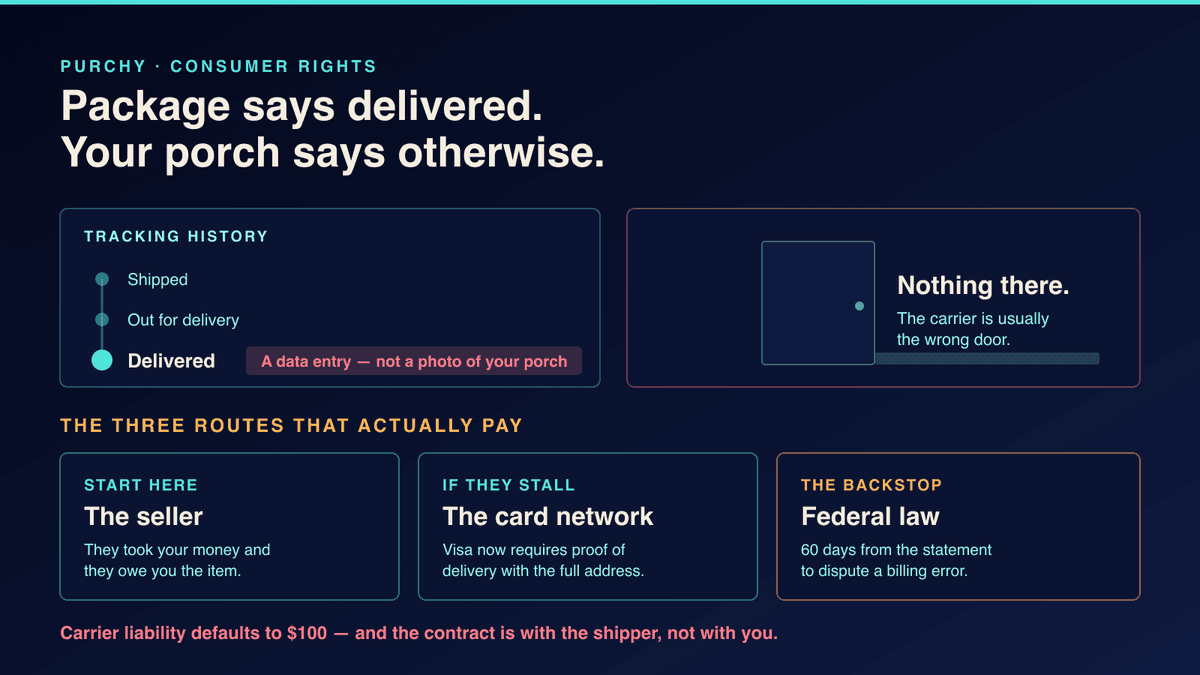
Your tracking says "Delivered." Your porch says otherwise. If your package says delivered but never arrived, start with the seller, not the carrier — almost every piece of advice you will find starts in the wrong place. The carrier's contract is with whoever shipped the parcel, not with you, and its default liability is capped at $100 — so even a successful carrier claim usually leaves you short. The money is owed by whoever sold you the item, and the leverage that forces them to pay it sits in three places: the seller's own guarantee, your card network's dispute rules, and federal law. This guide maps all three, with the exact deadlines, in the order you should actually use them — including a Visa rule that changed on April 18, 2026 and now requires a bank that escalates your non-receipt dispute to certify that it reviewed the merchant's delivery evidence with you.
What to do when a package says delivered but isn't there
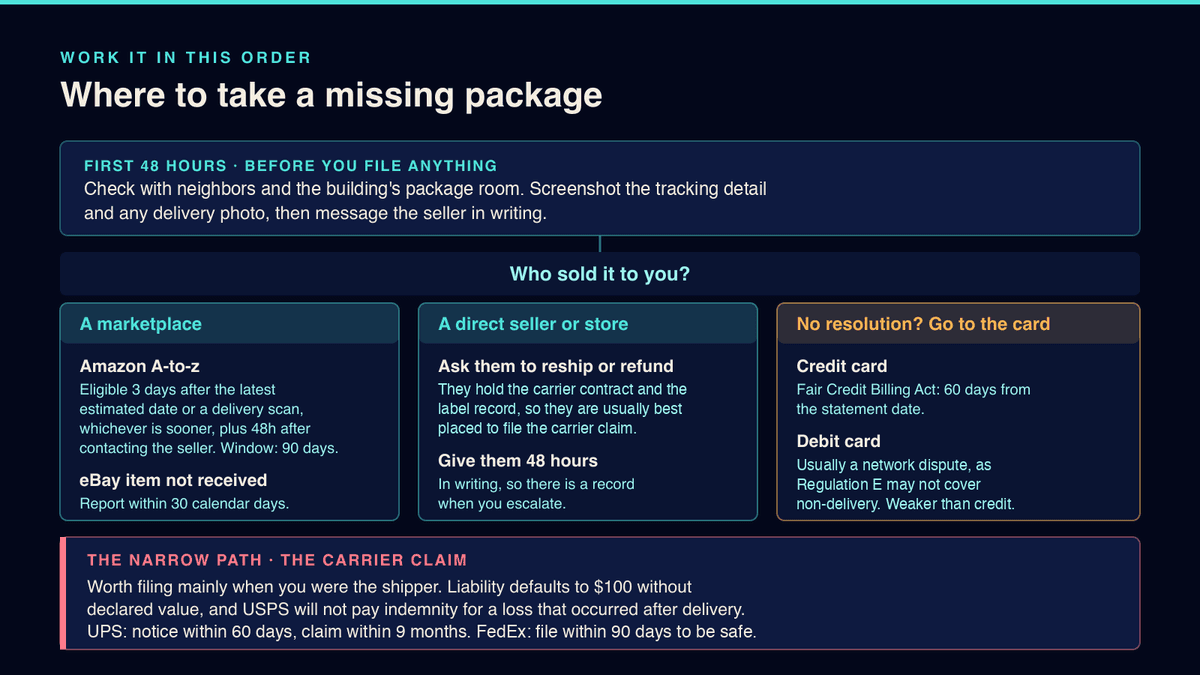
Do not start with the carrier. Start with the seller, give them 48 hours, and only then reach for a card dispute — and at Amazon never go to your bank first, because a chargeback permanently disqualifies the A-to-z claim.
- A "Delivered" scan is a data entry, not a photograph of your porch. A USPS Office of Inspector General audit found that a meaningful share of late-evening delivery scans were entered at the delivery unit rather than at the delivery address, and a third of that same late-evening subset carried no location data at all.
- The carrier is usually the wrong door. UPS and FedEx contract with the shipper, cap their default liability at $100, and USPS will not pay indemnity for a loss that "occurred after delivery by the USPS." Your money is owed by the seller.
- Amazon: you become eligible for an A-to-z Guarantee refund once three days have passed since the latest estimated delivery date or tracking shows a delivery confirmation — whichever is sooner — and you have waited 48 hours after contacting the seller without them resolving it. The claim window runs to 90 days.
- eBay: report it no later than 30 calendar days after the estimated or actual delivery date. Be aware that eBay may auto-close a case once tracking shows delivered, and may also close it if you file a chargeback for the same transaction.
- Credit card: the Fair Credit Billing Act gives you 60 days from the statement, and where you dispute non-delivery the creditor "may not construe such amount to be correctly shown unless he determines that such goods were actually delivered, mailed, or otherwise sent to the obligor and provides the obligor with a statement of such determination."
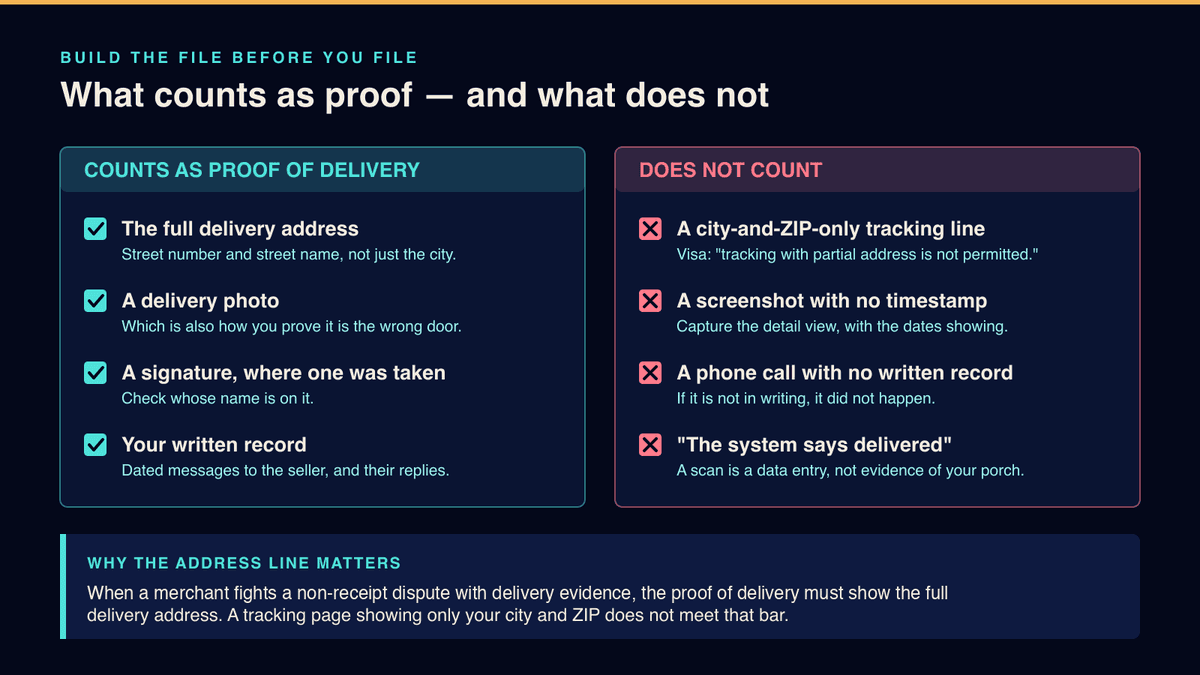
- Visa's 2026 rulebook says that when a merchant fights a non-receipt dispute by showing the item was delivered, the response its acquirer submits must include "proof of delivery that contains the full delivery address" — and states plainly that "tracking with partial address is not permitted."
What a "Delivered" scan actually proves
Before you argue with anybody, it helps to understand what you are arguing about. A delivery scan is a record created by a handheld device when a carrier presses a button. It is evidence. It is not proof.
The Postal Service's own watchdog has measured how loose that link can be. In audit report DR-AR-18-001, published October 27, 2017, the USPS Office of Inspector General examined 2 billion scans from July 1 through December 31, 2016 and isolated the 25.5 million of them that occurred "between 7 p.m. and when the carrier clocked out for delivery the following morning." Within that filtered set:
- 15.3 million (60 percent) were performed at a location outside the delivery unit, and the OIG did not flag them as improper.
- About 1.9 million (7 percent) were "improper stop-the-clock scans that occurred at delivery units instead of at the delivery location."
- 8.3 million (33 percent) "had no corresponding location data," which meant "it was not possible to determine if the 8.3 million scans were proper or improper."
Read that number precisely. The 7 percent figure is 7 percent of a deliberately narrow late-evening subset, not 7 percent of all deliveries, and the data is from 2016. It does not tell you how often packages go missing today. What it does establish — from the Postal Service's own auditors — is the mechanism: a scan can be entered somewhere other than your address, and a large share of scans carry no location data to contradict that. When a customer service agent tells you "the system shows it was delivered," that is the system they mean.
Carriers have since leaned harder on GPS and on photo-on-delivery. That is genuinely useful to you, because a delivery photo is a piece of evidence you can examine. If the photo shows a door that is not your door, a mat you do not own, or a house number that does not match, you are no longer arguing about a feeling. You are arguing about a misdelivery, and misdelivery is a very different conversation — one the carrier can actually fix.
So the first question is never "who do I yell at." It is: what does the evidence actually say, and do I have a copy of it?
The first 48 hours, before you file anything
Almost every refund path below has a waiting period baked into it. Use that time to do the boring work, because it is the work that wins claims later.
- Look in the unlikely places. Behind planters and gates, in the mailbox, under the doormat, on the side of the house, in a building's package room or mailroom, and with neighbors on both sides. Carriers hide parcels from the street on purpose, and a surprising share of "stolen" packages are simply well hidden.
- Screenshot the tracking page today. Tracking detail pages get purged. Capture the full event history with timestamps, the delivery photo if there is one, and the delivery address exactly as the carrier shows it.
- Check the address the carrier used, character by character. A transposed house number or a missing apartment line converts a theft story into a misdelivery story, and misdeliveries are far easier to get resolved.
- Ask your household and your building. A spouse, a roommate, a front desk, or a neighbor who "kept it safe for you" resolves this more often than anyone expects.
- Pull your order confirmation. You will need the order number, the exact amount charged, the item description and the promised delivery date. The card network rules below explicitly require a description of the goods that goes beyond what appears on your statement.
- Message the seller in writing, and keep the thread. Not a phone call. A written request creates the timestamp that starts several of the clocks in this guide, and several policies require you to have tried the seller first.
That last step is not optional politeness. Visa's rulebook states it as a condition: "Before the Issuer may initiate a Dispute, the Cardholder must attempt to resolve the Dispute with the Merchant …"
Who is responsible when a package is marked delivered but missing?
Here is the part most guides get backwards. When you buy something online, you have a contract with the seller. The seller has a separate contract with the carrier. You are not a party to that second contract.
That has three practical consequences:
- The seller owes you a delivered product, not a tracking number. Until you actually receive the goods, the seller has not finished performing.
- The carrier's liability runs to the shipper, which is why UPS's tariff speaks in terms of what "the Shipper agrees," and why carrier claims are so often filed by the merchant rather than by you.
- The carrier's payout is capped far below what you paid. Both UPS and FedEx default to $100 of liability unless the shipper declared a higher value and paid for it.
So the sequence that actually works is: seller first, card network second, carrier almost never. The exception is when you are the shipper — a return you mailed back, or a gift you sent — in which case the carrier claim is genuinely yours to file.
USPS says delivered but no package: Missing Mail search vs. claim
The Postal Service runs two separate processes, and people constantly file the wrong one.
A Missing Mail search is a request for USPS to go look. Per the Postal Service's guidance, "Missing Mail search requests can be submitted starting 7 days from mailing." It costs nothing, it sometimes works, and it generates a case reference that is useful later even when it does not.
An indemnity claim is a request for money, and it only exists where insurance exists. The filing windows are narrow and they run from the mailing date, not from the day you noticed:
| Service | File after | File before |
|---|---|---|
| Priority Mail Express | 7 days | 60 days |
| Priority Mail | 15 days | 60 days |
| USPS Ground Advantage | 15 days | 60 days |
| Insured Mail | 15 days | 60 days |
| Registered Mail | 15 days | 60 days |
| Damaged or missing contents (any service) | Immediately | 60 days from the mailing date |
Now the wall. Domestic Mail Manual 609 lists what USPS will not pay for, and one of the first entries on that list is decisive for porch theft: § 609.4.3(b) excludes losses that "occurred after delivery by the USPS." The same list also excludes "loss after items signed for by the addressee, the addressee's agent, or delivery employee if authorized under the applicable standards."
What that means in plain English. If the Postal Service's records show the item was delivered and you believe it was taken from your step afterward, USPS indemnity is not your remedy — by rule, that loss happened after delivery. Your remedy is the seller, the marketplace guarantee, or your card. Spending two weeks fighting a USPS claim first is the single most common way people burn through the deadlines that would actually have paid them.
One more detail worth knowing: DMM 609 lets "either the mailer or addressee" file for damage or missing contents, but for a lost article it requires the mailer or the addressee "who is in possession of the original retail mailing receipt" — or of "the online label record or computer printout of the Web-based application." As the buyer of an online order, you almost never hold any of those. The seller does.
UPS and FedEx: two clocks, a $100 default, and the shipper's name on the contract
Both carriers publish their terms, and both terms are stricter than their customer-service scripts suggest.
UPS runs two separate clocks, which is the detail nearly everyone misses. Section 55.3 of the UPS Tariff/Terms and Conditions of Service for the United States states that UPS "must receive notice of claims within sixty days after Delivery of the Package or, in case of failure to make Delivery, within sixty days after the date of scheduled Delivery," and that "Claims must be filed within nine months after Delivery of the Package" or, where delivery failed, nine months after the scheduled delivery date. Both clocks run from delivery or scheduled delivery, not from the day the parcel shipped.
Read that twice. Notice is due in 60 days. The claim itself can follow for up to nine months. People who assume they have nine months to do anything at all lose the claim on the notice requirement.
On money, Section 56 is blunt: "UPS's liability for loss or damage to each UPS domestic Package or international Shipment ... is limited to a value of $100, except as set forth below. Unless a greater value is recorded in the applicable field for purchasing additional protection in the UPS Source Document or the UPS Automated Shipping System used, the Shipper agrees that the released value of each domestic Package ... is no greater than $100."
FedEx publishes comparable rules, though not identical ones in every document. Its claims page states that "Claims for undelivered or lost shipments must be filed within nine months of the shipment date," while damage or missing-contents claims must be filed "no later than 60 calendar days from the shipment date for U.S. packages and 21 calendar days from the shipment date for international packages." The binding FedEx Service Guide is worded differently, and the difference matters for exactly the scenario this guide is about. It sets a filing limit of "90 calendar days from the date of delivery, or, in the event that FedEx failed to make delivery, within 90 calendar days after the package or packaging envelope/bag was tendered to FedEx for shipment." If FedEx treats the parcel as never delivered, that clock runs from the day it was handed to FedEx; if its records show a delivery, it runs from that recorded delivery date. Either way, 90 days is far shorter than the nine months the claims page advertises. Work to the shorter figure. The Service Guide's separate 60-day notification requirement is narrower than it looks: it applies to concealed loss or damage "not discovered at the time of delivery," not to a package that never came. FedEx does allow recipients to file: its guidance tells recipients they may "file a claim on your own" or ask the merchant to file it. The Service Guide attaches a condition, though: if the party filing "is not the shipper or the payor of transportation charges to FedEx," it "must obtain and provide a claim filing waiver from the shipper." For most online orders, that puts the merchant back in the middle.
On liability, FedEx states that "The first $100 of value in your shipment is included in your shipping rate at no extra charge as part of our standard $100 limit of liability," and is careful to add that "Declared value is not shipping insurance."
The $100 ceiling is the whole argument for going to the seller instead. If a $600 laptop vanishes, a successful carrier claim pays $100 unless the shipper declared and paid for more value. A successful seller claim or card dispute pays $600. The two routes are not equivalent, and only one of them makes you whole.
Amazon: the A-to-z Guarantee and the chargeback trap
Amazon's A-to-z Guarantee is the strongest marketplace remedy in US e-commerce, and it has one rule that will cost you the entire refund if you get it wrong.
First, scope. Amazon states that "The A-to-z Guarantee only applies when you buy items sold and fulfilled by a third-party seller." For items sold by Amazon Global Store, and for Marketplace items delivered using Prime, Amazon directs you to contact customer service instead — which in practice is usually faster, not slower. The Guarantee also "doesn't cover digital items, services, stored value instruments, Spot Buys or automobiles."
Second, eligibility. You can request a refund if "the last possible delivery date of your order is 90 days or less" and, for a package you never got:
"Three days have passed since the latest estimated delivery date OR the tracking shows a delivery confirmation (whichever is sooner) AND you have contacted the Seller more than 48 hours ago but they did not respond or resolve the issue."
That "whichever is sooner" clause is quietly generous, and it is the opposite of what most shoppers assume. At Amazon, a delivery confirmation scan does not block your claim — it accelerates it. A scan that says "Delivered" today can make you eligible today rather than three days after the estimated delivery date — provided you also messaged the seller more than 48 hours earlier. Both conditions have to be met, which is exactly why the written message in the first 48 hours matters so much.
Third, the trap: "If you request a refund or chargeback from your payment provider, you're not eligible for a refund through A-to-z Guarantee."
Order of operations at Amazon: message the seller, wait 48 hours, file A-to-z. Only if A-to-z is denied should you reach for your card issuer. Calling the bank first permanently disqualifies the marketplace remedy.
If A-to-z is denied, Amazon runs an appeal path of its own, and using it is free. For the broader rules on Amazon windows and exceptions, our Amazon return policy guide covers the rest of the system.
eBay: why a delivery scan hurts you here and helps you at Amazon
eBay's Money Back Guarantee runs on different assumptions, and the contrast is worth internalizing because it flips the advice.
Under eBay's item-not-received rules, you may report the problem "once the estimated or actual delivery/collection date has passed," and you must report it no later than 30 calendar days after that date. The seller then has 3 business days to respond. If they do not resolve it, you can ask eBay to step in starting 3 business days after the report and up to 21 business days after it. eBay also notes it "may step in without the buyer asking if there is no valid tracking information available."
And then the line that matters here: "If the seller provided tracking details, eBay may close the case automatically once tracking shows the item has been delivered."
eBay has its own version of the chargeback trap, too: it "may close a buyer's eBay Money Back Guarantee case if the buyer files a chargeback or buyer protection claim for the same transaction with their payment provider." As at Amazon, go through eBay before your card issuer.
Same fact, opposite effect. A "Delivered" scan speeds up your Amazon A-to-z eligibility and can automatically end your eBay case. On eBay, that means your evidence has to arrive with the report, not after it: the delivery photo showing the wrong door, the address mismatch, the building's package-room log. Filing a bare "it never came" against valid tracking is the weakest version of your case. Our eBay return policy guide covers how the rest of eBay's buyer protections fit together.
The credit-card dispute, and what changed on April 18, 2026
If the seller will not pay and no marketplace guarantee applies, your card is the backstop — and on a credit card it is a strong one, because it rests on a statute rather than on a company's goodwill.
The federal layer. The Fair Credit Billing Act, at 15 U.S.C. § 1666, defines a billing error to include "a reflection on a statement of goods or services not accepted by the obligor or his designee or not delivered to the obligor or his designee in accordance with the agreement made at the time of a transaction." Regulation Z states the same rule at 12 CFR 1026.13(a)(3), covering an extension of credit "for property or services not accepted by the consumer or the consumer's designee, or not delivered to the consumer or the consumer's designee as agreed."
The deadlines: your notice must reach the creditor "no later than 60 days after the creditor transmitted the first periodic statement that reflects the alleged billing error." The creditor must acknowledge in writing "within 30 days," and must resolve it "within 2 complete billing cycles (but in no event later than 90 days)." While it is pending, 12 CFR 1026.13(d)(1) says you "need not pay (and the creditor may not try to collect) any portion of any required payment that the consumer believes is related to the disputed amount."
And then the sentence that should be printed on every missing-package complaint. Under § 1666, where the dispute is that goods were not delivered, the creditor "may not construe such amount to be correctly shown unless he determines that such goods were actually delivered, mailed, or otherwise sent to the obligor and provides the obligor with a statement of such determination."
Read that clause carefully before you lean on it. "Mailed, or otherwise sent" sits right beside "actually delivered," so the statute does not by itself force a creditor to reject a tracking scan. What it does require is a determination — and that the creditor "provide the obligor with a statement of such determination." Ask for that statement in writing. A one-line denial that simply repeats the merchant's tracking number is not one.
The network layer. Underneath the statute, Visa's own rulebook — the Visa Core Rules and Visa Product and Service Rules, 18 April 2026 edition — governs how the dispute is actually processed. Non-receipt runs under Dispute Condition 13.1: Merchandise/Services Not Received. The relevant mechanics:
- You must try the merchant first. "Before the Issuer may initiate a Dispute, the Cardholder must attempt to resolve the Dispute with the Merchant."
- There is a waiting period. The issuer must "wait 15 calendar days" from the transaction date where no delivery date was specified. That waiting period "does not apply if the Merchant is insolvent or bankrupt."
- There is an outer limit. The dispute must be processed "no later than either 120 calendar days from the Transaction Processing Date" or "120 calendar days from the last date that the Cardholder expected to receive the merchandise or services." Where the clock runs from that last expected delivery date, Visa caps it at 540 calendar days from the transaction processing date.
- Describe the item properly. The issuer must supply "a detailed description of the merchandise or services purchased," and the rules specify that this "must contain additional information beyond the data required in the Clearing Record." Your statement line is not a description. "Blue jeans, 32x32, order #114-…" is.
- Repeat claims get scrutinized. A cardholder letter is required when "the Cardholder has disputed 3 or more Transactions for non-receipt of merchandise or services at the same Merchant on the same Card" and "the disputed Transactions all occurred within the same 30-calendar day period."
- Some things are simply not 13.1. Quality complaints, transactions the cardholder says are fraudulent, goods held by your own country's customs, and orders cancelled before the expected delivery date are all listed as invalid under this condition.
Now the two rules that matter most for a package marked delivered.
First, what has to be produced. When a merchant fights back, its evidence reaches your bank through its acquirer, and Visa writes the requirement as an obligation on that acquirer: it must provide documentation showing the cardholder "received the merchandise at the agreed location or by the agreed date/time," including — for merchandise that was delivered — "proof of delivery that contains the full delivery address (tracking with partial address is not permitted)."
That parenthetical is the whole ballgame. A tracking page that says "Delivered, Miami FL 33024" is a partial address. The rules say that is not sufficient proof of delivery. If your dispute is denied on the strength of a bare tracking number, the rulebook is on your side when you push back.
Second, a change dated April 18, 2026. At the pre-arbitration stage of a 13.1 dispute, Visa's rules now add a requirement on your own bank. Effective for dispute responses processed on or after 18 April 2026, where the merchant provided evidence of delivery including a full delivery address — or evidence that the merchandise was collected — "the Issuer is required to certify that they reviewed the information with the Cardholder and address the information provided by the merchant (for example: if photo evidence was provided, the Issuer must acknowledge the photo. If signed proof of delivery was provided, the Issuer must address the signature)."
Why this is worth knowing by name. The old failure mode was a bank that received a delivery photo, glanced at it, and closed your case without ever showing it to you. As of April 18, 2026, at that stage of a Visa 13.1 dispute, the issuer has to certify that it reviewed the merchant's evidence with you and addressed it. If your bank denies a non-receipt dispute citing evidence you were never shown, ask for that evidence by name — the photo, the signature, the full delivery address — and ask them to address it. Note the scope honestly: this requirement attaches at the pre-arbitration stage, not to every first-round decision, and it is a Visa rule. Mastercard, Amex and Discover run their own rulebooks with their own numbers.
For the step-by-step mechanics of filing, our guide on how to dispute a credit card charge walks the process end to end, and how long a refund takes covers what happens after you win.
Debit cards, prepaid cards and payment apps
A debit card is a weaker instrument here, and it is worth understanding exactly why.
Regulation E, at 12 CFR 1005.11, gives you strong rights over errors — and it defines an error narrowly: "an unauthorized electronic fund transfer," "an incorrect electronic fund transfer to or from the consumer's account," an omission from a statement, a computational error, and similar. A purchase you genuinely authorized, where the merchant simply failed to deliver, is not obviously any of those. It is a merchant dispute, and merchant disputes on a debit card ride on the card network's rules rather than on Regulation E.
Where Regulation E does apply, the timing is excellent: notice within 60 days after the institution sends the statement; investigation within 10 business days; up to 45 days if the bank provisionally credits your account within that initial period. Two narrower extensions exist, and they are often run together: the 10 business days becomes 20 business days only for an error on a new account, while the 45 days becomes 90 days for new accounts, point-of-sale transactions and foreign-initiated transfers.
The practical upshot is simple. On a credit card, non-delivery is a statutory billing error with a statute behind it. On a debit card, it is a network dispute, usually without provisional credit, against money that has already left your account. Our comparison of debit versus credit card disputes goes through the liability ladder in detail, and payment app buyer protection covers PayPal, Venmo, Cash App and Zelle — where, notably, a Zelle payment to a seller has no purchase protection at all.
If the seller never shipped in the first place — as opposed to shipping something that vanished — you have an additional and often overlooked federal right under the FTC's Mail Order Rule, covered in our guide to the 30-day shipping rule.
Police reports, the Postal Inspection Service and federal mail theft
Filing a police report will rarely get your package back. File one anyway, for three reasons: some sellers and insurers require a report number, a report creates a dated record of the loss, and repeat thefts in one neighborhood only get worked when they are on paper.
If the item came through the Postal Service, there is a second channel. Mail theft is a federal crime. Under 18 U.S.C. § 1708, anyone who "steals, takes, or abstracts, or by fraud or deception obtains" mail "from or out of any mail, post office, or station thereof, letter box, mail receptacle, or any mail route or other authorized depository for mail matter" — or who knowingly receives or possesses mail they know was stolen — may be "fined under this title or imprisoned not more than five years, or both."
That five-year federal exposure is why organized package-theft crews get charged federally when USPS parcels are involved, and it is why reporting to the US Postal Inspection Service is a separate and worthwhile step alongside a local police report. It is not a refund mechanism. It is a law-enforcement referral, and you should treat the two tracks as independent: pursue the money through the seller and your card while the report exists on its own timeline.
State package-theft laws, using Texas as the template
A growing number of states have added dedicated package-theft offenses so that prosecutors do not have to charge a $40 parcel as ordinary petty theft. The statutes differ, and rather than list classifications we cannot verify state by state, it is more useful to read one closely — because the drafting choices repeat.
Texas added Penal Code § 31.20, "Mail Theft," through House Bill 37 in 2019 — and then broadened it on September 1, 2025 through Senate Bill 1281. That amendment matters here, because most summaries still quote the 2019 wording. S.B. 1281 struck the words "from another person's mailbox or premises" out of the core offense, which now reads:
"A person commits an offense if the person intentionally appropriates mail without the effective consent of the addressee and with the intent to: (1) deprive that addressee of the mail; or (2) steal a negotiable instrument."
Deleting the location element made the offense wider, not narrower: the mail no longer has to be taken from a mailbox or from someone's property.
The definition of "mail" is the part that matters most for this article. Under § 31.20(a)(3), mail includes a letter, postal card, package, bag or other sealed article that is "delivered by a common carrier or delivery service" and either "is in transit" or "has been delivered but not yet received by the addressee," as well as anything "left to be collected for delivery." That middle clause is exactly the window this guide is about. A parcel sitting on your step after the scan, before you have picked it up, is still protected.
S.B. 1281 also added rebuttable presumptions. Under § 31.20(b-1), possessing mail from "five or more addressees" raises a presumption that the actor took it without consent and meant to deprive the addressee, and § 31.20(b-2) does the same for five or more negotiable instruments. Neither presumption applies to a business or governmental agency engaged in lawful activity (§ 31.20(b-3)).
Grading scales with the number of victims rather than the value of the goods — and it runs on three separate ladders, which is where most published summaries go wrong. The ordinary offense uses one set of bands:
| Addressees affected | Ordinary mail theft, § 31.20(c) |
|---|---|
| Fewer than 10 | Class A misdemeanor |
| At least 10 but fewer than 30 | State jail felony |
| 30 or more | Third degree felony |
If the mail contained identifying information and was taken to facilitate identity theft under § 32.51, § 31.20(d) applies different bands entirely — which is why reading across a single combined table gives the wrong answer:
| Addressees affected | Taken to facilitate identity theft, § 31.20(d) |
|---|---|
| Fewer than 10 | State jail felony |
| At least 10 but fewer than 20 | Third degree felony |
| At least 20 but fewer than 50 | Second degree felony |
| 50 or more | First degree felony |
S.B. 1281 added a third ladder at § 31.20(d-1) for mail taken to steal negotiable instruments, counted by instruments rather than by addressees: a state jail felony for five or fewer, a third degree felony for more than five but fewer than 10, a second degree felony for at least 10 but fewer than 50, and a first degree felony for 50 or more.
Two drafting details are worth carrying into any state's version. First, the definition keys on mail that has been "delivered but not yet received by the addressee" — which is precisely why a delivered-but-uncollected parcel is still protected, and it is the clause to look for in your own state's statute. Second, the elderly-and-disabled enhancement is narrower than it first appears: § 31.20(e) lifts the offense "to the next higher category" for the identity-theft tiers and the new § 31.20(e-1) does the same for the negotiable-instrument tiers, but neither one reaches the ordinary mail-theft offense.
Several other states have since enacted their own package-theft statutes with different thresholds and classifications. Check your own state's code rather than trusting a national summary; the numbers vary a great deal. For the wider picture on state-level consumer protections in retail, see our guide to return policy laws by state.
Insurance and card purchase protection
Two backstops exist that most people forget they are already paying for.
Homeowners and renters insurance generally covers personal property theft, including property stolen from outside the home, subject to your deductible. For a $60 package that is useless — the deductible swallows it. For a stolen $1,400 appliance or a high-value electronics order, it is worth a call. Be aware that claim frequency affects renewal pricing, so a single small claim is rarely a good trade.
Credit card purchase protection is the more practical option and the more forgotten one. Many cards cover theft or damage of newly purchased items for a set window after purchase, with per-claim and per-year caps. The windows are short, often measured in weeks, so this is a benefit you have to remember early rather than discover late. Our roundup of credit cards with purchase protection lays out how those benefits differ.
Every deadline in one table
| Route | Earliest you can act | Hard deadline | Clock starts from |
|---|---|---|---|
| USPS Missing Mail search | 7 days | Not stated | Mailing date |
| USPS claim, Priority Mail Express | 7 days | 60 days | Mailing date |
| USPS claim, Priority Mail / Ground Advantage / Insured / Registered | 15 days | 60 days | Mailing date |
| UPS notice of claim | Immediately | 60 days | Delivery, or scheduled delivery if none |
| UPS claim filing | Immediately | 9 months | Delivery, or scheduled delivery if none |
| FedEx lost / undelivered claim | Immediately | 9 months (claims page); the Service Guide says 90 calendar days | Shipment date; the Service Guide runs its 90 days from the recorded delivery date, or from tender where FedEx failed to deliver |
| FedEx damage or missing contents (US) | Immediately | 60 calendar days (claims page) | Shipment date; the Service Guide sets a 90-day filing limit from delivery, and its 60-day notice covers concealed loss or damage |
| Amazon A-to-z Guarantee | 3 days after latest estimated delivery, or a delivery scan, whichever is sooner, plus 48 hours after contacting the seller | 90 days | Last possible delivery date |
| eBay item not received | Once the estimated or actual delivery date has passed | 30 calendar days | Estimated or actual delivery date |
| eBay: ask eBay to step in | 3 business days after report | 21 business days after report | Report date |
| Visa dispute, non-receipt (13.1) | Issuer waits 15 calendar days | 120 days; from the last expected delivery date, capped at 540 days | Transaction processing date, or last expected delivery date |
| Credit card, Fair Credit Billing Act | Immediately | 60 days | Date the statement was transmitted |
| Debit card, Regulation E error | Immediately | 60 days | Date the statement was sent |
The two clocks that trip people. USPS runs from the mailing date, so a package that spent nine days in transit has already burned nine of its 60. The Fair Credit Billing Act runs from the statement date, which is usually later than the purchase — that is the one case where the delay works in your favor. Never assume a clock starts the day you noticed.
Six mistakes that sink a missing-package claim
- Starting with the carrier. Weeks disappear into a process that, for a package scanned as delivered, is closed to you by rule at USPS and capped at $100 at UPS and FedEx. Go to the seller.
- Filing a chargeback before an Amazon A-to-z or eBay claim. Amazon states outright that requesting a chargeback from your payment provider makes you ineligible for A-to-z, and eBay may close a Money Back Guarantee case for the same reason. This is the most expensive ordering mistake in the whole guide.
- Calling instead of writing. Several remedies require you to have contacted the seller and to show when. A phone call proves nothing. A message in the platform's own thread proves everything.
- Describing the item the way your statement does. Visa's rules require a description that goes beyond the clearing record. "AMZN Mktp US" is not a description of a pair of headphones.
- Letting the bank deny it on a bare tracking number. Visa's response requirements call for proof of delivery containing the full delivery address and state that "tracking with partial address is not permitted." A city-and-ZIP tracking line does not meet that bar.
- Not screenshotting the delivery photo on day one. Carrier photos age out of the tracking page. The photo that shows somebody else's front door is the single best piece of evidence you will ever have, and it is the one most likely to be gone by the time you need it.
How to keep packages from going missing next time
None of this is as good as the package simply arriving. A few changes move the odds more than the rest:
- Redirect the delivery, not the blame. Carrier pickup points, locker networks, and "hold at location" options remove the doorstep from the equation entirely, and they are usually free.
- Ship high-value items where a signature is required. A signature converts a disputed scan into a documented handoff, and it is the evidence standard the card networks name explicitly.
- Use delivery windows you are home for on anything you would be unhappy to lose, rather than on everything.
- Turn on carrier notifications so a delivery scan reaches you within minutes rather than at the end of the day. Most porch thefts happen in the gap between the scan and the moment someone brings the box inside.
- Keep your order records somewhere you can search. Every remedy in this guide starts with an order number, a date and an amount. Our guide on tracking online purchases and tracking receipts digitally covers how to keep them findable.
How Purchy helps
Purchy is a spending app, not a delivery tracker — it will not go find your package. What it does is keep the paperwork every one of these claims depends on, and keep your return deadlines in view.
- Receipt capture keeps the order confirmation, the amount and the date together, so when a dispute asks for "a detailed description of the merchandise" and an exact figure, you are not digging through a year of email.
- Return-deadline and calendar reminders put your return windows on a calendar you actually look at, with a reminder before they close.
- Recurring-charge review lists the subscriptions and other repeat charges on your account in one place.
- Ask Purchy lets you ask about your own spending in plain language — useful when you remember the item but not the merchant, the date or the amount.
- The Perch, Purchy's daily budget, is the part that runs every day: one number for what you can spend today.
Bank linking is optional. Purchy is free to download on iPhone and Android; Purchy Pro is $12.99 a month or $99.99 a year.
Frequently asked questions
My tracking says delivered. Is it too late to do anything?
No. A delivery scan is the beginning of the argument, not the end of it. At Amazon, a delivery confirmation actually makes you eligible for an A-to-z claim sooner. Under the Fair Credit Billing Act, a creditor who decides the charge stands must determine that the goods were "actually delivered, mailed, or otherwise sent" and must "provide the obligor with a statement of such determination" — so ask for that statement in writing.
How long should I wait before reporting a missing package?
Long enough to check the property and ask your household and neighbors — a few hours, not a week. Then message the seller in writing immediately, because several remedies count from the moment you contacted them. Amazon requires 48 hours to have passed since you contacted the seller before you can file.
Can I file a claim with USPS for a stolen package?
Generally no. Domestic Mail Manual 609 excludes losses that "occurred after delivery by the USPS" from payable claims. A Missing Mail search is still worth filing if the item may never have arrived at all, but for a theft after delivery your remedy is the seller or your card.
Can I file a UPS or FedEx claim myself as the recipient?
FedEx allows recipients to file, though its Service Guide requires a claim filing waiver from the shipper when the person filing is neither the shipper nor the payer of the shipping charges. UPS's terms are written around the shipper, and in practice merchants usually file. Either way the payout is capped at $100 unless the shipper declared a higher value, which is why the seller and the card route matter more.
What is the UPS claim deadline exactly?
Two deadlines. UPS "must receive notice of claims within sixty days after Delivery of the Package or, in case of failure to make Delivery, within sixty days after the date of scheduled Delivery," and the claim itself "must be filed within nine months." Missing the 60-day notice is what usually ends these.
Should I file a chargeback or an Amazon A-to-z claim?
A-to-z first, if the item was sold and fulfilled by a third-party seller. Amazon states that "If you request a refund or chargeback from your payment provider, you're not eligible for a refund through A-to-z Guarantee." The chargeback is your fallback if A-to-z is denied.
How long do I have to dispute the charge on my credit card?
Under the Fair Credit Billing Act, your notice must reach the creditor no later than 60 days after the creditor transmitted the first statement showing the charge. Visa's own processing rules allow up to 120 calendar days, capped at 540 days from the transaction processing date, but the statutory 60-day clock is the one to plan around.
My bank denied the dispute because the merchant sent a tracking number. Now what?
Push back and cite the standard. Visa's dispute-response requirements call for "proof of delivery that contains the full delivery address (tracking with partial address is not permitted)." Ask the issuer what delivery evidence it received, and ask to see it. At the pre-arbitration stage, for dispute responses processed on or after 18 April 2026, Visa requires the issuer to certify that it reviewed the merchant's evidence with the cardholder and addressed it — including acknowledging a photo or addressing a signature.
Does a delivery photo settle a missing-package claim?
Only if it shows your address. A photo of a door that is not yours is strong evidence of misdelivery, which the carrier can often resolve directly. Save it the day you see it; carrier photos do not stay on the tracking page forever.
Is package theft a crime worth reporting?
Yes, on both tracks. Mail theft is a federal offense under 18 U.S.C. § 1708, carrying up to five years — though the statute keys on mail taken from a mailbox, letter box or other authorized depository, and whether an unattended porch counts is less settled. Many states have added dedicated package-theft offenses: Texas Penal Code § 31.20 grades the ordinary offense by the number of addressees hit, from a Class A misdemeanor up to a third degree felony, with separate and steeper ladders when the mail was taken to facilitate identity theft or to steal negotiable instruments.
Does my debit card give me the same protection as a credit card?
No. Regulation E's error-resolution rights cover unauthorized or incorrect transfers; a purchase you authorized where the goods never arrived is a merchant dispute running on network rules instead. You generally get no statutory provisional credit and you are arguing over money that already left your account.
The bottom line
The reason missing-package claims fail is almost never that the shopper was wrong. It is that they spent the first two weeks arguing with the party that owed them the least, and arrived at the party that owed them everything with the clock nearly out.
Reverse the order. Check the property and the address. Screenshot the tracking page and the delivery photo today. Message the seller in writing and note the time. Give them 48 hours. Then use the marketplace guarantee if there is one — before touching your card, not after. And if it comes to a dispute, do not accept a denial built on a tracking line that shows a city and a ZIP code. Under Visa's own rulebook that is not proof of delivery, and under federal law a creditor that decides the charge was right all along still has to make a determination and give you a written statement of it.
Wake to one edition. Only what matters.
$12.99 a month or $99.99 a year. Cancel any time from the App Store or Google Play.